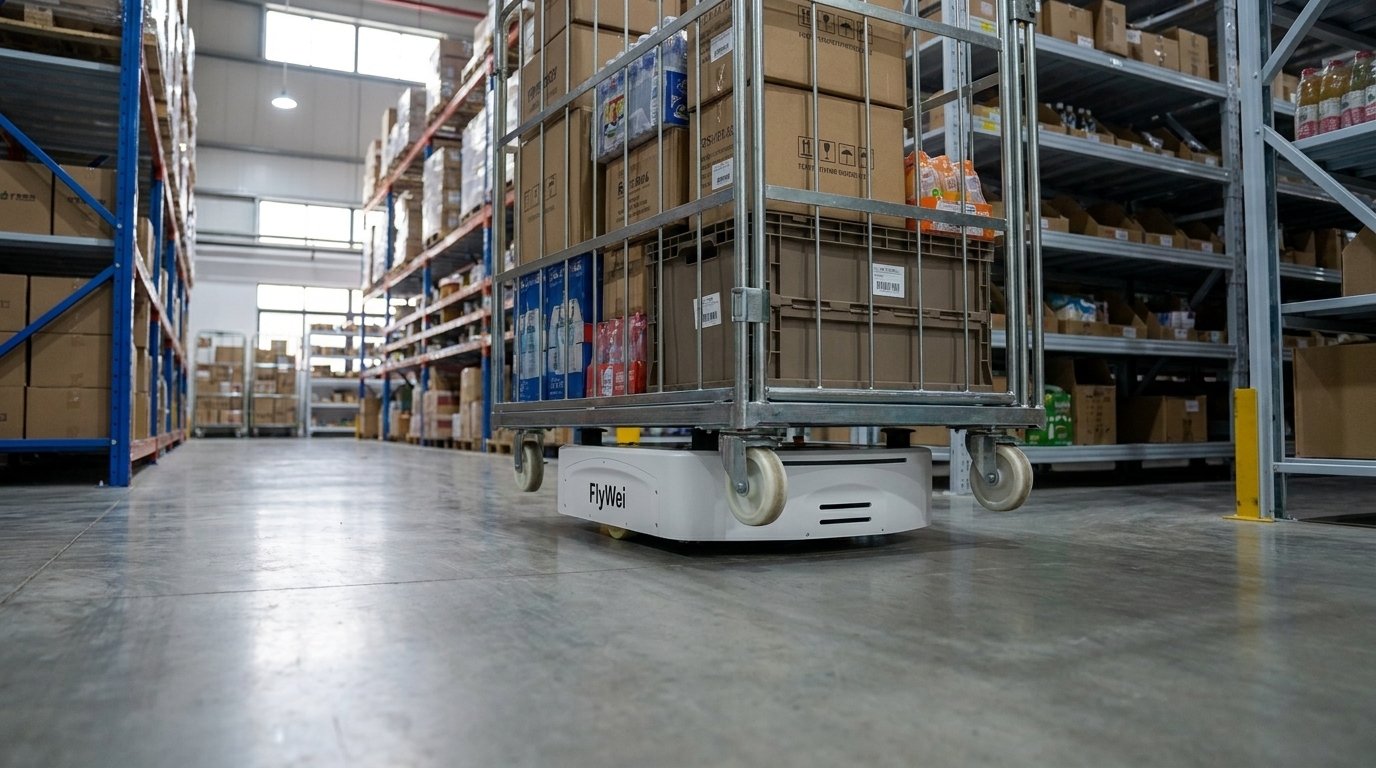
Lifting automated robots are driverless mobile machines that lift, carry, stack and set down loads under their own power — a class of warehouse robot that shifts up to 1,000 kilograms per unit and that is now doing real work on UK drinks-distribution floors. In Great Britain, workplace-transport incidents involving being struck by a moving vehicle account for roughly a quarter of all fatal workplace injuries every year, according to the HSE workplace transport statistics. For a UK drinks Operations Director staring down Q4 — a six-to-eight-week window in which grocery, on-trade and hospitality all draw at peak simultaneously — that safety pressure collides with an HGV and forklift-driver shortfall of tens of thousands of qualified operators. The result: every extra pallet of kegs or long-necks that has to move at 02:00 on a Friday is a manning risk, a compliance risk and a customer-service risk rolled into one — and no amount of overtime fixes it sustainably.
Why it happens: the Q4 drinks-depot squeeze
UK drinks logistics runs on a brutal cadence: flat H1, Q3 build, then a Q4 peak in which grocery, on-trade, hospitality wholesalers and event supply all draw at once. Volumes at Midlands hubs around Burton-on-Trent, Daventry and the East Midlands Gateway can jump 40–70% for six to eight weeks, then fall off a cliff in January.
That cadence collides with three structural pressures. First, driver supply: Logistics UK continues to warn that the logistics workforce is tens of thousands of qualified operators short of demand, and forklift-truck-driver availability at UK drinks depots follows the HGV curve almost perfectly. Second, load severity: a full keg stack, an aluminium-cask pallet or a mixed brewery pick-line all sit at the top of the manual-handling risk register. Third, dwell cost: a single missed 05:30 Friday load out of a Burton-on-Trent depot ripples through hospitality customers all weekend.
Traditional responses — hire agency drivers, buy another counterbalance truck, run a third shift — no longer close the gap. Agency rates at peak have climbed above the point at which they beat robot-per-shift economics. New counterbalance trucks still need a certified operator per truck. And a third shift only trades throughput for HSE risk, since fatigue-related incidents in workplace transport remain a live concern in the HSE PUWER guidance. The lifting automated robot exists to break this triangle at the manning corner.
The four levers that fix it
Lever 1 — Deploy heavy-lift lifting automated robots directly on kegs and full pallets
The workhorse of a drinks-depot deployment is a heavy-lift jacking AMR — a knee-height mobile robot with a scissor-lift deck that slides under a pallet, cage or keg-stack cart, jacks it 12–15 centimetres clear of the floor, and drives it under its own power. On the current platform underpinning FlyWei lifting automated robots, that means a 1,000 kg working payload, four top-mounted LiDAR pucks, VDA 5050-compliant communications, and a top speed of about 1.6 m/s laden. In a Burton-on-Trent brewery-DC pilot format, one heavy-lift robot completes the equivalent of 42 manual pallet-truck moves per shift with no operator, no repositioning stop, and no PUWER exemption paperwork.
Two specification details matter for drinks work. Deck-load stability under a top-heavy keg stack must be modelled against acceleration and cornering, not just static load — a risk that the ISO 3691-4 standard for driverless industrial trucks now addresses head-on. And the recharge cycle must be opportunistic — 15-minute top-ups on end-of-aisle docks — so the robot never leaves the shift.
Lever 2 — Use latent-jacking AMRs to shuttle keg trolleys through the pick face
Beneath the pallet layer sits a second workflow that eats manual hours: the movement of half-full keg trolleys and cased-beer cages between the pick face, the mezzanine and the outbound staging lanes. A latent-jacking AMR — the smaller cousin of the heavy-lift robot, roughly 300 kg capacity and knee-height — slides under a wheeled trolley, lifts it a few centimetres, and takes it wherever the fleet manager sends it. There is no forklift involved and no operator to certify.
For a UK drinks depot this lever is the fastest to pilot. A single latent-jacking robot with two shared charging points can absorb the entire trolley-shuttling workload of a 40-metre pick face; the human pick team then focuses on picking, not walking. In practice this frees roughly 1.2 full-time equivalents per line — sharp payback at Q4 agency rates.
Lever 3 — Orchestrate the mixed fleet on a single fleet manager
A drinks-depot fleet becomes chaotic when heavy-lift AMRs, latent-jacking AMRs and staffed counterbalance trucks share the same aisles. The technical lever that keeps peak-week flow steady is a fleet manager that speaks VDA 5050 to the autonomous units and MQTT to the yard telematics — the role FlyWei M4 fleet manager and RDS robot dispatch play in a live deployment. Concretely, M4 holds the digital map, prioritises orders by SLA, and hands each robot a task; RDS translates warehouse-management-system pick tickets into robot missions in real time.
For an Ops Director the operational win is a single dashboard showing utilisation, dwell and near-miss telemetry across the mixed fleet. For a compliance officer the win is that every robot decision — every route, every hand-off, every emergency stop — is logged and time-stamped in a way a paper-log-only fleet never has been.
Lever 4 — Ground the deployment in PUWER, LOLER and ISO 3691-4 from the risk assessment onwards
Regulatory footing is the lever most easily under-invested by drinks operators still on their first robot pilot. The UK autonomous-lift envelope is defined by three instruments: the Provision and Use of Work Equipment Regulations 1998 (PUWER) for the robot as work equipment, the Lifting Operations and Lifting Equipment Regulations 1998 (LOLER) for the lifting mechanism itself, and ISO 3691-4 for the safety design of the driverless industrial truck. On top of that, floor flatness under TR34 governs whether the fleet LiDAR-slam navigation stays stable at peak load.
A drinks-depot Ops Director should demand three documents from any robot supplier before signing: (1) the LOLER thorough-examination schedule for the lift mechanism, (2) the ISO 3691-4 conformity declaration for the truck, and (3) the PUWER training pack for supervisors sharing the aisle with the fleet. Anything less means the compliance risk lands on the operator, not the vendor. The BSI guidance library and the wider Health and Safety Executive material remain the authoritative reference set.
| Method | Peak-shift throughput | Driver required | PUWER / LOLER burden | Typical payback |
|---|---|---|---|---|
| Manual pallet truck | ~1× baseline | Yes (per truck) | PUWER (medium) | n/a — labour recurring cost |
| Counterbalance forklift (staffed) | ~2× baseline | Yes (certified) | PUWER (high) + operator competency | 2.5–3.5 years capex |
| Autonomous forklift | ~2.5× baseline (24/7) | No | PUWER + ISO 3691-4 conformity | 18–30 months on lease |
| Heavy-lift + latent-jacking AMRs | ~3× baseline (24/7) | No | PUWER + LOLER + ISO 3691-4 | 14–24 months on lease |
Lifting automated robots are driverless mobile machines that lift, carry and stack loads of up to 1,000 kilograms under their own power, and are now deployed in UK drinks distribution centres to flex Q4 peak throughput without adding forklift drivers.
What FlyWei does here
FlyWei designs, supplies and integrates the lifting-robot fleet a UK drinks depot actually needs to survive Q4 — heavy-lift and latent-jacking AMRs matched to the depot real keg, cask and pallet flow, delivered with M4 fleet orchestration and RDS dispatch as one commissioned system. Every unit ships with FlyWei UK engineering support, PUWER and LOLER documentation, ISO 3691-4 conformity, and a training pack for the depot supervisors — nothing landed on a pallet and left to the operator to figure out.
Ops directors weighing this for Q4 typically move in three steps. First, a 30-minute site survey identifies the two or three flows where a lifting AMR lifts the most labour per pound spent. Second, a fleet-sizing model — usually four heavy-lift units and two latent-jackers as a first tranche — is priced against a full-service lease so the number lands on the P&L, not the capex plan. Third, a 90-day pilot proves the case before the depot commits the full peak roster. FlyWei own 3, 5 and 7-year full-service leasing programme was built for exactly this profile: no residual, no maintenance surprise, one number per month across the whole fleet. See the broader solutions overview for sector-specific configurations, and the autonomous forklift range for higher-payload workstreams that sit alongside the lifting robots.
Frequently asked questions
What exactly is a lifting automated robot?
A lifting automated robot is a driverless mobile robot with an integrated lift mechanism — usually a scissor-jack or a latent-jack — that slides under a pallet, cart or keg-stack, raises it a few centimetres and drives it to its next location under its own power. It is a subset of the broader autonomous mobile robot (AMR) category, distinguished by its ability to physically lift the load rather than simply pull or push it.
How heavy a load can a lifting automated robot move in a UK drinks depot?
Modern heavy-lift AMR platforms carry up to 1,000 kg — enough for a full-height stack of aluminium beer kegs, a mixed pallet of long-necks or a cased-beer pallet. Latent-jacking robots for trolley shuttling typically top out around 300 kg. FlyWei sizes the fleet against the depot actual per-flow load table before any quote lands.
Which UK regulations apply to a lifting automated robot fleet?
Three primary instruments plus one standard: PUWER 1998 for the robot as work equipment, LOLER 1998 for the lifting mechanism, ISO 3691-4 for the safety design of the driverless industrial truck, and the local floor flatness spec (typically TR34) for reliable LiDAR-slam navigation.
How quickly can a UK drinks depot bring a fleet live before Q4?
A typical six-robot first tranche runs from survey to go-live in 10–14 weeks, assuming site connectivity is in place. If the run-in has to hit Q4 hard, FlyWei will phase the pilot so the first two heavy-lift units are working productive shifts within six weeks of order.
Do lifting automated robots replace forklift drivers?
Not entirely. Robots take the repetitive, injury-prone heavy-lift and shuttling work; humans move up to fleet supervision, exception handling and the high-judgement inbound-goods and outbound-load tasks. The net effect is fewer Q4 agency shifts, not a permanent redundancy round.
Is leasing or buying the right route for a first fleet?
For most UK drinks operators the answer is leasing. A 3-, 5- or 7-year full-service lease keeps the fleet off the capex plan, includes maintenance and software updates, and gives the finance director a single per-shift number to compare against agency labour. Buying makes sense only when the fleet size stabilises above ~30 units at a single site.
If Q4 keg and pallet throughput is on your risk register this year, the fastest way to see whether a lifting-robot fleet fits your depot is a short conversation with our UK engineers.
Book a free 30-minute site survey and we will walk your peak-week flow with you, or explore the FlyWei lifting automated robots range for the full specification set.
UK-based engineers. No obligation. Reply within one business day.