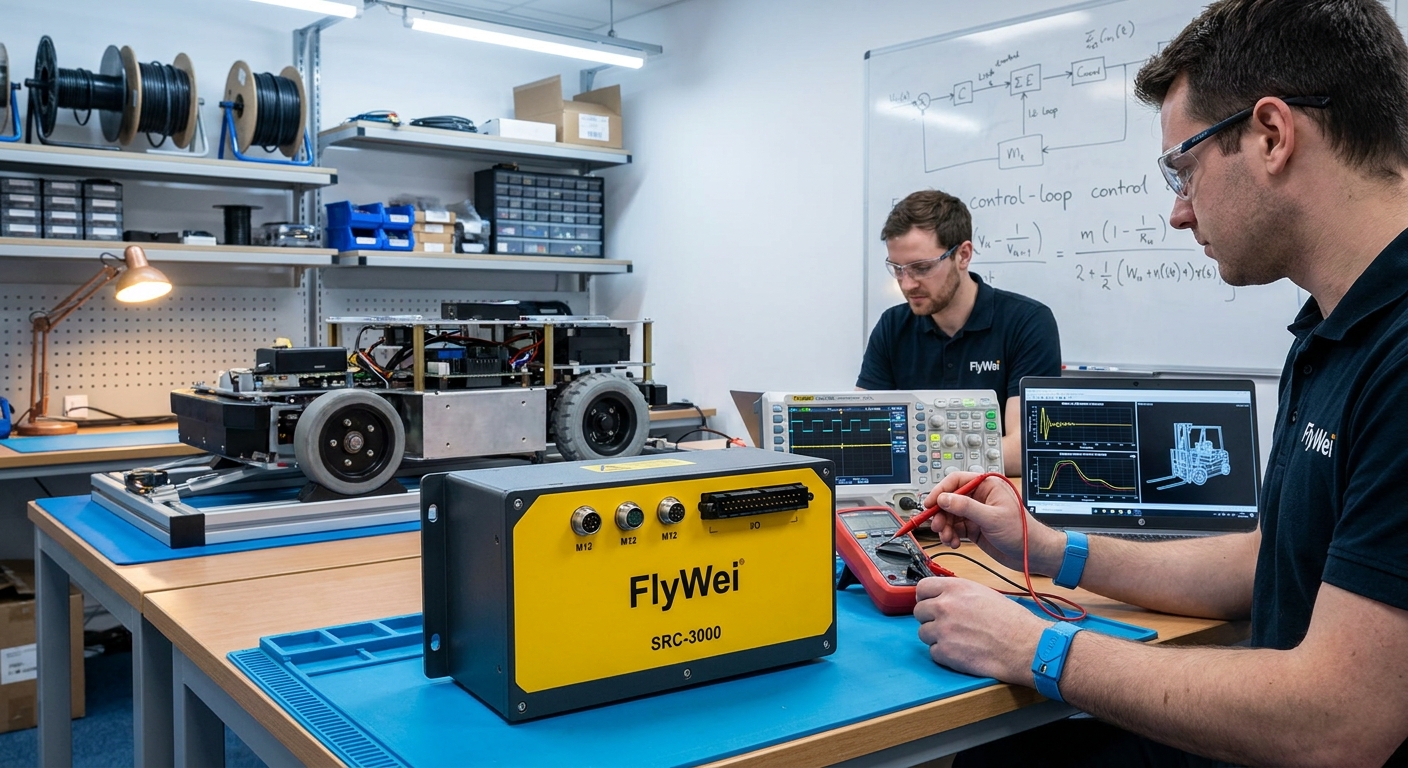
Lifting automated robots are knee-height mobile platforms that lift, carry and lower wheeled carts, totes and sub-assemblies under their own power, removing the need for human trolley-pullers across UK e-commerce mezzanine floors. Manual handling and workplace-transport incidents account for roughly 25% of major warehouse injuries in the UK each year, according to the Health and Safety Executive (HSE), with the figure spiking during overnight peak shifts when fulfilment centres lean on agency staff. For the Warehouse Manager running a 100,000-to-250,000 sqft pick mezzanine at sites such as Magna Park or SEGRO East Midlands Gateway, the operational pain is unambiguous: trolley-pullers feeding the pick face during cut-off, agency churn at thirty-five per cent a quarter, and pick-line OEE that collapses every time the wrong cart goes up the wrong aisle. Lifting automated robots remove that bottleneck by replacing the trolley-puller with a fleet of cart-shuttling units coordinated by one fleet manager.
Why this happens
UK e-commerce volumes grew almost five per cent year-on-year through 2025, according to Logistics UK, yet the warehouse footprint absorbing that growth has barely moved. Operators have pushed pick density up by adding mezzanine levels (second, third, sometimes fourth floors of pick faces stacked above the ground-level dock) and the only way to feed those mezzanine pick faces is to shuttle wheeled cages, totes and roll-cages between goods-in, replen, pick and despatch. The default solution is still a human with a manual trolley.
Three structural forces make that default unsustainable for a 2026 Warehouse Manager.
First, labour. Driver and picker churn in UK fulfilment routinely exceeds thirty per cent a year, and trolley-pulling is the role agency workers leave first. The Provision and Use of Work Equipment Regulations 1998 (PUWER) place the employer on the hook for safe handling, while the same regulations make it harder to push older or pregnant staff into repetitive lifting roles: narrowing the available workforce further.
Second, mezzanine geometry. Pick mezzanines in distribution centres at DIRFT, Daventry and Burton-on-Trent are typically engineered for around 4.8 kN/m² uniform load but only 1.5 m of clear-aisle width. That rules out a conventional counterbalance forklift and any AGV carrying an overhead mast. The only viable autonomous platform is one that fits under a wheeled cart and lifts it from below.
Third, WMS blindness. The enterprise warehouse-management system tells the picker which item to pick, but it does not know which trolley is where, or whether the next cart is queued at the lift. The result is a constant low-grade collision between the digital pick wave and the physical cart flow, and the Warehouse Manager wears the variance every Monday morning.
Lifting automated robots address all three forces inside one platform.
Lifting automated robots are knee-height mobile platforms that lift, carry and lower wheeled carts, totes and sub-assemblies under their own power, removing the need for human trolley-pullers across UK e-commerce mezzanine floors.
The four levers that fix it
Lever 1: Map the actual cart missions before you procure the robot
Every Warehouse Manager who has bought AMRs without first counting cart missions tells the same story: the fleet does about sixty per cent of what it was sold to do. Spend a week with a clipboard on the mezzanine and record every cart movement: origin zone, destination zone, cart type, time of day, peak-hour density and bottleneck cross-overs. From that data come the three numbers your procurement document needs: peak carts per hour (the AMR fleet must sustain this), mean transit distance per cart (this sets the energy budget and dwell-time at chargers), and the cross-over count where two flows intersect (this drives the M4 ruleset). If your peak demand is 28 carts per hour and a single AMR sustains 9 carts per hour, you need at least four robots plus a one-unit spare, not the three the vendor demonstration recommended.
| Approach | Sustainable carts/hour | Capex band | PUWER compliance load |
|---|---|---|---|
| Manual trolley-puller | 6 to 10 per worker | Low (high opex) | High: every shift, every worker |
| Fixed towline conveyor | 20 to 30 fleet-wide | High fixed | Medium: single asset class |
| Lifting AMR fleet (6 units) | 25 to 45 fleet-wide | Medium capex | Low: once certified, daily inspection only |
Lever 2: Layer the M4 fleet manager and VDA 5050 over the AMR fleet
One AMR on its own is a toy. A fleet of twelve AMRs with no orchestration is a daily fire. The M4 fleet manager, FlyWei’s orchestrator, issues each AMR its next mission, handles cross-traffic at aisle junctions, coordinates charging windows so the fleet never drops below ninety per cent availability, and falls back gracefully when a single robot is out of service. M4 speaks the VDA 5050 protocol, the BSI-aligned interoperability standard that lets AMRs from different manufacturers run inside one fleet: useful when the operation scales past thirty units or when an acquisition brings a different brand into the building. Underneath M4, the fleet dispatch layer maps each cart-shuttling mission to the optimal robot based on real-time battery state, distance and current queue depth. Without this layer, the operation runs the fleet on a spreadsheet.
Lever 3: Certify the deployment against ISO 3691-4 and PUWER from day one
A lifting AMR in a UK warehouse sits inside the scope of PUWER 1998 and the safety-performance requirements of ISO 3691-4, the international standard for driverless industrial trucks. The HSE Approved Code of Practice expects the employer to risk-assess the workspace, designate exclusion zones during commissioning, train every picker on the mezzanine on the AMR’s stop behaviour, and keep the inspection log for the lifetime of the asset. The mistake Warehouse Managers make is to treat compliance as a launch-week task: it is a daily one. Bake the inspection into the morning shift huddle, photograph the LiDAR lenses weekly, and keep a one-page incident log per AMR. Logistics UK and the BSI both publish guidance that maps PUWER and LOLER onto AMR fleets specifically: keep both in the safety file the inspector will eventually open.
Lever 4: Stage the deployment around peak to protect the cut-off
A Warehouse Manager who turns on a new AMR fleet two weeks before Black Friday is asking to lose Black Friday. The right cadence is a three-stage rollout: months one and two, a single AMR on a single low-risk loop, with picker training and the PUWER inspection routine bedded in; months three and four, fleet expanded to half the target size on twin loops, with M4 cross-traffic rules tuned against live data; month five onwards, full fleet, integrated with the WMS pick wave, with a 48-hour rollback plan documented and signed off. Keep the existing trolley-puller team in place for the first two stages so the cut-off is protected; only release that capacity once the AMR fleet has hit its sustained carts-per-hour target across three consecutive weeks.
What FlyWei does here
FlyWei supplies and integrates the lifting automated robot fleet that sits underneath your e-commerce mezzanine. The FlyWei range starts with the AMB-300JZ-class latent-jacking AMR: a 300 kg payload knee-height unit that slips under a wheeled cage, lifts ten centimetres and carries the load along the LiDAR-mapped route to the next pick zone. For heavier movements, full mesh cages of bottled goods or sub-assembled gift sets, the same fleet accommodates the AMB-1000-class scissor-lift unit at one-tonne payload. Both machines are autonomous: there is no operator on the chassis, no seat, no steering wheel, and a sealed electronics enclosure where the driver position would otherwise sit.
Above the hardware, the FlyWei M4 fleet manager coordinates the entire fleet against the WMS pick wave, while fleet dispatch assigns each cart mission to the optimal robot in real time based on battery state, distance and queue depth. The whole stack (hardware, fleet manager, dispatch) is delivered as one integrated package by FlyWei, not three separate vendor contracts to glue together. FlyWei autonomous forklifts can ride alongside the same M4 fleet for any pallet movements at goods-in or despatch: see the autonomous forklift and solutions pages for the broader product picture.
For a UK Warehouse Manager scoping a lifting AMR project in 2026, that integration shortens the deployment window from the typical fourteen-month industry average down to roughly six months from PO to cut-off-proof go-live. Site survey, mezzanine load check and a written PUWER-aligned commissioning plan are part of the standard FlyWei engagement.
Frequently asked questions
What are lifting automated robots?
Lifting automated robots are knee-height autonomous mobile platforms that lift wheeled carts, totes or sub-assemblies under their own power and carry them along LiDAR-mapped routes inside warehouses, fulfilment centres and manufacturing plants. They replace the human trolley-puller role and report into a fleet manager.
Where do lifting automated robots fit best in a UK e-commerce fulfilment centre?
On mezzanine pick floors, between goods-in and replen zones, on returns processing lines, and on the cart-shuttle route between pick and despatch consolidation. Anywhere that today involves a human pulling a trolley or cage with no value-adding task in between is a candidate.
How many lifting AMRs do I need for a 150,000 sqft mezzanine?
The answer depends on cart density at peak hour, not floor area. A 150,000 sqft pick mezzanine running twenty-five carts per hour at peak typically needs four to six AMRs plus a one-unit spare, sized off a one-week cart-mission map. Do not size the fleet from the vendor brochure.
Do lifting automated robots need building changes before deployment?
Typically no structural change is required. They need a clean, level floor inside the TR34 flatness tolerance band, wireless coverage that holds the VDA 5050 protocol, and clear sight-lines for the LiDAR. Marked exclusion zones during commissioning are mandatory under PUWER.
Are lifting automated robots regulated in the UK?
Yes. They fall under PUWER 1998 and the safety-performance requirements of ISO 3691-4. Employers must risk-assess each route, train staff on the AMR stop behaviour, keep an inspection log, and ensure the equipment carries UKCA marking.
What is the payback period on a lifting AMR fleet?
For a 100,000 sqft mezzanine doing thirty or more cart movements per peak hour, typical payback is fourteen to twenty-two months. The biggest variable is whether the existing trolley-puller labour cost is on-payroll (longer payback) or agency at premium rates (shorter payback).
Can I run lifting AMRs alongside autonomous forklifts in the same building?
Yes: provided the fleet manager speaks VDA 5050. FlyWei’s M4 coordinates lifting AMRs, autonomous forklifts and tugger AMRs inside one fleet, with cross-traffic rules at aisle junctions and a single charging schedule.
Next step
Talk to FlyWei about your mezzanine cart-flow challenge: book a 30-minute scoping call via the contact page and we will walk you through the one-week cart-mission survey before any kit is quoted.