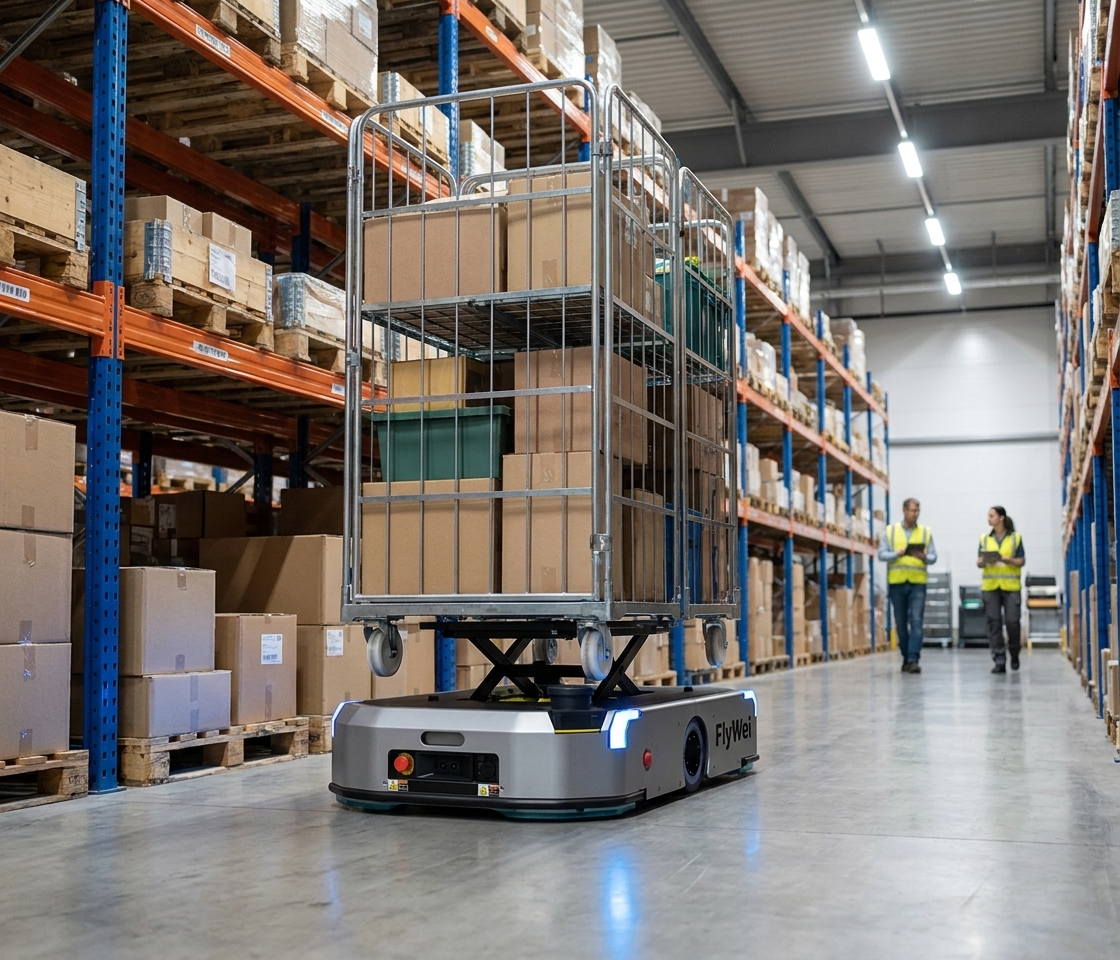
A lifting robot is a compact autonomous mobile robot that slides under a wheeled cage, tote-cart or dolly, jacks it a few centimetres off the deck, and moves the load across the warehouse without a human driver, an assigned aisle or a strip of magnetic tape. For the UK retail distribution centre — with its 150,000 to 400,000 sqft footprint, its mixed-SKU picking peaks and its stubborn pedestrian pallet-truck labour bill — the lifting robot is the operational tool that removes the walking without touching the racking. According to HSE workplace-transport statistics, vehicles at work account for around 20 fatalities and more than 1,000 major injuries in UK workplaces each year, and forklifts and pedestrian pallet trucks are the two largest contributors. For warehouse managers running 3-shift grocery flows, that is the number that keeps recruiting and the safety review moving in opposite directions.
Why UK retail DC managers run out of pickers before they run out of orders
Every retail distribution centre in the UK — the grocery mega-hubs around DIRFT and Magna Park, the multi-channel sheds along the M6 corridor, the omnichannel returns hubs around Burton-on-Trent — is built around one hard number: the pedestrian pallet-truck operator. That role does the ground-level SKU shuffling that keeps replenishment, cross-dock and returns moving under a mixed-SKU peak. It is also the role Logistics UK Skills & Employment reporting has flagged as the single biggest recruitment gap in the sector, quarter after quarter.
Three forces stack on the warehouse manager at once:
- Peak amplitude has widened. Grocery e-commerce, promotional cycles and returns cycles no longer share the same calendar with in-store replenishment, so the DC has to absorb three overlapping surges through Q3 and Q4 rather than one.
- Pedestrian-truck labour is scarce and expensive. Warehouse manager job ads are running near a decade high while pallet-truck operator vacancies stay open for weeks. Every hour those roles sit vacant shifts back onto the pickers themselves, pushing walking distances up and productivity down.
- The safety bar is not softening. HSE workplace-transport data continues to place forklifts and pedestrian pallet trucks in the top-two contributor slots. PUWER and LOLER inspectors do not accept "we cannot recruit" as mitigation for a near-miss.
The net effect: the warehouse manager is asked to run more mixed-SKU flow across a bigger floor, with fewer competent pallet-truck hands, against an HSE bar that is rising rather than falling. The lifting robot exists to break that stack — not by replacing forklifts, but by removing the walking most of the pedestrian pallet-truck fleet was doing in the first place.
The four levers a UK retail DC warehouse manager can pull
Lever 1 — Map the cart moves before you buy the robot
The single most expensive lifting robot deployment is the one bought before the DC has traced its cart movements to the aisle. Before any procurement conversation, spend two weeks tagging pedestrian pallet-truck routes: which cage moves from goods-in to replenishment, which dolly moves from mezzanine pick-face to loop conveyor, which tote-cart shuttles returns back to inspection. Cluster them by weight, floor, aisle width and cycle time. In a 200,000 sqft UK retail DC this exercise typically surfaces four repeating cart-move patterns that together account for 60 to 75 per cent of pedestrian pallet-truck labour. Those are the flows the lifting robot fleet lives on. The exercise also tells procurement how many robots to buy — usually 40 to 60 per cent fewer than the first sizing conversation assumed — and which floor sections need epoxy or floor-flatness remediation before day one.
Lever 2 — Orchestrate the fleet with M4, not the WMS
The technical mistake most retail DCs make on their first lifting robot programme is trying to dispatch individual robots from the enterprise WMS. That approach turns every cart move into a queued transaction, which is exactly the pattern that collapses under Q4 peak. The correct architecture puts M4 — the FlyWei fleet manager — between the enterprise WMS and the robot fleet, talking to every robot over the open VDA 5050 interface. M4 handles path planning, battery swaps, traffic negotiation with any legacy AGV or forklift, and shared-floor traffic with pickers; the WMS keeps the order book. That separation is what lets the same fleet absorb a 40 per cent volume swing between a normal Tuesday and a Black Friday run-in without a supervisor re-cutting the pick-route file. Warehouse managers who architect the interface once, then let M4 broker every transaction, add fleet capacity in a morning rather than in a project cycle.
Lever 3 — Bake PUWER, LOLER and ISO 3691-4 into commissioning, not the post-mortem
Every lifting robot in the UK is work equipment. That means PUWER 1998 applies to the robot itself and to every dolly, cage or trolley it lifts, and LOLER 1998 applies to the lifting mechanism and any load above the statutory threshold. On top of that, ISO 3691-4 — the international standard for driverless industrial trucks — sets the safety architecture and shared-floor rules HSE will expect at inspection. The disciplined UK retail DC bakes all three into commissioning: PUWER-eligible operators complete the specific training standard before day one, LOLER thorough examinations are diarised at the 6-month and 12-month marks, and the ISO 3691-4 zone map (protective, warning, restricted) is signed off by the site safety lead before the first cage is jacked. That way the first HSE inspection is a paperwork walkthrough, not a stop-work notice.
Lever 4 — Fund the fleet through a leasing line, not a capex bid
The capex-versus-opex fight is where most retail DC lifting robot programmes stall in a UK finance committee. A 3, 5 or 7-year FlyWei leasing line moves the fleet, the M4 licences and the on-site engineering into a single opex line item, which finance can offset directly against the pedestrian pallet-truck agency-labour bill it is trying to remove. Because the leasing line covers refresh, replacement-in-kind and controller upgrades, the DC never carries obsolescence risk on a robot whose SLAM stack will move on twice inside a 7-year window. For a warehouse manager pitching a Q3 board pack, that framing turns the programme from "we would like to spend £X million on robots" into "we are cutting agency-labour spend by Y per cent from month one, at fixed monthly cost, with no residual value risk". That is the language a UK retail DC board actually says yes to.
| Approach | Peak flex | Capex profile | PUWER / LOLER / ISO 3691-4 surface | Typical payback |
|---|---|---|---|---|
| Agency pedestrian pallet-truck labour | Poor — hiring cycle is weeks | Pure opex, high volatility | Full — PUWER training per operator, LOLER on each truck | Cost keeps rising |
| Fixed conveyor / sortation | None — fixed capacity | Heavy capex, long lead time | Low, but rebuild cost each SKU-mix change | 4 to 6 years |
| Traditional AGV on magnetic strip | Limited — path change is a project | Medium capex, slow to add | PUWER plus partial ISO 3691-4 | 3 to 4 years |
| Lifting robot fleet on M4 | High — add a robot in a morning | Opex via leasing, capex-neutral | Full PUWER plus LOLER plus ISO 3691-4, commissioned once | 18 to 30 months |
A lifting robot is a compact autonomous mobile robot that slides under a wheeled cage, tote-cart or dolly, jacks it a few centimetres off the deck, and moves the load across the warehouse without a human driver, an assigned aisle or a strip of magnetic tape.
What FlyWei does inside a UK retail DC
FlyWei designs, supplies and integrates lifting robot fleets for UK retail distribution centres from a UK engineering base. The starting point is not a robot spec sheet — it is a two-week cart-flow audit done on the DC floor, in shift, with the warehouse manager and the site safety lead in the room. From that audit FlyWei sizes the fleet, picks the right chassis for each move pattern (latent-jacking pucks for cages and dollies, heavy-lift scissor units for the loaded cart moves that break a standard puck, rotary-lift units for cart moves that need to reorient a load), and hands the sizing back to the warehouse manager for challenge.
M4 — the FlyWei fleet manager — brokers every move over VDA 5050, negotiates with any legacy AGVs already on the floor, and integrates cleanly with the enterprise WMS the DC already runs. RDS — the FlyWei robot dispatch service — sits behind M4 to allocate jobs across the mixed fleet and hold the shared-floor traffic model that keeps pickers safe. UK-based FlyWei engineers own the commissioning, the PUWER training, the ISO 3691-4 zone sign-off and the first LOLER thorough examination.
For the retail DC finance conversation, FlyWei runs the fleet through its 3, 5 and 7-year leasing lines, so the warehouse manager can put a fixed monthly number against the agency-labour cost the fleet displaces. The commercial model is designed to be a straight substitution, not a bet.
FAQ
What is a lifting robot?
A lifting robot is an autonomous mobile robot that drives itself under a wheeled cage, cart or dolly, raises the load a few centimetres, and moves it across the DC floor without a human driver, an assigned aisle or a floor-guide strip.
Where does a lifting robot fit in a UK retail DC?
It fits the repeating pedestrian pallet-truck moves a mixed-SKU retail DC generates: goods-in to replenishment aisle, mezzanine pick-face to loop conveyor, returns to inspection, and dock-to-pick-face top-up. Those flows are the labour hours a retail DC loses first when hiring gets tight.
How much picker walking does a lifting robot remove?
In a mapped 150,000 to 400,000 sqft UK retail DC, an M4-orchestrated lifting robot fleet typically removes a large share of the pedestrian pallet-truck walking, freeing pickers to stay at the pick-face.
Is a lifting robot PUWER compliant?
Yes. A lifting robot is work equipment under PUWER 1998, and its lifting mechanism falls under LOLER 1998. Commissioning includes operator training, thorough examinations and the ISO 3691-4 zone sign-off before the first live cage move.
What load types can a lifting robot handle?
Roll-cages, tote-carts, wheeled dollies, mesh cages and euro-pallet cages on wheels — 300 kg on latent-jacking pucks, 1 tonne on heavy-lift scissor units, reorientation on rotary-lift units.
How long is a first lifting robot deployment in a live UK retail DC?
Typically eight to twelve weeks from the signed cart-flow audit to first live moves. Most of the time is ISO 3691-4 zone sign-off and the LOLER thorough examination — the robots themselves commission in days.
If Q3 mixed-SKU peaks and pedestrian pallet-truck labour cover are already on your retail DC risk register, the fastest way to test whether a lifting robot fleet fits your floor is to have a FlyWei UK engineer walk it with you.
Book a free 30-minute site survey — a UK FlyWei engineer will map your four highest-volume cart moves and hand you a fleet-sizing indication before you leave the floor. If your finance conversation is next, see the FlyWei leasing options for a straight opex substitution against agency labour.
UK-based engineers · no obligation · reply within one business day.