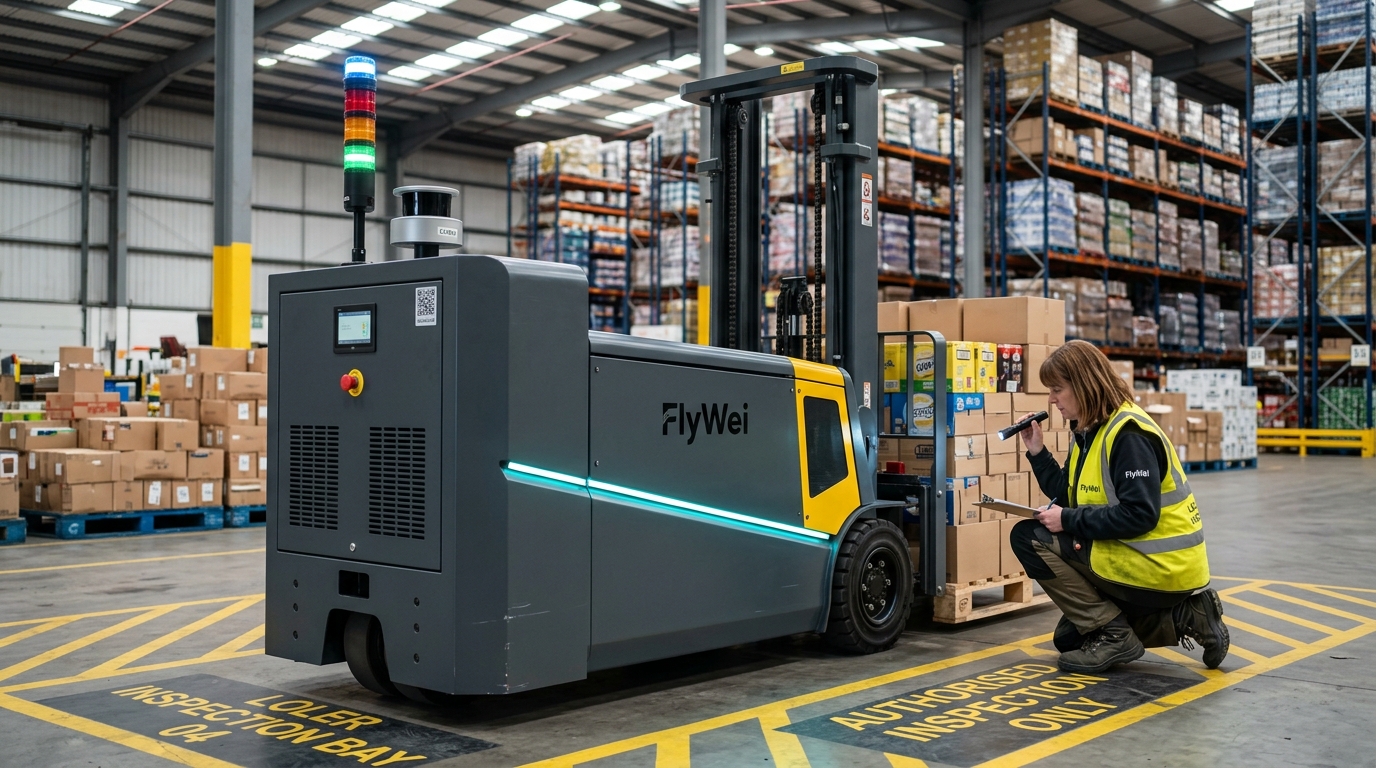
Autonomous forklift LOLER compliance is the duty for any UK operator running mobile lifting equipment to thoroughly examine, document and competently inspect that equipment under the Lifting Operations and Lifting Equipment Regulations 1998, even when the truck has no driver and no overhead-guard cab. PUWER 1998 sits alongside it, requiring a written risk assessment for every safety-critical change. The Health and Safety Executive recorded around 30% of all reportable workplace transport injuries as forklift-related in 2024-25, and that figure has not improved since autonomous fleets began entering UK 3PL contracts. For a 3PL Operations Director running a dozen client SLAs across Magna Park, DIRFT and Burton-on-Trent, the problem is no longer whether the robot can lift: it is whether the LOLER inspection certificate, the PUWER risk assessment and the UKCA conformity file are presentable to an HSE inspector within two hours of a request, on any of those sites, with the right named competent person attached.
Why LOLER and PUWER compliance gets harder when the forklift has no driver
UK 3PL operators have adopted autonomous mobile forklifts (AMFs) faster than the regulatory drafting around them was designed for. LOLER 1998 was written when "lifting equipment" meant cranes, hoists and counterbalanced trucks with a seated operator. PUWER 1998 assumed the work equipment had a person on it. Neither names autonomous forklifts explicitly. The Approved Code of Practice (ACOP L117: Rider-Operated Lift Trucks) was last meaningfully revised in 2013, before VDA 5050 navigation stacks and laser-scanning safety pucks were in the field.
That regulatory drift creates three operational pressures inside a 3PL business. First, the inspection regime moves: a thorough examination under LOLER must be done by a competent person at six- or twelve-month intervals depending on lift cycles, and the inspector now needs to verify the LiDAR pucks, the laser scanners, the safety-rated PLC, the emergency-stop logic and the map seal, not just the chains and forks. Most LOLER inspectors who walked onto a UK distribution centre five years ago were not equipped for that. Second, PUWER risk assessment becomes continuous: every time a fleet manager updates the warehouse map to add a dock, reposition a pick face or redirect a route around a maintenance bay, that is a significant change under PUWER and a new written assessment is required. The HSE has been clear in workplace transport guidance that risk assessment is not a once-a-year document. Third, UKCA documentation has bedded in: from 1 January 2025 new lifting equipment placed on the UK market must carry the UKCA mark, and procurement-side checks on the declaration of conformity now sit in goods-in, not in operations.
This adds up to a quiet compliance debt that auditors and HSE inspectors are now starting to pull on, particularly inside multi-site 3PL contracts at Magna Park, DIRFT and the Midlands belt.
"The robot lifts the load; the regulations do not lift themselves. UKCA, LOLER and PUWER all apply to an autonomous forklift from day one, and the duty-holder is the operator, not the supplier."
Lever 1: Build a multi-site LOLER register before the first robot lands
An operational lever first. Most 3PLs run a LOLER register at single-site level, typically a maintenance spreadsheet held by the site engineering manager. That breaks the moment a Hub Operations Director needs evidence across six sites for a Logistics UK audit or an HSE follow-up. The fix is to consolidate at portfolio level on day one. Identify every piece of lifting equipment that will be in scope (autonomous forklifts, manual counterbalanced trucks, mezzanine lifts, scissor lifts, AMR scissor decks) and capture serial number, last thorough examination date, next due date, the named competent person, and the scheme of examination (six-monthly for personnel lifts, twelve-monthly for goods). Set the register to read-only outside the maintenance team and version every change. When the HSE knocks, the Operations Director should be able to filter by site, by truck type, by competent person and by next-due date inside ten minutes. The register should drive procurement too: any new autonomous forklift order needs the LOLER scheme pre-loaded against the serial number before the truck is commissioned, not after.
Lever 2: Treat every map update as a PUWER event, and automate the audit trail
This is the technical lever. Autonomous forklifts are mapped against the warehouse layout, and the map changes: sometimes weekly. A new dock door, a relocated mezzanine, a temporary repair bay, even a seasonal change to high-bay rack layout all alter the safe operating envelope. Under PUWER, each of those is a significant change requiring a fresh written risk assessment. Most fleet managers will not have considered this, because the map looks like a software configuration rather than an equipment change. Wire the audit trail in: the fleet manager, the FlyWei M4 console handles this natively, should record every map publication as a timestamped PUWER trigger, link it to the named risk-assessment author, and refuse to push the new map to fleet until a sign-off is logged against it. FlyWei fleet dispatch software should not task any truck against the new map until the PUWER record is closed. That gives the Operations Director a tamper-evident trail without manual paperwork or screenshot folders.
Lever 3: Replace CE-only paperwork with UKCA declarations of conformity at procurement
The regulatory lever. ISO 3691-4 sets the international safety requirements for driverless industrial trucks and is the reference standard against which UKCA conformity declarations are written. CE marking remained valid for new equipment placed on the UK market until the end of 2024; since 1 January 2025, new units need UKCA. For a 3PL Operations Director, that turns into a procurement gate. Every purchase order for autonomous forklift fleet (whether outright capex, leased, or as part of a robotics-as-a-service contract) must include the UKCA declaration of conformity referencing ISO 3691-4 and the relevant ACOP. Reject deliveries that arrive CE-only without a manufacturer-signed transition statement. The same gate applies to ancillary lifting equipment: AMR scissor lifts, lifting robots, stacker units. The cost of getting this wrong is not the HSE fine: it is the contractual breach with a client whose own ESG audit pulls UKCA evidence by serial number and finds a CE-only gap.
Lever 4: Name a competent person per site and put the chain of liability in writing
Operational lever again, this time about people. The duty-holder employing the equipment carries operator liability under the Health and Safety at Work Act 1974, not the manufacturer or the integrator. For a multi-site 3PL, that liability cascades from the company Board to a named officer at each licensed site. Make the chain explicit in the site management contract: who is the competent person under LOLER, who authorises PUWER risk assessments, who maintains the local register, who signs off map updates. Train each named person on autonomous fleet specifics: LiDAR field of view, safety scanner Performance Levels, emergency-stop logic, the difference between a software stop and a hardware stop, and the conditions under which the truck must refuse a task. Audit the chain twice a year and refresh after any personnel change. When something goes wrong, the HSE will look for the named individuals first; if the chain is missing or out of date, the duty-holder is exposed at company-director level under the Corporate Manslaughter and Corporate Homicide Act 2007.
What FlyWei does here
FlyWei autonomous forklifts are supplied with their declaration of conformity (CE on selected models), the manufacturer's user instructions in English, and a competent-person commissioning walkthrough at go-live. The M4 fleet manager logs every map change as a PUWER-trigger event and names the risk-assessment author. For a 3PL Operations Director running multi-site contracts across Magna Park, DIRFT and Burton-on-Trent, that turns three separate compliance burdens (LOLER, PUWER, UKCA) into a single console with a single register and a single audit trail. The FlyWei autonomous forklift range covers counterbalanced, reach, stacker and pallet-truck variants under one compliance scheme, so the register does not fragment by truck type. Lifting robots and end-to-end FlyWei solutions share the same evidence model, which is what HSE inspectors and Logistics UK auditors actually ask for.
Frequently asked questions
Does LOLER apply to autonomous forklifts in the UK?
Yes. LOLER 1998 applies to all lifting equipment regardless of whether it has a driver. The Lifting Operations and Lifting Equipment Regulations require thorough examination by a competent person at six- or twelve-month intervals, plus a written scheme of examination signed off under regulation 9.
How often must an autonomous forklift be thoroughly examined under LOLER?
Every six months if the lifting equipment is being used to lift people, every twelve months for goods, or at intervals set out in a written scheme of examination drawn up by a competent person under regulation 9 of LOLER 1998.
What counts as a significant change under PUWER for an autonomous mobile forklift?
Map updates that alter the safe operating envelope, new dock doors or routes, changes to load type, changes to the autonomy software stack affecting safety-rated functions, and addition or removal of fleet members. Each requires a fresh written PUWER risk assessment before the change goes live.
Do I still need a named competent person if the forklift has no driver?
Yes. The competent person verifies the LOLER documentation, the physical state of the lifting components, the safety-rated electronics, and the conformity file. Their role is to inspect and certify the equipment, not to operate it.
Is CE marking still valid for autonomous forklifts placed on the UK market?
Only for units placed on the UK market before 1 January 2025. New units now require UKCA marking. Stock placed before that cut-off is grandfathered but cannot be substantially modified without re-conformity assessment against ISO 3691-4.
Who is liable when an autonomous forklift causes a workplace incident?
The duty-holder employing the equipment under the Health and Safety at Work Act 1974, with directors' duties cascading to named competent persons at each site. The manufacturer or integrator may carry product-liability exposure separately, but operator liability sits squarely with the employer.
What is the difference between LOLER and PUWER for an autonomous forklift?
LOLER covers the lifting function specifically: chains, forks, masts, and any equipment whose primary purpose is to lift a load. PUWER covers the use of all work equipment, including risk assessment of the operating environment, training of personnel, and management of significant changes.
Talk to FlyWei about a multi-site compliance pack
If you are a UK 3PL Operations Director carrying multi-site LOLER, PUWER and UKCA evidence across Magna Park, DIRFT or Burton-on-Trent, talk to FlyWei about a multi-site compliance pack and an M4-driven audit register that closes the gap in 2026.