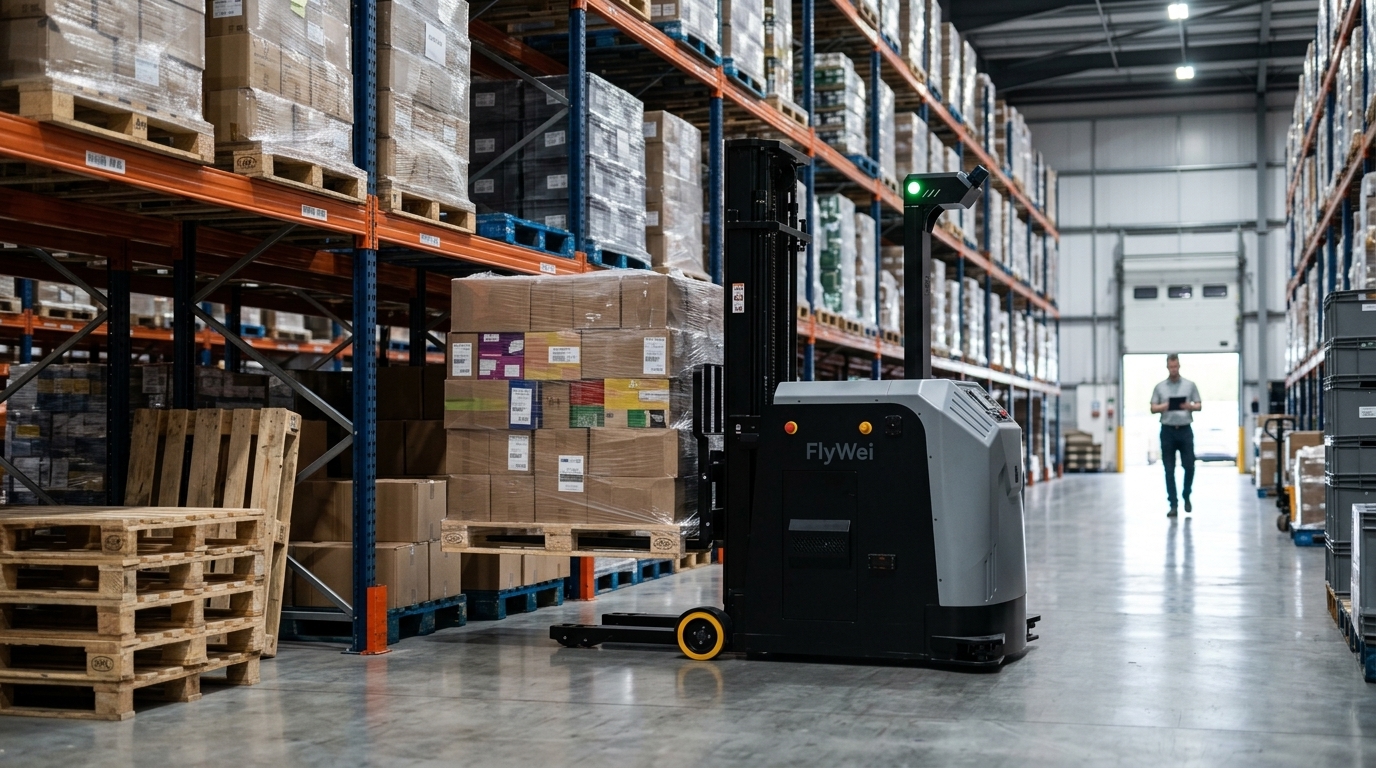
Robotics as a Service UK is a commercial model where engineering procurement teams pay a fixed monthly fee for autonomous forklift and lifting-robot fleets — hardware, software, maintenance, parts, telematics and on-site engineering rolled into one operating-expenditure line. Logistics UK estimates the fully-loaded cost of running a single conventional counterbalance forklift across a UK manufacturing plant now exceeds £41,000 per year once operator wages, fuel, maintenance and downtime are stacked together, and that figure has climbed every quarter since 2022. For the procurement director rebuilding a three-year envelope for a multi-site engineering operation, that bill is no longer something the board will defer. It is also not something the capex committee wants to see arrive as a £900,000 outright purchase requisition for fleet replacement. Robotics as a Service moves the same capability onto an opex line, removes residual-value risk, and lets procurement match cost to throughput month by month.
Why engineering procurement is moving off outright purchase
UK engineering manufacturing has spent four years absorbing structural cost rises on every piece of material handling kit. HSE workplace transport guidance recognises that lift trucks are involved in approximately a quarter of all workplace transport accidents, and the recurring cost of insurance, downtime and retraining stacks up. Capex committees have tightened in parallel. Most multi-site operators now require board sign-off, twelve-month payback evidence and a defensible residual-value forecast for any plant investment over £250,000. A traditional fleet purchase struggles against all three tests.
Three trends are squeezing procurement at once. The fully-loaded run-rate per conventional counterbalance forklift has crossed £41,000 a year. Autonomous forklift technology has matured to where sealed-cab trucks discharge the same duty cycle unmanned on second and third shifts under BS EN ISO 3691-4 for driverless industrial trucks. And five-year residual values are now hard to forecast — finance directors have lost confidence in the secondary market they used to rely on for write-down assumptions. Robotics as a Service was built for this shape of problem: one monthly invoice covers the asset, software, spares, engineer cover and warranty, with an uptime SLA attached. Residual and obsolescence risk shifts to the lessor. The board sees a stable opex line. Procurement gets a predictable, scalable instrument that flexes with throughput and plant lifecycle.
The four levers that make Robotics as a Service work in a UK engineering plant
Lever 1 — Match the contract term to the plant lifecycle
The contract length is the single most consequential decision an engineering procurement team makes when signing up to Robotics as a Service. Three-year terms suit pilot sites and lines where the duty cycle is still being proved out; they keep early-termination cost containable if the line is rationalised. Five-year terms are the sweet spot for established West Midlands and East Midlands engineering plants running steady-state automotive, aerospace or heavy-machinery production where the duty cycle is predictable. Seven-year terms make sense where the plant is on a long capital programme, the OEM customer contract underwriting demand is itself long-dated, and procurement wants to lock in today''s monthly rate against future supply-chain price moves. The trade-off:
| Term | Typical fit | Monthly fee | Residual-value risk | Early-termination cost |
|---|---|---|---|---|
| 3 years | New site, pilot, unproven duty | Highest | Lessor, short window | Lowest |
| 5 years | Steady-state UK engineering plant | Balanced | Lessor, medium window | Moderate |
| 7 years | Long-dated OEM contract underwriting demand | Lowest | Lessor, long window | Highest |
Lever 2 — Insist on VDA 5050 fleet orchestration inside the lease
This is the technical lever and the one most often missed at signature. A fleet of autonomous forklifts needs to interoperate with the operator''s existing ERP and warehouse management system, with any future AMR types added to the fleet, and with the plant safety perimeter. The open VDA 5050 communication standard is what makes that possible. A Robotics as a Service contract that bakes VDA 5050 orchestration into the monthly fee — through a fleet manager such as M4 and a dispatch layer such as RDS — protects against vendor lock-in. If the lessor refuses to commit VDA 5050 inside the lease, the procurement team is being asked to absorb integration risk that should sit with the supplier. Insist on it. Insist also on a telemetry-led uptime SLA that credits the monthly fee back when contracted uptime is missed.
Lever 3 — Build PUWER, LOLER and ISO 3691-4 into the monthly fee
A UK engineering plant operating a mixed fleet is on the hook for PUWER 1998 regulation 6 inspection and maintenance, for thorough examination under LOLER 1998, and for the safety-related design and operational requirements set out in BS EN ISO 3691-4 for driverless industrial trucks. A well-drafted Robotics as a Service contract absorbs every one of these into the monthly fee — scheduled inspections, certificate generation, breakdown response, replacement parts, on-site engineer cover and ACOP-aligned competence sign-off. Procurement teams should never accept a leasing contract that ringfences any of these into a separate side agreement. That is how unpriced costs creep onto the plant balance sheet eighteen months in.
Lever 4 — Get the accounting treatment agreed at signature
Operating-lease treatment under FRS 102 — combined with the right interaction with the UK Annual Investment Allowance — is what keeps the fleet off the balance sheet and the monthly fee on the opex line. The lessor should confirm in writing at signature that the contract structure has been reviewed against current HMRC and FRS 102 guidance, that the equipment will not be deemed a finance lease, and that the monthly fee includes a clear breakdown between hardware, software and services for tax-relief purposes. Procurement that locks this down up front rarely has to defend the treatment at year-end audit.
What FlyWei does here
FlyWei designs, supplies and integrates autonomous forklift and lifting-robot fleets for UK engineering plants on three, five and seven-year full-service leases. The programme covers FlyWei autonomous counterbalance, reach, stacker and pallet-truck forklifts, FlyWei latent and heavy-lift AMRs from the lifting-robots range, the M4 fleet manager for VDA 5050 orchestration across the plant, and the RDS robot dispatch layer that pushes tasks into the fleet from the operator''s existing ERP and warehouse management system. The monthly fee includes the asset, software, all PUWER and LOLER inspection regimes, replacement parts, on-site UK-based engineer cover during contracted hours, and an uptime SLA that credits the monthly fee when targets are missed. Engineering procurement teams typically take a deal site by site as plants are re-baselined for autonomy, with the option to add capacity for peak production cycles without re-papering the head contract. FlyWei holds residual-value, obsolescence and parts-supply risk for the contract term, so the board sees one predictable line.
Robotics as a Service in the UK is a commercial model where engineering procurement teams pay a fixed monthly fee for autonomous forklift and lifting-robot fleets — hardware, software, maintenance, parts and on-site engineering rolled into one operating-expenditure line.
Frequently asked questions
What is Robotics as a Service in a UK context?
Robotics as a Service in the UK is a commercial model where a procurement team pays a fixed monthly fee for an autonomous forklift or lifting-robot fleet. The fee bundles hardware, software, maintenance, parts and on-site engineer cover into one opex line, removing capex and residual-value risk.
How does Robotics as a Service compare with a finance lease?
A finance lease puts the asset on the balance sheet and transfers most ownership risk to the lessee. Robotics as a Service is structured as an operating lease under FRS 102: the asset stays off the balance sheet, the monthly fee is opex, and obsolescence and residual-value risk sit with the lessor for the term.
Is three, five or seven years better for a UK engineering plant?
Three years suits new sites or pilot lines with unproven duty cycles. Five years is the typical fit for steady-state engineering plants. Seven years suits sites underwritten by a long-dated OEM contract where procurement wants to lock in today''s monthly fee against future price moves.
Does Robotics as a Service cover PUWER and LOLER inspections?
A well-drafted contract does. The monthly fee should include PUWER regulation 6 inspections, LOLER thorough examinations, BS EN ISO 3691-4 safety checks, breakdown response, parts and ACOP-aligned engineer sign-off. Procurement should reject any structure that ringfences these into a separate side agreement.
Can we add capacity for peak production without re-papering the head contract?
Yes. A flexible Robotics as a Service contract lets engineering procurement add units site by site or for peak cycles without re-tendering the head contract. The new units sit under the same VDA 5050 orchestration layer and the same uptime SLA.
Does Robotics as a Service work for both autonomous forklifts and lifting AMRs?
Yes. The same head contract typically covers autonomous counterbalance, reach, stacker and pallet-truck forklifts alongside latent-jacking and heavy-lift AMRs. A VDA 5050 fleet manager such as M4 orchestrates the mixed fleet in one schedule.
What happens at the end of the contract?
The lessor takes the fleet back. The plant balance sheet has carried no residual-value exposure for the term. Engineering procurement can re-lease the same fleet at a refreshed rate, upgrade to the current generation of autonomous trucks, or step away with no asset-disposal obligation.
If converting a £900,000 fleet replacement into a predictable monthly opex line is on your Q3 procurement risk register, the next step is a sizing read. Request a fleet-sizing and ROI estimate for your engineering plant, or explore the FlyWei full-service leasing programme for three, five and seven-year terms. UK-based engineers · no obligation · reply within one business day.