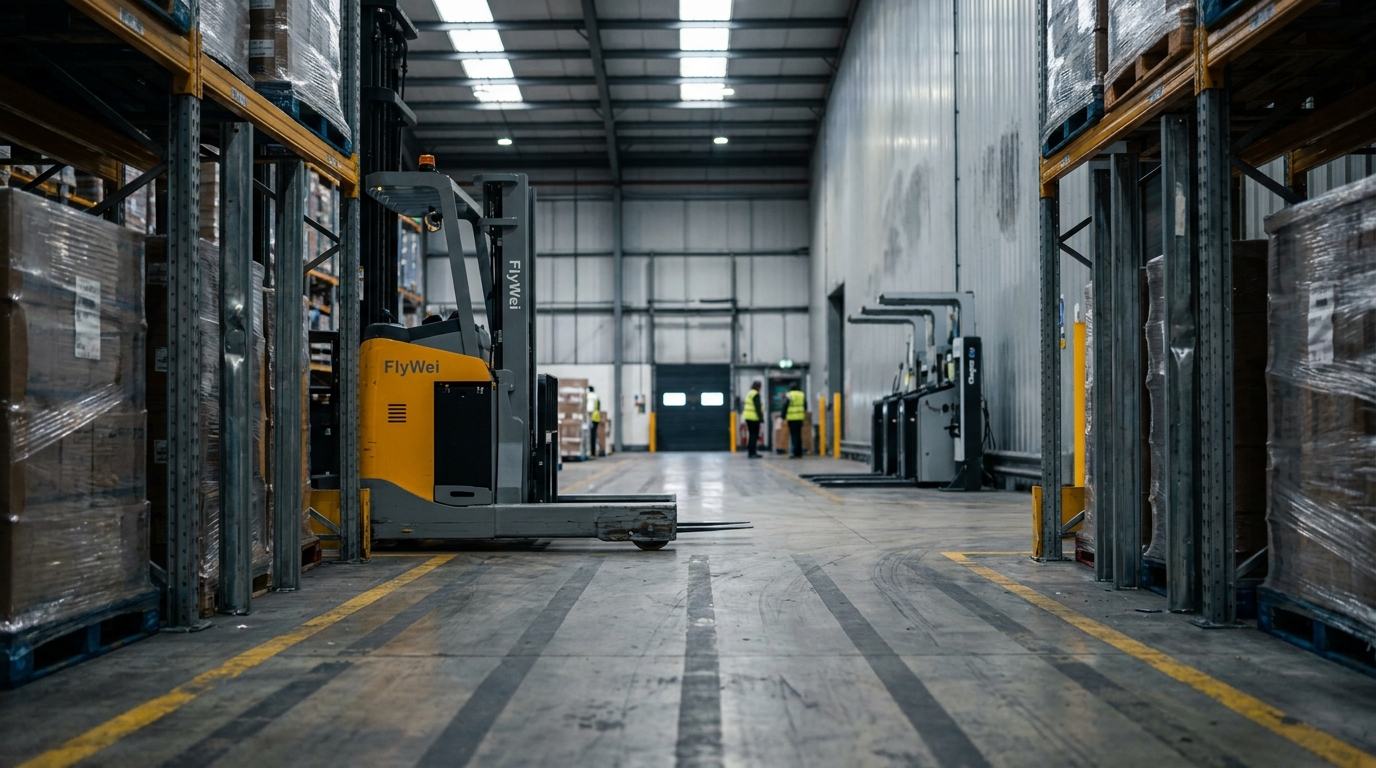
Vertical ASRS UK procurement is in a 2026 buying window: live evaluation hardware is now within a one-hour flight of every UK 3PL headquarters, and operators across Magna Park, DIRFT and SEGRO East Midlands Gateway will be asked to take a vendor demo before the financial year ends. This article is the buyer's framework that survives the demo theatre.
Why vertical ASRS UK became a distinct market in 2026
Until late 2025, vertical ASRS, the family of goods-to-person robots that climb racking columns to retrieve totes, was largely a continental European and APAC story. UK 3PLs evaluating goods-to-person automation were typically shown horizontal AGV fleets and shuttle systems. Two events in spring 2026 changed that calculus: rack-climbing units now have thousands of installations in daily continental operation, and a full demonstration and assessment facility opened a one-hour Schiphol flight from every UK 3PL HQ between Daventry and Magna Park.
For warehouse buyers in the East Midlands corridor, the consequence is simple: vertical ASRS UK pilots are being booked weekly, often on the back of an existing relationship with a tier-one MHE channel. The question UK operators should be asking is no longer whether to evaluate vertical ASRS: it is how to evaluate it without conceding the orchestration layer.
What vertical ASRS UK actually means in a Magna Park aisle
Vertical ASRS is shorthand for goods-to-person robotics that retrieve totes from rack-supported storage by climbing the rack itself. The shared feature across the category is rack density: 1.6× to 2.4× the SKU storage of the same footprint configured for shuttle-based ASRS, and 4× to 6× the density of a manual VNA aisle.
That density advantage is real. It is also the most over-pitched number in the category. The honest question for a UK 3PL is whether the existing building can carry the implied loads. TR34:2024 floor flatness, racking column tolerances and seismic anchoring requirements vary by depot age. A 1995-vintage Magna Park unit and a 2024 SEGRO East Midlands Gateway 2 build sit at opposite ends of that distribution. Vertical ASRS demos rarely surface this mismatch. A FlyWei feasibility survey does: within phase one, in week one.
Channelled vertical ASRS vs the FlyWei programme
| Dimension | Channelled vertical ASRS pilot | FlyWei vertical ASRS programme (M4 + fleet dispatch software) |
|---|---|---|
| Robot brand | Channel partner's chosen robot, fixed | FlyWei autonomous forklifts primary; third-party AMRs orchestrated via VDA 5050 |
| Orchestration layer | Channel partner stack + integrator middleware | FlyWei M4 fleet manager + fleet dispatch: open APIs to enterprise WMS and ERP |
| Year-five vendor switch | Replatform of fleet and orchestration | Add a new robot brand; keep M4 and fleet dispatch software |
| UK demo lead time | 3 to 6 weeks via channel facility | 1 to 3 weeks at FlyWei Wimbledon or partner UK depot |
| ISO 3691-4 dossier | Authored by channel partner | Authored by FlyWei; owned by operator |
| Indicative GBP capex (5,000 totes) | £1.4M to £2.6M | £900k to £1.7M |
| RaaS pricing available | Yes, channel-dependent | Yes, FlyWei direct |
The capex range is indicative: real numbers depend on tote count, throughput class and existing rack reuse. The point of the table is the row procurement teams skip: who owns the year-five switch.
The four traps in vendor-led vertical ASRS demos
UK warehouse leaders walk into vertical ASRS demos expecting to evaluate the robot. The traps are upstream of that.
Trap one: the orchestration assumption. Channelled vertical ASRS pilots usually presume the customer adopts the channel partner's orchestration stack. That commits the WMS integration, the operator UX and the year-three exception-handling library to the channel, not to the customer. The decision is rarely flagged as a decision; it travels in the proposal as a default.
Trap two: the floor that "passes". Vendor pre-survey teams typically clear a floor against the robot vendor's published tolerances. They rarely cross-check against TR34:2024 and the depot's PUWER-mandated risk register. A floor can pass the robot's spec and still fail the operator's regulatory case in front of an HSE inspector.
Trap three: RaaS that becomes opex lock-in. Robotics-as-a-Service pricing converts capex objections into 60-month opex commitments. The headline monthly figure is attractive. The exit clause, escalator and minimum-utilisation language are the lines nobody redlines.
Trap four: the four-week go-live screenshot. Marketing case studies citing four-week deployments rarely include an ISO 3691-4:2023 audit, a PUWER 1998 risk-assessment update and a TUPE-aware operator transition. In most UK depots, those three workstreams alone consume six to ten weeks.
"The robot is not the procurement decision: the orchestration layer is. Choose the orchestration layer once; choose robots every five years."
UK regulatory matter: what does not transfer to the integrator
Three regulatory anchors define vertical ASRS UK deployments. None of them transfer to the integrator, regardless of the commercial model.
PUWER 1998. The duty holder under HSE's Provision and Use of Work Equipment Regulations is the operating employer. Logistics UK's 2026 guidance is explicit: a RaaS contract does not move the duty holder. The operator owns the inspection regime, the competency case and ACOP L22 evidence.
ISO 3691-4:2023. The functional safety standard for driverless industrial trucks attaches to the equipment in service, not to the contract under which it was procured. The dossier (risk assessment, safety functions, performance level evidence) must be auditable on-site, in English, by the operator's safety lead. ISO 3691-4:2023 is the working edition; pre-2023 dossiers cited by overseas references rarely transfer cleanly.
TR34:2024 and BS EN 15620. Floor flatness and racking tolerances govern whether a vertical ASRS can be installed at all. The Concrete Society's TR34 fourth edition is the working standard for new builds; older Magna Park, DIRFT and Daventry units typically need a remediation plan rather than a wholesale relay. A vertical ASRS that lifts to twelve metres is unforgiving of slab settlement a manual VNA truck has lived with for a decade.
The FlyWei evaluation framework for UK 3PLs
FlyWei runs vertical ASRS evaluations as a structured 12-week programme, not a demo. The four phases are designed to keep orchestration, regulatory readiness and commercial flexibility on the buyer's side of the table.
Weeks 1 to 2: Site truth. A FlyWei applications engineer walks the depot with the operations manager, captures TR34 floor data, racking tolerances, RF heat-map, dock and charging zones, and produces a confidence-graded readiness score against the operator's own PUWER register. If the score comes back red, we say so: most often the issue is floor flatness or pedestrian zoning, not the robot.
Weeks 3 to 5: Hardware and orchestration set-up. FlyWei autonomous forklifts and any third-party vertical ASRS units are staged, UKCA-cleared and connected through the M4 fleet manager. Fleet dispatch is layered for high-throughput task assignment. The customer keeps whichever ERP and WMS they entered with: the orchestration layer is decoupled from the ERP roadmap.
Weeks 5 to 9: Integration and shadow runs. Real put-aways and tote retrievals run under operator supervision. Cycle-time variance, exception rates and energy per pallet move are measured against eight FlyWei reference KPIs published in our earlier ERP integration playbook.
Weeks 9 to 12: ISO 3691-4 sign-off and go-live. An independent functional safety auditor completes the assessment, the operator team finishes competency training, the PUWER risk register is updated, and the fleet starts billable cycles. From this point M4 owns uptime; fleet dispatch software owns throughput.
Speak to the FlyWei team
That is the design intent: open the vertical ASRS UK question on the orchestration layer first; let the robot brand argue for itself on the floor. Speak to the FlyWei team via flywei.co.uk/contact for a UK-grade evaluation pack.
FAQ
What is vertical ASRS in a UK warehouse context?
Vertical ASRS in UK warehouses describes goods-to-person robotics that climb rack columns to retrieve totes. UK deployments must satisfy TR34 floor flatness, BS EN 15620 racking tolerances and ISO 3691-4 functional safety to clear PUWER inspection.
How much does vertical ASRS cost in the UK?
Indicative UK capex for a 5,000-tote vertical ASRS programme runs £900k to £2.6M depending on robot brand, orchestration stack and existing rack reuse. RaaS pricing is available across most channels at £8k to £18k per robot per month inclusive. Year-five switching cost typically lands at 15 to 25% of replacement value when the orchestration layer is locked to the robot vendor.
What is the FlyWei M4 stack?
M4, deployed in the UK by FlyWei, is a fleet manager that orchestrates AMRs and autonomous forklifts over open APIs and VDA 5050. M4 sits above the robot layer, so changing robot brand in year five does not require a re-platform.
Does a RaaS contract move the PUWER duty?
No. Under HSE PUWER 1998 the duty holder is the operating employer. Logistics UK's 2026 warehouse automation guidance is explicit on this. A RaaS commercial structure changes who owns the asset; it does not change who owns the safety case in front of an HSE inspector.
Can FlyWei orchestrate non-FlyWei robots in a UK warehouse?
Yes. The M4 fleet manager speaks VDA 5050, the open European standard for AMR-to-master-control communication. Third-party AMRs and vertical ASRS units that comply with VDA 5050 can be orchestrated alongside FlyWei autonomous forklifts inside the same building, without a re-platform.
How long does a UK vertical ASRS deployment take from contract to go-live?
FlyWei runs vertical ASRS UK programmes as a 12-week phased deployment: weeks 1 to 2 site survey, weeks 3 to 5 hardware staging, weeks 5 to 9 integration and shadow runs, weeks 9 to 12 ISO 3691-4 sign-off and go-live. Four-week deployment screenshots circulating from overseas references rarely include a UK-equivalent regulatory dossier.