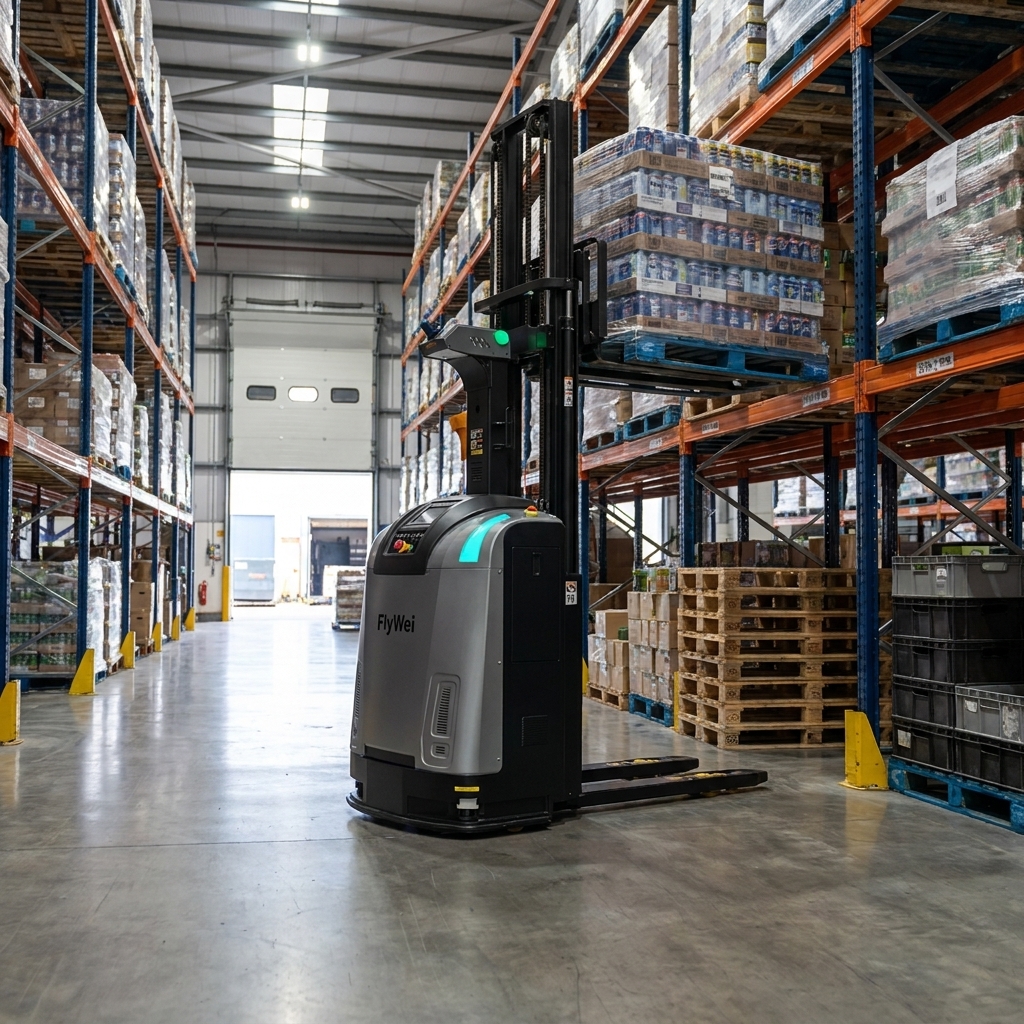
Warehouse robot leasing is a long-term operational-lease model in which a UK drinks distributor takes an autonomous forklift fleet on a fixed monthly OpEx charge — typically over three, five or seven years — instead of buying the machines outright. The scheme was extended to autonomous industrial trucks in 2026 to match the pay-per-use financing that already dominates diesel forklift hire. The Health and Safety Executive records more than 1,300 workplace transport injuries a year in Great Britain, and drinks-sector supply-chain directors tell industry surveys that a summer heatwave can push depot throughput 40% above the annual mean — yet the machines are idle three months later. That mismatch is the persona pain: a Supply Chain Director signs off Capex for a fleet sized to the peak, then defends the unit cost when the surge is over. Leasing rebases the conversation from ownership to utilisation, which is what the modern drinks depot actually pays for.
Why drinks distribution keeps overpaying for autonomous MHE
Drinks is a demand-shock business. The UK heatwave weeks of July and August can push a brewery depot to 140 to 150% of its annual mean pallets per shift, and the run into Christmas repeats the pattern on the spirits and premium wines side. Logistics UK reports the sector as one of the most seasonal in ambient distribution, second only to gifting and confectionery. Yet the traditional MHE procurement route is Capex — a five to seven-year straight-line depreciation with a fleet size defined by whichever week of the year hurts most.
Three forces make this worse in 2026. First, autonomous MHE is now a genuine like-for-like swap for driven counterbalance trucks under BS EN ISO 3691-4, so procurement can no longer hide behind the “we do not automate here” objection. Second, statutory inspection load is climbing: LOLER 1998 thorough examinations sit on top of PUWER 1998 maintenance regimes, and a fleet you own is a fleet you must inspect twelve months a year even in a quiet January. Third, the cost of not automating is now visible: HSE workplace-transport injury data shows the human forklift accident rate has stubbornly refused to fall through the last decade.
Meanwhile the drinks capex committee still runs a discounted-cashflow model that penalises equipment idle more than half of the year. A machine bought outright at around £96,000, sitting for twenty weeks a year, is a very visible line item in the year-end review. The internal argument for automation stalls not on merit but on utilisation risk — and that is precisely the argument a lease removes.
The four levers that turn drinks MHE into a variable cost
Every lever below is available today under a FlyWei operational lease. The warehouse robot leasing catalogue at FlyWei runs three, five and seven-year terms, all with full service, LOLER cover and tech-refresh options built in.
Lever 1 — Peak-flex leasing: size to average demand, rent the peak
The operational move is to break the fleet in two: a permanent core sized to Q1 or Q3 average pallets per shift, plus a short-term uplift that comes on-site for the four to twelve weeks of peak. Autonomous forklifts are ideal for this because a fleet manager onboards a new unit in under an hour — no driver hiring, no induction backlog, no PUWER re-authorisation. In practice a Burton-on-Trent depot handling 4,500 pallets a day at peak might carry ten permanent autonomous units and pull in three seasonal uplifts from June to September. The lease agreement makes those uplift units pay only for the weeks they are on-site — the accounting looks like temporary agency labour rather than a Capex spike, which is precisely what the drinks capex committee wants to see on the year-end reconciliation.
Lever 2 — Technology-refresh alignment (a technical lever)
The technical lever is the tech-refresh clause. A five-year lease can be written with a 30-month mid-term refresh option that swaps the LiDAR head, safety controller and onboard compute without breaking the contract. This matters because BS EN ISO 3691-4, VDA 5050 and the SICK nanoScan3 firmware baseline all move — a machine bought outright in 2024 does not automatically inherit those upgrades. FlyWei’s M4 fleet manager decouples the safety controller from the truck chassis so a refresh is a service visit, not a rebuild. RDS speaks VDA 5050 to any compatible AMR on the floor, so the lease covers your future integration as well as today’s fleet. This lever alone can add two to three years of useful economic life to a drinks fleet — and remove the “stranded asset” risk from the capex committee’s objection list.
Lever 3 — Compliance transfer under LOLER and PUWER (the regulatory lever)
Under a full-service lease the lessor takes and retains the LOLER 1998 thorough-examination duty and the PUWER 1998 maintenance regime, including HSE ACOP L117 for rider-operated lift trucks. For a UK drinks distributor with sites across Magna Park, DIRFT and SEGRO East Midlands Gateway, that compliance transfer is worth more than the cash saving — the Health & Safety Manager inherits a single evidence pack per depot instead of building one from scratch. If the fleet drops in size for winter, the compliance liability drops with it. This is not a small paperwork issue: HSE prosecutions for badly-maintained forklifts still average several a year against ambient distribution operators, and every one lands on the Supply Chain Director’s desk before the Health & Safety Manager’s. Warehouse robot leasing turns the LOLER file from a liability into a supplier deliverable.
Lever 4 — OpEx-first capital allocation (a financial lever)
The financial lever is the tax treatment. A lease payment is fully deductible against operating profit in the year incurred; a bought forklift is depreciated over five to seven years under the writing-down allowance regime administered by HMRC. For a drinks group deploying around £600,000 of autonomous MHE, the difference in year-one relief between an outright purchase and a five-year operating lease is material, and it is compounded by the release of working capital that would otherwise be locked up in an idle machine. Under IFRS 16 the right-of-use asset still appears on balance sheet, but the profile of the deduction is the point — a drinks SC Director trying to defend Capex to a Board that wants free cash for premium-brand acquisition wins that argument with an OpEx model, not a depreciation schedule.
| Lease term | Best fit for | Tech-refresh mid-term | Fleet-flex clause | £/robot/month indication |
|---|---|---|---|---|
| 3 years | New-to-automation drinks depots trialling an AMR and forklift blend | Not required | ±20% seasonal swing included | Higher rate — suits pilots |
| 5 years (pragmatic default) | Established drinks distributors with a defined peak versus core split | Optional at 30 months (LiDAR & safety controller) | ±30% seasonal swing included | Middle band — best £/pallet economics |
| 7 years | Owned-DC operators with 24/7 shift patterns and stable throughput | Included at 42 months (major) | ±15% seasonal swing included | Lowest £/robot/month — least flex |
In UK drinks logistics, moving to warehouse robot leasing rebases procurement from ownership to utilisation — you size the fleet to average demand and rent flex for the peak, rather than buying to the summer high and idling the surplus in winter.
How FlyWei supports UK drinks distribution
FlyWei designs and delivers autonomous forklift fleets on operational lease for drinks distributors from Burton-on-Trent through Magna Park and DIRFT to the SEGRO East Midlands Gateway cluster. A standard engagement starts with a 48-hour throughput read on the busiest flow in the DC — inbound tanker discharge, keg-line replenishment, or outbound loading of shrink-wrapped mixed pallets — followed by a lease sizing that separates core throughput from seasonal uplift so the capex committee sees a defensible variable-cost profile rather than a peak-fitted Capex request.
The fleet itself blends FlyWei autonomous counterbalance forklifts for pallet-in and pallet-out on the dock, autonomous reach trucks for high-bay bulk storage above 6 metres, and latent-jacking lifting robots for goods-to-person picking of variety cases. All of it runs on the M4 fleet manager, which orchestrates traffic across the site and speaks VDA 5050 to any AMR the drinks operator already owns. RDS handles the second-by-second decisions — which robot picks up which pallet, which route it takes, which charger it drops to when its state-of-charge crosses the threshold.
The commercial layer is the warehouse robot leasing agreement itself — three, five or seven-year terms, LOLER and PUWER cover retained by FlyWei, tech-refresh baked into the mid-term, and a peak-flex clause that lets the drinks operator draw up to 30% additional capacity for the six weeks of hardest peak without a new capex request or a driver-hiring campaign.
Frequently asked questions
What does warehouse robot leasing cover in a UK drinks distributor?
A full-service warehouse robot leasing contract from FlyWei covers the autonomous forklift or AMR hardware, the M4 fleet manager licence, the RDS orchestration layer, LOLER thorough examinations, PUWER maintenance, safety-controller firmware updates, and a peak-flex clause for seasonal uplift.
Is a five-year term always the right choice for drinks?
For most drinks distributors handling both a Q3 heatwave and a Q4 Christmas peak, a five-year term with a 30-month tech-refresh clause is the pragmatic default. Depots with steadier 24/7 throughput may take a seven-year term for lower £/robot/month; pilots and new-to-automation sites default to three years.
How does LOLER 1998 apply when the fleet is leased?
Under a full-service warehouse robot leasing contract, the LOLER 1998 thorough-examination duty for lifting operations sits with the lessor — FlyWei arranges the six or twelve-month examinations depending on use pattern, and hands over the certificates to the drinks operator’s Health & Safety Manager as compliance evidence.
Does IFRS 16 remove the OpEx benefit of a lease?
No. IFRS 16 requires the right-of-use asset and lease liability to appear on the drinks group’s balance sheet, but the profile of the deduction against operating profit — and the release of working capital versus outright purchase — remains meaningfully different from a Capex acquisition depreciated under HMRC writing-down allowances.
Can a leased autonomous forklift work alongside an existing driven fleet?
Yes. FlyWei’s M4 fleet manager and RDS dispatch layer are designed for brownfield drinks depots: they orchestrate an autonomous zone (typically bulk racking or dock loading) while pedestrian and driven-truck areas continue unchanged. The lease size can be increased as the automated zone expands.
What happens at the end of a five-year term?
The lease has three end-of-term options: return the fleet to FlyWei, roll into a follow-on lease with refreshed hardware, or take title of the machines at the residual value. Most drinks operators roll on because the M4 site model, orchestration rules and driver-supervisor training carry forward untouched.
If volatile summer peaks and a defensible Capex committee are on your Q3 risk register, a 48-hour feasibility read from FlyWei is the fastest way to compare buy versus lease against your actual pallet flow.
Get a 48-hour feasibility read on your highest-volume flow or explore the warehouse robot leasing catalogue — three, five and seven-year terms with LOLER cover, PUWER maintenance and tech-refresh built in.
UK-based engineers · no obligation · reply within one business day.