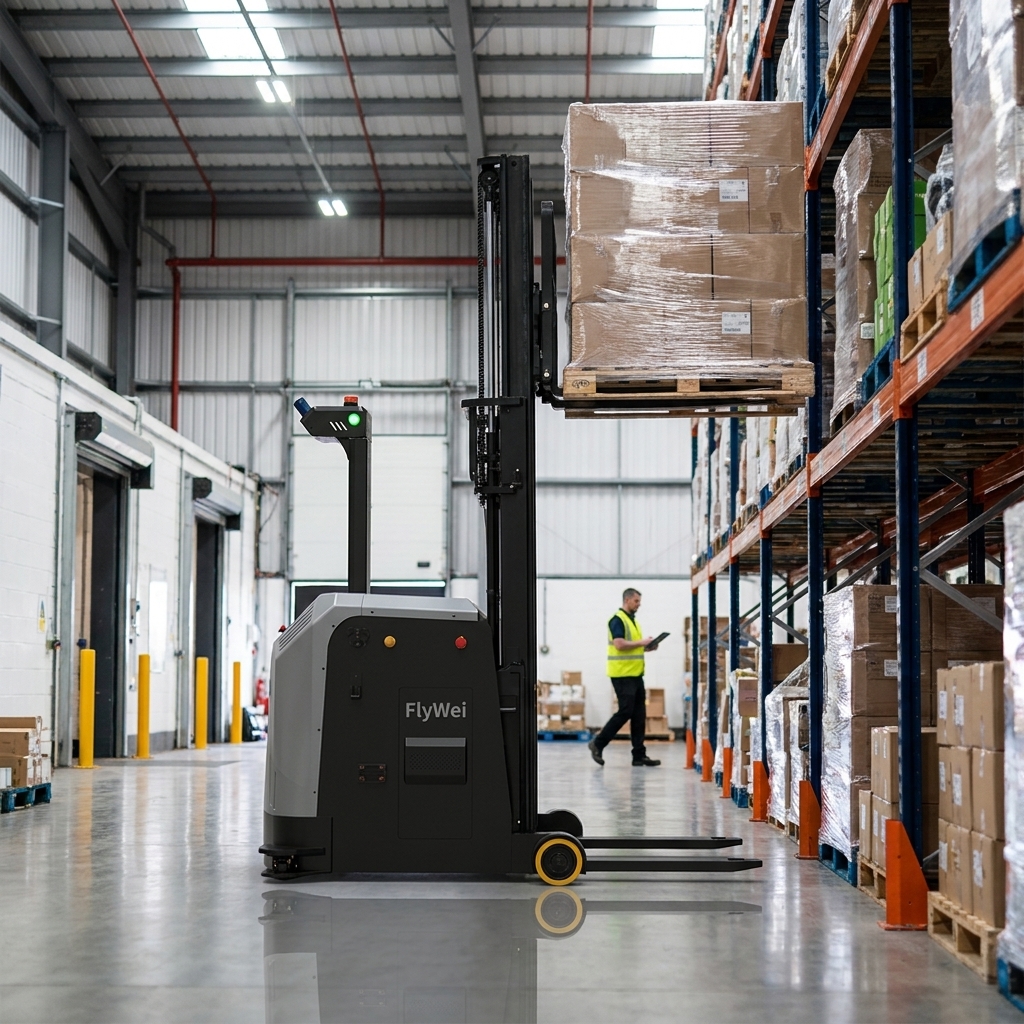
An AGV forklift price is the total cost of putting a driverless truck into productive service, not the list price of the machine on its own. The gap between those two numbers is where engineering capex goes wrong, and it is measurable: the Health and Safety Executive puts the cost of workplace injury in Great Britain at £6.5bn a year, about £10,000 for every injury case, in its 2023/24 cost to Britain model. For a procurement lead in heavy industrial parts, the pain this quarter is narrower than a safety statistic. Three quotes arrive for what reads like the same 2-tonne truck and they differ by six figures, because one carries navigation infrastructure, aisle remediation and a warehouse system interface while another prices the chassis and leaves the remainder as customer scope. The committee approves the cheapest number in Q4 and the overrun arrives in the next financial year.
An AGV forklift price is the total cost of putting a driverless truck into productive service — the machine, the navigation reference infrastructure, the safety validation and the interface to the existing warehouse system — not the list price of the chassis alone.
Why identical AGV forklift quotes arrive six figures apart
Automation quoting in UK heavy engineering has no agreed bill of quantities. A machined-casting distributor in Birmingham, a gearbox parts operation near Coventry and a steel stockholder in Sheffield each receive a document titled the same way and scoped quite differently. Nothing forces a supplier to state what is excluded, so exclusions migrate into footnotes.
Three UK-specific factors widen the spread. First, the building stock is old: much of the Midlands industrial estate predates the floor tolerances narrow-aisle automation assumes, so one supplier surveys the slab and prices remediation while another treats it as someone else's. Second, heavy parts are awkward rather than uniform — machined housings on stillages, bar stock and part-built sub-assemblies load differently from grocery pallets, and the truck class that handles them honestly costs more. Third, the case is safety-led. HSE treats workplace transport as a distinct risk area, and a site mixing pedestrians, manual counterbalance trucks and driverless trucks needs a validated segregation plan that costs real money to produce.
A commercial driver widens it further. Funding models are splitting, so two quotes can differ because one is a capital purchase and the other an operating cost spread across a term — two financial instruments, not two prices, as Logistics UK members increasingly find.
Lever 1 — Price the flow before you price the truck
The most effective way to control an AGV forklift price is to arrive with the flow already measured, because suppliers pad quotes in proportion to the ambiguity you hand them. Produce one page per candidate flow: moves per hour at average and peak, one-way travel distance, stillage weight and dimensions, pick and drop heights, how the load presents, and the hours the flow runs.
That page shifts the conversation from truck count to cycle time. If a goods-in to racking move takes six minutes round trip and you need eighteen an hour, the fleet-size arithmetic is yours to check, not the supplier's to assert. It also exposes flows that should not be automated at all. Our guide to autonomous forklift cost in the UK sets out the same inputs as a worksheet, and the ROI calculator turns them into a payback range you can defend line by line.
Lever 2 — Price the floor, the aisle and the charging plan
This is the lever that silently breaks budgets. A driverless truck is far less tolerant of a tired slab than a driver who compensates without noticing. Floor flatness and joint condition, assessed against the TR34 framework UK industrial floors are specified to, decide whether a reach or very narrow aisle truck can place a load at height repeatably. Racking entry tolerances, upright damage, aisle widths and dock kerbs feed the same question.
Charging is the other omission. Charging positions need power, floor space and a location clear of pedestrian routes, and the number follows duty cycle, not fleet size. Network coverage matters as much: dead spots behind racked steel are common, and retrofitting after commissioning is far dearer than surveying first. Insist every quote names the survey behind it; a price without one is an estimate wearing a quotation's clothing. Our notes on narrow-aisle automation cover what a competent survey reports.
Lever 3 — Price the integration seam to your warehouse system
Commissioning the vehicles is rarely the long pole. Mapping order and stock fields, agreeing how exceptions surface and testing against live data are. Treat the seam between the robots and your existing systems as its own priced work package with a named owner on each side.
The seam has three layers. Your enterprise WMS or ERP decides what work is needed and remains the record of stock. An orchestration layer such as FlyWei M4 turns each task into routes, traffic rules and vehicle assignments. The trucks report position, load and task status over VDA 5050, the open standard between a mobile robot fleet and a central fleet controller — which lets one controller command vehicles from different manufacturers without a bespoke interface for each. Dispatch logic sits in FlyWei RDS. Ask three questions of every quote: who builds each side of the interface, what happens to work in progress if the link drops, and whether a test environment exists. A supplier who cannot answer the second has not costed it.
Lever 4 — Price the safety case as a deliverable
A driverless forklift is mobile work equipment, and the regulatory position is not ambiguous. The Provision and Use of Work Equipment Regulations 1998 apply in full: regulation 4 on suitability, regulation 18 on control systems, and regulation 29 on remote-controlled self-propelled work equipment. HSE's PUWER guidance sets out the inspection, maintenance and training duties that follow. ISO 3691-4 covers driverless industrial trucks, and UKCA marking with a technical file is the UK conformity route.
None of that is free or optional. The deliverables are a risk assessment covering mixed pedestrian and vehicle traffic, a segregation and signage plan, witnessed safety function tests, the UKCA technical file, training with records, and an inspection regime. Each should be a visible quotation line with an owner and a date. Where it appears instead as "safety as required", you are carrying an unpriced liability into a capex paper, and the HSE injury cost above is its scale. BSI publishes the UK adoptions of the standards.
| Scope line | In a machine-only quote? | Who absorbs it if unpriced | Where it belongs in the capex paper |
|---|---|---|---|
| Truck, battery and chargers | Yes | Supplier | Capital — equipment |
| Navigation reference infrastructure | Sometimes | Site engineering | Capital — installation |
| Slab survey and floor remediation | Rarely | Site facilities | Capital — enabling works |
| Network coverage survey and fill | Rarely | Group IT | Capital — IT enabling |
| Fleet orchestration licence | Sometimes | Operating budget | Opex — recurring |
| WMS or ERP interface build and test | Rarely | Group IT and integrator | Capital — integration |
| Safety validation and UKCA file | Sometimes | Site SHE function | Capital — compliance |
| Operator and supervisor training | Sometimes | Site operations | Capital — commissioning |
| Year-one service and spares | Rarely | Maintenance budget | Opex — recurring |
What FlyWei does here
FlyWei is an independent, vendor-neutral UK systems integrator of autonomous forklifts and AMRs. Not tied to a single manufacturer, FlyWei selects the truck class that matches the flow rather than the one in a catalogue, and has no reason to recommend a bigger fleet than the cycle times support. For heavy industrial parts that means a mixed answer: counterbalanced FlyWei autonomous forklifts for stillage and drum work at goods-in, a narrow-aisle reach truck where racking runs high, and lifting AMRs for trolleys feeding the shop floor.
On pricing, FlyWei quotes the scope lines above as visible items. The survey comes first — slab, racking, aisle geometry, charging, network coverage — and the fleet-sizing arithmetic is handed over with the flow data behind it, so procurement can audit the assumption, not accept a number. FlyWei M4 handles orchestration and traffic management across mixed-manufacturer fleets over VDA 5050, FlyWei RDS handles dispatch, and the interface to the operator's existing ERP and WMS is its own work package. Safety validation, the UKCA file and training are dated items, not assurances. Where capital is the obstacle rather than the engineering, FlyWei can present the same build as an AGV forklift price converted into a monthly leasing figure over three, five or seven years. See also manufacturing operations and a UK assembly deployment.
Frequently asked questions
What is an AGV forklift price in the UK?
It is the total cost of putting a driverless truck into service: the machine, navigation infrastructure, any floor or racking remediation, the warehouse system interface, safety validation and training. A machine-only figure is one component, not the cost.
Why do AGV forklift quotes differ so much for the same truck?
There is no standard bill of quantities, so exclusions vary — commonly slab and racking remediation, network coverage, the warehouse system interface and safety validation. Financial structure differs too: a capital purchase and a lease give different headline numbers for identical engineering.
Do PUWER and other regulations apply to driverless forklifts?
Yes, in full. A driverless forklift is mobile work equipment under PUWER 1998: regulation 4 on suitability, regulation 18 on control systems and regulation 29 on remote-controlled self-propelled equipment. ISO 3691-4 covers vehicle safety functions; UKCA marking with a technical file is the UK route.
Does our floor need work before autonomous forklifts will run?
Often yes, and it is the most frequently unpriced item. Driverless trucks are less tolerant of slab defects and joint damage than a driver who compensates automatically. Floor flatness against TR34, racking entry tolerances and upright damage decide whether loads can be placed at height.
Do we have to replace our WMS to run autonomous forklifts?
Usually not. An orchestration layer sits above your warehouse system and takes work from it, so that system stays the source of truth for stock and orders. Replacement is only worth considering where it cannot expose work through an interface or export.
How long does payback take on an autonomous forklift fleet?
It depends almost entirely on how many hours the flow runs. A two or three-shift repetitive move pays back far faster than a single-shift irregular one, because the truck earns through utilisation, not purchase price. Model it from your own measured moves per hour.
Should we buy or lease autonomous forklifts?
Lease where capital availability rather than the engineering case is the constraint, where the cost should sit in operating budget, or where the flow may change within the term. Buy where the flow is stable, and compare both on total cost across the same term.
If an AGV forklift price that will not survive your Q4 capex committee is on your risk register, the fastest fix is to replace the estimate with measured numbers.
Request a fleet-sizing and ROI estimate for your DC and FlyWei will size the fleet from your own move profile and quote every scope line. If capital is the obstacle, the same build works as autonomous forklift leasing over three, five or seven years.
UK-based engineers, no obligation, and a reply within one business day.