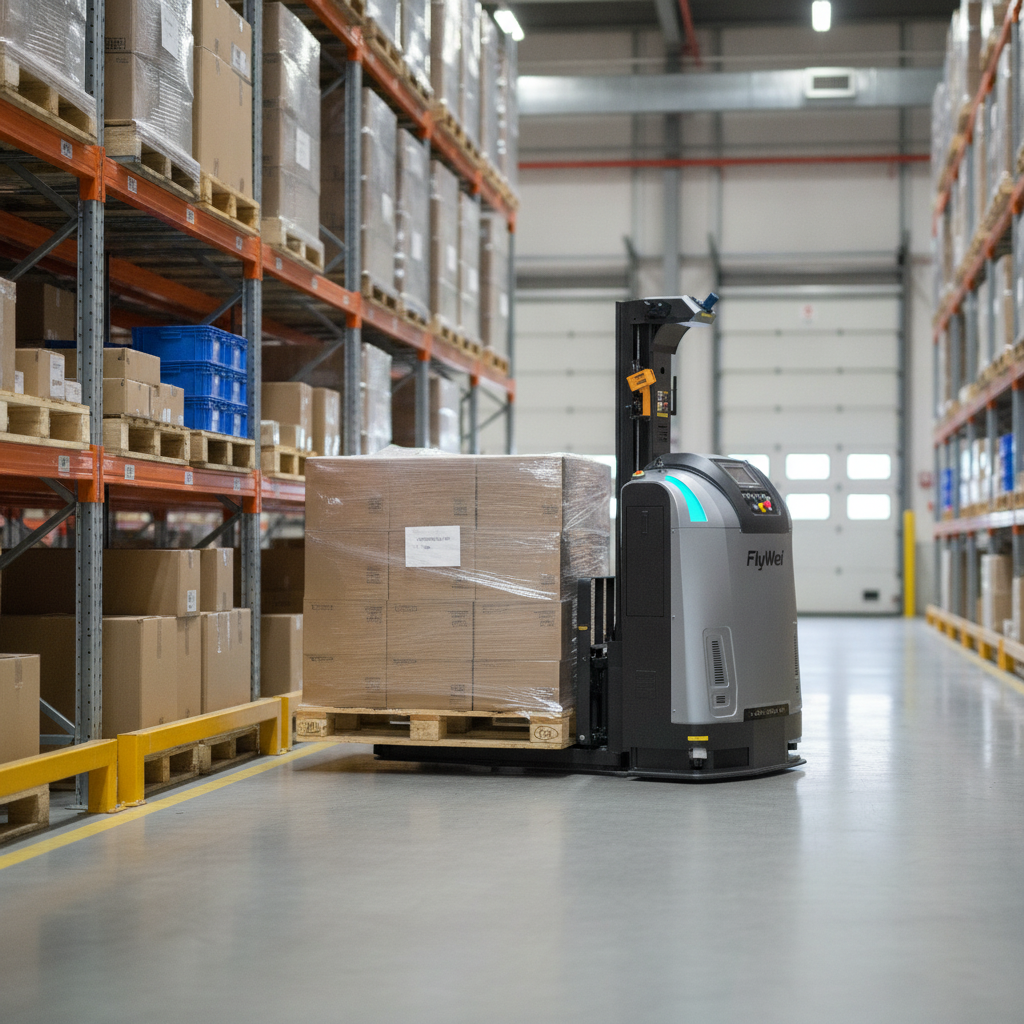
This is an illustrative, representative scenario based on FlyWei Robotics' engineering experience with UK general manufacturing and assembly plants. It is not a named client reference; the operator profile and every figure below is a typical capability range rather than a single project result.
General manufacturing and assembly sites in the United Kingdom — from metal-fabrication cells and plastics moulding through electromechanical sub-assembly to small-appliance build — share a common intralogistics rhythm. Raw materials arrive on pallets, get broken down into kits, feed multiple assembly cells running on different takt times, and finished goods flow back to a packing and dispatch area on a schedule that rarely matches the inbound cadence. Manual pallet trucks and counterbalance drivers spend most of a shift moving air, waiting on cell operators, or repositioning empties. A vendor-neutral autonomous forklift and AMR deployment is aimed squarely at that waste.
Operation profile (illustrative)
- Operator persona: a privately-held UK general manufacturing and assembly business operating a single site.
- Scale band: approximately 8,000-18,000 m² of combined production and warehouse floor, with three to six assembly lines or cells.
- Shift pattern: typically two- or three-shift working, five to six days a week, with periodic weekend catch-up during build-out weeks.
- Throughput band: in the region of 60-180 pallet moves per shift, plus 200-600 tote or kit deliveries to line.
- Existing stack: a mixed manual forklift fleet, a WMS in use for finished goods, and usually an MES or ERP driving production orders.
At-a-glance application snapshot
The indicative capability ranges we would typically size around for a UK general manufacturing site — drawn from vendor-neutral autonomous forklift and AMR platforms:
- Payloads: autonomous pallet trucks in the 1.4-3 tonne band; lifting AMRs for totes, sub-assemblies and small kits typically in the 150-1,000 kg band.
- Lift heights: in the region of 1.6 m for basic pallet transport, rising to around 6 m for narrow-aisle stacker duty.
- Travel speeds: typically 1.2-2 m/s in mixed-traffic corridors, tuned down in busy assembly zones and pedestrian areas.
- Runtime: autonomous forklifts can generally run a full shift with opportunity charging at natural production pauses.
- Aisle configurations: options span wide-aisle counterbalance down to very narrow aisle stacker setups where floor area is scarce.
The challenge
The recurring pains we see in a UK general manufacturing and assembly plant are:
- Line-side starvation and pile-up. When a manual driver is diverted, a cell either runs dry or gets flooded with a full pallet it cannot consume before the next changeover.
- Empties, dunnage and returns. Empty totes, cages and pallets accumulate at cell edges, block aisles and eat operator time.
- Peak and model-change waves. Build-out weeks, new-product introductions and quarter-end pushes can double the internal-transport load almost overnight.
- Mixed-load complexity. A single flow may combine sheet metal, sub-assembled housings, small-parts totes and finished goods, each with different handling rules.
- Safety around people. Assembly plants have unpredictable pedestrian movement, mezzanine steps, forklift crossings and manual carts all sharing the same footprint.
- Data silos. The WMS, MES and shop-floor Andon systems often do not share a single view of where a kit or pallet actually is at any given moment.
The solution: a vendor-neutral, multi-manufacturer design
FlyWei is an independent UK systems integrator of autonomous forklifts and AMRs. That means we do not lock a general manufacturing site into a single robot brand or ecosystem. Instead, we match the best class of driverless forklift or lifting robot to each flow, then orchestrate them together as one fleet. A typical assembly-plant blueprint looks like this:
- Inbound and finished-goods pallet moves — autonomous counterbalance forklifts and pallet-truck AGVs, sized to the heaviest pallet actually on site.
- Racked put-away and picking — autonomous pallet stackers or reach trucks, with narrow-aisle configurations where floor area is the constraint.
- Line-side kit and tote delivery — lower-payload lifting AMRs and jacking robots that slot under carts, dollies or tugger trains.
- Empties and dunnage return — the same AMR fleet closes the loop on the return journey, so no move is wasted.
- Orchestration layer — a vendor-neutral fleet-management and safety-controller stack (VDA 5050-capable) so robots from different manufacturers cooperate cleanly at intersections, charging stations and drop points.
- Integration — clean interfaces into the incumbent WMS and MES/ERP so production orders trigger the right move at the right minute, without duplicate data entry.
The point of the independent-integrator model is honesty about trade-offs. The right platform for a 3-tonne finished-goods aisle is rarely the right platform for a 400 kg kit-cart into an assembly cell. Buying one manufacturer's full catalogue forces compromises; matching platforms across manufacturers usually does not, and a modern orchestration layer means the mixed fleet still behaves as one system on the shop floor.
How a deployment typically runs
- Free site survey. Our engineers usually start a general manufacturing project by walking the floor, mapping current flows, measuring aisles, noting charging locations and photographing pinch points.
- Simulation and sizing. We model the mix of pallet, cage and tote moves against production takt to estimate fleet size, robot classes and charging strategy before any hardware is quoted.
- Controlled pilot. Typically one or two robots on the highest-friction loop — often line-side feed or the finished-goods aisle — with full safety and integration in place from day one.
- Phased rollout. Additional robot classes are added flow by flow, so operators, health-and-safety and IT are never overwhelmed with change all at once.
- Live operations and scale. Ongoing tuning of routes, priorities and shift patterns; the fleet grows with build-out weeks, new lines and NPI programmes.
Typical results (qualitative + ranges)
- Line-side starvation events generally fall as delivery cadence becomes deterministic rather than driver-availability driven.
- Manual driver hours are typically redeployed to higher-value tasks — quality checks, changeovers, kitting and problem-solving — rather than simply removed.
- Night-shift and lights-out finished-goods movement becomes feasible, spreading load away from the day peak.
- Pedestrian-forklift near-miss reports tend to reduce, because robot paths are fixed, audited and speed-limited by design.
- WMS and MES data quality improves: every move is timestamped and location-verified without a manual scan.
- Intralogistics capacity typically scales through build-out weeks without adding headcount for the peak.
What to consider for your site
- Which flow bleeds the most driver-hours today — inbound, line-feed, empties return, or finished-goods?
- What is the heaviest and tallest pallet a robot must actually handle in the next three years?
- Is the WMS or MES ready to publish move requests, or does that interface need to be built as part of the project?
- Where are the safe charging locations, and how does that shape the fleet split between forklift and AMR classes?
- Is capex the right vehicle, or does a full-service leasing model better fit your capital plan and NPI cycle?
Talk to an independent integrator
FlyWei is vendor-neutral by design: we specify, integrate and support autonomous forklifts and AMRs from multiple manufacturers across UK general manufacturing and assembly plants. If you would like a free, no-obligation site survey and a simulation of your line-side and finished-goods flow, our engineers will visit and give you a straight answer — including whether automation is the right call at all for your operation right now. For background, explore our autonomous forklifts, lifting robots, controllers, sector solutions and flexible leasing options.