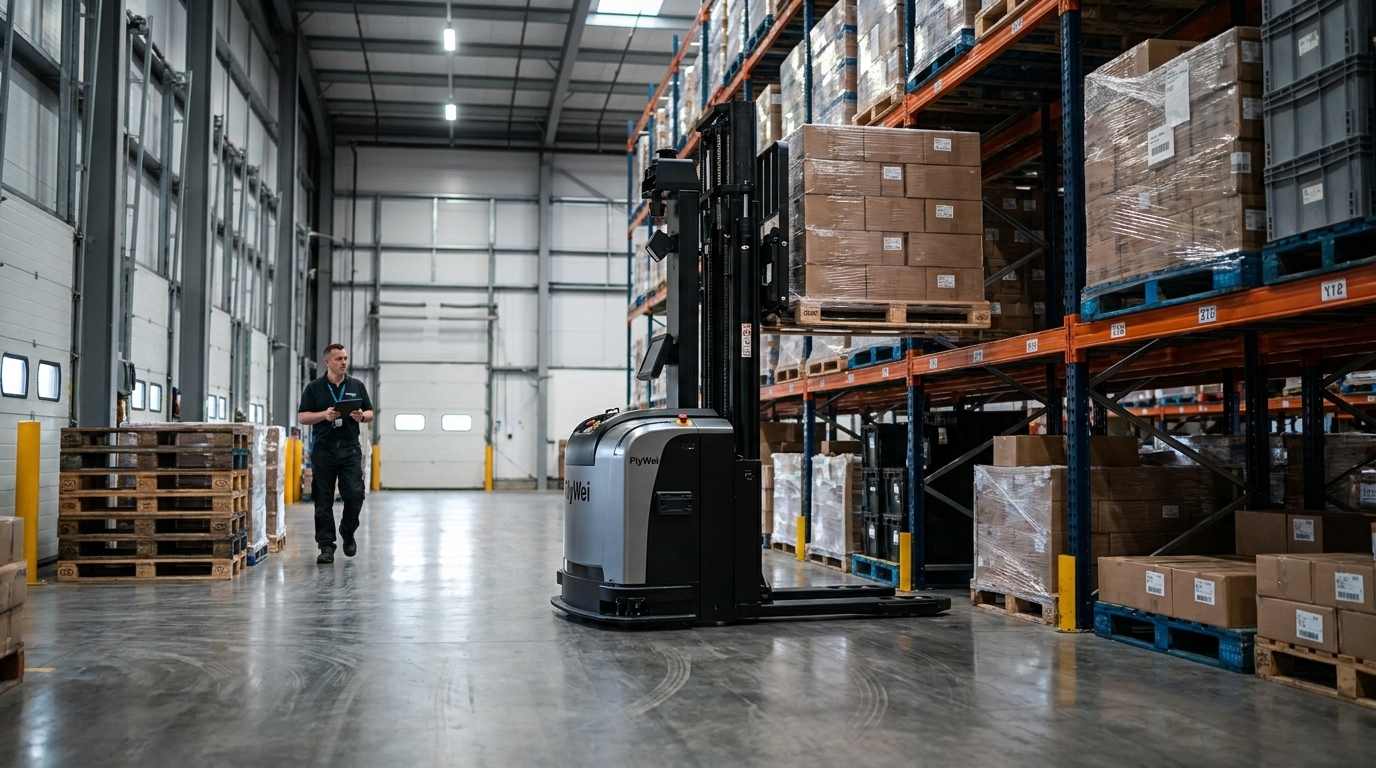
AGV forklift price in the UK is a lifecycle figure, not a sticker price, because the truck is only one line in the total. Every driverless forklift working on a UK site is work equipment under the Provisions and Use of Work Equipment Regulations 1998, published in full by legislation.gov.uk, so validation and planned inspection carry cost no truck quotation shows. For a retail DC procurement lead, that gap is a live problem in Q3. The capex committee wants a single defensible figure; the operation needs pallet moves per hour, headroom for peak weeks and a support route that will not strand a chilled aisle in December. Quotations arrive in incompatible shapes — some carrying commissioning, mapping and safety scanning, others quietly excluding all three — so like-for-like comparison is impossible before normalisation. The paper going to the board therefore has to answer questions a spec sheet never covers.
Why an AGV forklift price refuses to sit still
Retail distribution has an awkward shape for automation costing. A grocery and multi-channel DC around Daventry or on the Magna Park estate runs a stable ambient core, a chilled envelope with its own rules, and a peak that reshapes outbound volume for weeks. Any figure quoted against average throughput is wrong by design, because the fleet must be sized for the shape of the week, not the mean of the year.
The second cause is scope drift. One quotation prices trucks plus commissioning; another treats marker installation, floor survey and network coverage as the customer's responsibility. Both are honest documents. Neither is comparable until rebuilt against the same scope, and procurement teams routinely find the difference at contract stage, when the negotiating position has gone.
Third, compliance sits outside most machine quotations entirely. The Health and Safety Executive treats workplace transport as a persistent cause of serious injury, and its workplace transport guidance applies to automated trucks exactly as it does to manned ones. Pedestrian segregation, revised traffic routes and updated safe systems of work are real spend. So is the floor: long autonomous travel paths expose flatness defects a driver would simply steer around.
Finally, integration cost is a function of your systems, not the robot's. Where the existing warehouse system already exposes open work through a documented interface, the fleet layer connects quickly. Where it cannot, middleware and exception handling absorb weeks — variance invisible on a price list and dominant in the final figure.
An AGV forklift price in the UK is a lifecycle figure rather than a sticker price, because the truck is only one line alongside navigation infrastructure, integration, safety validation and support.
Lever one: normalise every quotation to cost per pallet move
This is the operational lever, and the one that makes a capex paper defensible. Take your own data — pallet moves by hour, by zone, across an ordinary week and a peak week — and ask every supplier to price against that profile rather than a demonstration cycle. Specify the awkward parts: the chilled interface, the double-deep locations, the afternoon dock congestion, the pallets that arrive out of specification.
Then convert each quotation into cost per pallet move across the intended term. That single denominator absorbs fleet size, charging strategy, availability assumptions and shift pattern, and it lets you compare a smaller fleet running hard against a larger fleet running gently. It also exposes the assumption most likely to be optimistic, which is machine availability during peak. Ask each supplier to state availability as a contractual figure and to describe what happens to your throughput on the day one truck is out of service. A cost per move that only holds at full fleet health is not a number the board should sign.
Lever two: separate the fleet layer from the trucks
This is the technical lever, and it is where long-term cost is decided. Autonomous trucks do not connect to a warehouse system directly. A fleet management layer sits between them, converting work into routes, traffic rules and vehicle assignments, then writing completions back so your existing system remains the record of stock. If that layer is welded to one manufacturer's hardware, every future truck purchase is pre-decided and your price exposure over a seven-year horizon is entirely in someone else's control.
Insist the orchestration layer speaks the VDA 5050 open standard natively rather than through an adapter, so vehicles from different manufacturers can be commanded through one interface. Ask what the fleet manager does when the link to your warehouse system drops: a sound design finishes the issued task, holds safely, queues completions and replays them on reconnection without duplicating stock movements. Price integration as its own line — interface scope, who builds each side, test environment, support — rather than accepting it bundled. M4 fleet management and RDS robot dispatch exist so this layer stays independent of the chassis underneath it.
Lever three: price the compliance workstream as a visible line
This is the regulatory lever. An automated truck is work equipment, so the duties in PUWER apply in full: suitable selection for the place and conditions of use, protection against specified hazards, and inspection at appropriate intervals by a competent person. Where the machine lifts loads, the Lifting Operations and Lifting Equipment Regulations 1998, also on legislation.gov.uk, bring thorough examination on a defined cycle.
On top of that sits ISO 3691-4, the international standard covering driverless industrial trucks and their systems, which shapes safety scanner configuration, detection fields, speed control and the design of the operating zone. UKCA marking, the risk assessment behind it, and the technical file all need an owner. Floor flatness to the relevant TR34 classification is a genuine capital item in older buildings, and one that is far cheaper to survey during evaluation than to remediate after go-live. Publications from BSI and sector guidance from Logistics UK are useful reference points when you write these duties into the specification. Give each item an owner, a cost and a date in the tender document; unowned compliance work becomes a variation order later.
Lever four: choose the funding shape before you choose the fleet
This is the commercial lever, and for a capex committee it often matters more than machine selection. Outright purchase suits a stable, long-lived flow in a building you control. Where the contract, site or volume profile is less certain — which describes many retail DC operations — matching payment shape to operational commitment protects the case.
| Cost line | In a truck quotation? | Where it lands | Demand in writing |
|---|---|---|---|
| Site survey and floor flatness | Rarely | Customer capital works | Survey before contract, TR34 class stated |
| Navigation infrastructure and mapping | Sometimes | Project cost, often a variation | Named as included or excluded, with quantities |
| Integration to your warehouse system | Rarely | Separate integration budget | Interface scope, ownership, test environment |
| Safety validation and UKCA file | Partially | Shared, frequently disputed | Named competent person and deliverable list |
| PUWER inspection and LOLER examination | No | Recurring operating cost | Frequency, cost and owner for the full term |
| Response time and spares availability | Varies widely | Support agreement | Contractual response, escalation, UK parts holding |
| Peak-week capacity headroom | No | Fleet sizing decision | Availability figure and effect of one truck down |
Three-, five- and seven-year terms let the committee compare a capital case against an operating case on identical throughput assumptions, with maintenance and inspection obligations named rather than assumed. That is the practical value of agv forklift leasing in the UK: not a lower headline figure, but a fully scoped one. The chilled variant sits in our note on AGV forklift price in cold storage, and the contracting angle in forklift leasing for 3PL procurement.
What FlyWei does here
FlyWei is an independent, vendor-neutral UK systems integrator of autonomous forklifts and AMRs. We are not an OEM, which is exactly why we can build a price comparison that survives a capex committee: we integrate the best machine for the flow across multiple manufacturers rather than defending one product line.
For a retail DC, that starts with a survey of your real move profile rather than a demonstration. We size the fleet against your peak week, not your average day, and say plainly where a FlyWei autonomous forklift is the wrong answer — congested short shuttles often suit a latent-jacking AMR, and some flows should stay manual until the floor is addressed.
M4 holds the traffic rules, charging strategy and vehicle assignment for the whole fleet, and speaks VDA 5050 so a second manufacturer's truck can join later without a new integration. RDS dispatches against the work your existing systems already produce, so the warehouse system stays the record of stock. The compliance workstream — PUWER inspection regime, LOLER cycle, ISO 3691-4 conformity, UKCA file — is scoped and costed in the proposal rather than discovered afterwards. Fleets around DIRFT and SEGRO East Midlands Gateway are supported by UK-based engineers, with response times written into the agreement rather than described in a brochure. Where funding shape matters more than the capital figure, we model purchase and lease side by side. Broader sector context sits under FlyWei solutions.
Frequently asked questions
What determines an AGV forklift price in the UK?
Four things beyond the truck: fleet size driven by your peak profile, navigation and site infrastructure, integration to the warehouse system you run, and the compliance workstream. Identical machines price differently because these are scoped differently.
Is leasing or buying better for a retail DC?
It depends how certain the flow is. Purchase suits a stable operation in a building you control. Where contract length, network strategy or volume could change, matching payment shape to operational commitment protects the case.
Do we need to replace our warehouse management system?
Usually not. An orchestration layer sits above your existing system and takes work from it, so that system stays the source of truth for stock and orders. Replacement matters only where it cannot expose work at all.
What safety regulations apply to a driverless forklift?
PUWER governs selection, protection against hazards and inspection by a competent person. LOLER adds thorough examination where equipment lifts loads. ISO 3691-4 shapes scanner configuration, detection fields and operating-zone design, and HSE workplace transport guidance applies as it does to manned trucks.
How long does an automated forklift deployment take?
Data access drives the timeline more than the machines. Commissioning is rarely the long pole; mapping order and stock fields, agreeing exception handling and testing against live data are.
Can we mix trucks from different manufacturers in one fleet?
Yes, where they support a common interface. The VDA 5050 open standard lets one fleet manager issue orders to vehicles from different suppliers in the same message format. This is your main protection against future price exposure.
What should we ask a supplier before signing?
Ask for cost per pallet move at your own profile, a contractual availability figure, an include-or-exclude list for survey, mapping and integration, the named competent person for PUWER and LOLER duties, and UK response times.
If an unscoped AGV forklift price is sitting on your Q3 capex risk register, the fastest way to close it is to price the whole workstream, not the trucks.
Request a fleet-sizing and ROI estimate for your DC and we will model purchase against agv forklift leasing on your own throughput profile, with survey, integration and compliance costed as visible lines.
UK-based engineers. No obligation. We reply within one business day.