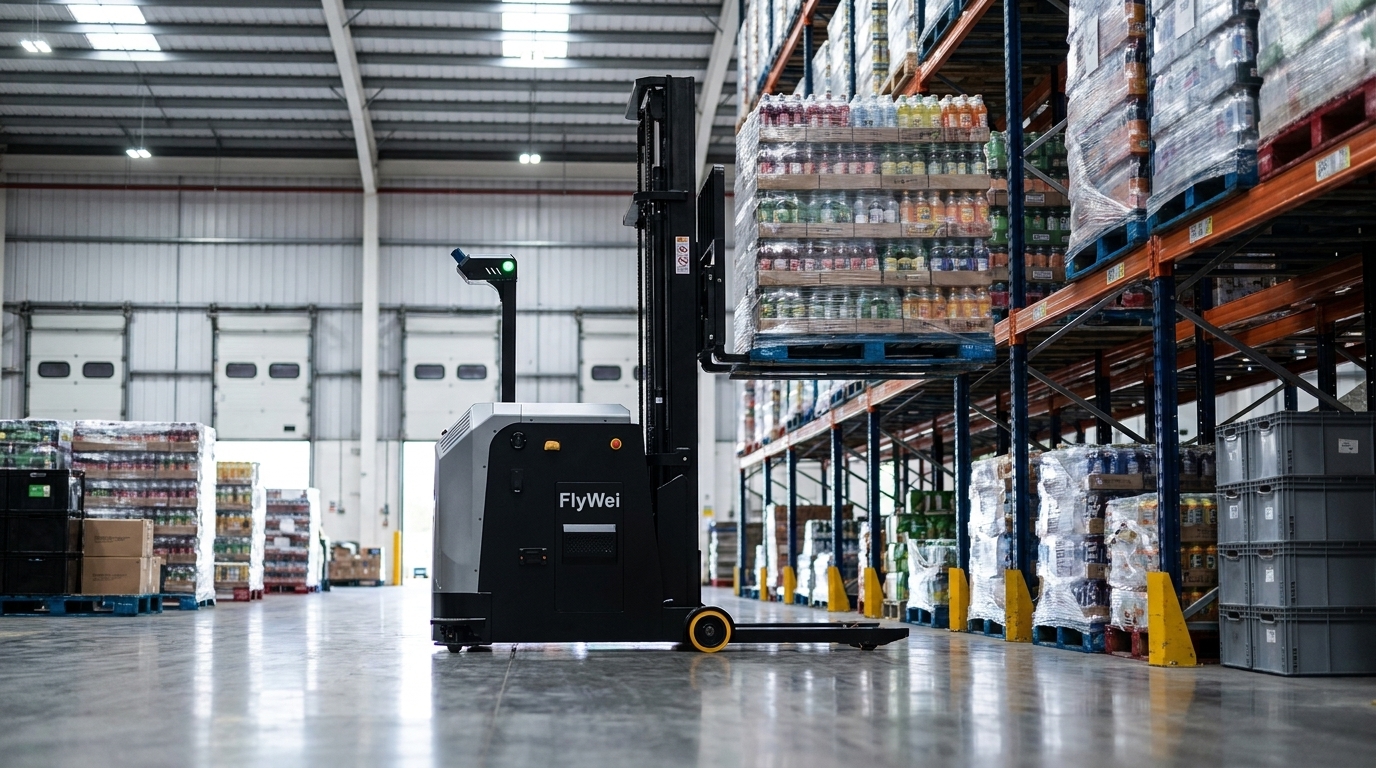
An AGV forklift is a driverless lift truck that moves palletised loads under software control, with no operator on board. In Great Britain the machine sits under the Provision and Use of Work Equipment Regulations 1998, while its autonomous behaviour is governed by BS EN ISO 3691-4, the standard for driverless industrial trucks. For an Operations Director in drinks logistics the pressure is seasonal and unforgiving. Peak volume arrives in a fortnight, not a quarter. Mixed pallets of cans, glass and kegs bank up on the marshalling floor, agency cover thins out exactly when trailer turnaround matters most, and the same three dock-to-block-stack moves absorb a disproportionate share of your counterbalance hours. Those moves are repeatable, high-volume and low-judgement work: precisely the profile a driverless truck was built for, and precisely what your most experienced operators should not be spending peak week doing.
Why drinks distribution centres lose pallet moves at peak
Drinks logistics has a load profile that punishes manual handling harder than most sectors. Palletised beverage is dense, heavy and frequently unstable: shrink-wrapped glass, canned multipacks and kegs each behave differently on the forks, and a single dropped pallet costs you the stock, the clean-up and the lane for twenty minutes. Volume is also brutally seasonal. A site that runs comfortably in February can be asked to absorb a step change in outbound pallets across a warm fortnight, and the usual answer — more agency drivers on more counterbalance trucks — arrives slowly and leaves quickly.
The second factor is UK-specific and structural. Skilled counterbalance operators are a scarce, mobile labour pool concentrated around the big distribution corridors: Burton-on-Trent, Magna Park, DIRFT, Daventry and SEGRO East Midlands Gateway. When three neighbouring sites all peak in the same week, they compete for the same operators, and the winner is whoever pays most that month. That is a cost line you cannot forecast and a capability you do not own.
The third is safety exposure that scales with congestion. The Health and Safety Executive's workplace transport guidance is clear that vehicle and pedestrian movement in shared space is a principal source of serious injury in warehousing, and peak is when marshalling lanes are fullest and agency familiarity is lowest. Add block-stacked beverage built and broken down at height, and the risk register writes itself. Industry reporting from Logistics UK has tracked the same twin pressure on labour availability and operating cost for several years running.
Lever one — put the AGV forklift on the repeatable lane, not the interesting one
The single most common deployment error is asking a driverless forklift to do the job your most capable operator does: mixed exception work, damaged pallets, awkward trailer loads. That is the wrong end of the problem. Start by counting moves rather than trucks. Pull a fortnight of movement data from your warehouse system and rank origin-destination pairs by frequency. In most drinks DCs, two or three lanes — decant bay to block stack, block stack to pick face, empties and dunnage back to the yard door — account for a large share of all counterbalance hours, and almost none of them require judgement.
Automate those first. The gain is not that the robot is faster than a person; a good operator is quick. It is that the lane runs at a constant rate across all three shifts and does not disappear when a neighbouring site offers a better rate. It also releases your experienced people onto the exception work where their judgement pays, which is where damage and mis-ship costs concentrate.
Lever two — orchestrate the fleet, do not create islands
A driverless forklift on its own is a machine. A fleet that shares traffic rules, charging strategy and task priority with the rest of your operation is an asset. The technical lever is the orchestration layer that sits between your warehouse system and the vehicles: it takes work from the systems you already run, converts each task into routes, right-of-way rules and vehicle assignments, then writes completions back so your existing system remains the record of stock.
Insist on the open standard. VDA 5050 defines how a fleet manager issues orders to mobile robots and how vehicles report state in return, which means one control layer can command machines from more than one manufacturer without a bespoke interface for each. For an Operations Director this is a commercial point as much as a technical one: it is what stops your second phase being dictated by whoever supplied your first. Ask any supplier whether their fleet layer speaks the standard natively or through an adapter, how long it keeps running if the link to your warehouse system drops, and how duplicate task confirmations are prevented on reconnection.
Lever three — treat PUWER, ISO 3691-4 and the floor as design inputs
Regulatory work done late is the most expensive kind. Under PUWER, an automated lift truck is work equipment like any other: suitable for its purpose, maintained, inspected, and used only by people who have been properly instructed — including the supervisors who will interact with it. Lifting accessories bring LOLER 1998 duties with them. BS EN ISO 3691-4 sets the safety expectations specific to driverless industrial trucks and their systems, and standards published through BSI are the reference your insurer and your auditors will reach for.
Then there is the surface. Autonomous trucks are less tolerant of floor defects than a human who instinctively slows for a bad joint, and high-bay work amplifies small errors in flatness. Commission a TR34 floor survey before you commit to mast heights, not after, and budget for remedial grinding as a line item rather than a surprise. The same applies to lighting, racking condition and the pedestrian segregation plan — all of which are cheaper to fix on a drawing than during peak week.
Lever four — prove it on one lane, before peak, on your own numbers
Capital committees are rightly sceptical of modelled savings. The counter is a narrow, measurable trial: one lane, one shift pattern, an agreed baseline captured before anything changes. Measure pallet moves per hour, dwell time at the dock, damage incidents per thousand pallets and the percentage of shifts requiring agency cover. Run it long enough to include a bad day — a trailer late, a lane blocked, a pallet built badly — because the exception behaviour is what tells you whether the system will hold at peak.
Time it deliberately. Standing a lane up in the quiet quarter gives you a clean baseline and a settled system before volume arrives; attempting it three weeks out from peak gives you neither. If capital timing is the obstacle rather than the business case, structure it as an operating cost instead of a capital one, so the trial does not have to win a place in the capex round before it has produced any evidence.
| Lever | What changes on the floor | Effort to stand up | Measure in week one | Where the benefit lands |
|---|---|---|---|---|
| Repeatable lane first | Fixed origin-destination pairs run at a constant rate, all shifts | Low | Pallet moves per hour | Agency hours |
| Fleet orchestration | Traffic, charging and task priority managed centrally | Medium | Completions written back unaided | Throughput stability |
| Compliance by design | PUWER regime and segregation plan agreed before install | Medium, front-loaded | Open risk-assessment actions | Insurance and audit position |
| Floor and infrastructure | TR34 flatness verified for the aisles and heights planned | Variable | Manual interventions per shift | Availability at height |
An AGV forklift is a driverless lift truck that moves palletised loads under software control, regulated in Great Britain under PUWER 1998 and BS EN ISO 3691-4 for driverless industrial trucks.
What FlyWei does here
FlyWei is an independent, vendor-neutral UK systems integrator. We are not tied to a single manufacturer, which matters in drinks logistics because no one builder makes the best machine for every move in your building. FlyWei designs the flow first, then selects the right vehicle class for each lane and integrates the fleet as one system.
In a beverage DC that usually means a mix. FlyWei AGV forklift fleets cover the heavy work: counterbalanced autonomous forklifts for two-tonne palletised loads on dock-to-block-stack lanes, autonomous pallet trucks for low-profile dock-to-stock moves, and narrow-aisle reach and stacker classes where racked beverage goes up rather than out. Where cased goods, trolleys or dunnage need shuttling rather than lifting, FlyWei lifting robots handle it without occupying a forklift.
The M4 fleet manager is the orchestration layer: it takes work from the systems you already run, applies traffic and charging rules across the whole fleet, and reports state back so your existing warehouse system stays the source of truth for stock. RDS robot dispatch reallocates tasks when priorities shift mid-shift, which in peak week is most shifts. FlyWei engineers carry out the site survey, the PUWER and ISO 3691-4 assessment, the segregation design and the commissioning, then support the fleet afterwards. Where capital timing is the constraint rather than the business case, FlyWei offers leasing across three, five and seven-year terms. Sector approaches are set out across our solutions pages.
Frequently asked questions
What is an AGV forklift?
An AGV forklift is a driverless lift truck that moves palletised loads under software control, with no operator on board. Driverless forklift, automated forklift and automated guided forklift all describe the same class of machine.
How is an AGV forklift different from an autonomous mobile robot?
An AGV forklift lifts palletised loads on forks, often to height. An autonomous mobile robot moves loads at floor level, under a cart or on a jacking platform. Most drinks sites end up running both.
Do we need to replace our warehouse system to run driverless forklifts?
Usually not. An orchestration layer sits above your existing system, takes work from it and writes confirmations back, so that system stays the record of stock. Replacement is rarely the cheaper route.
What are the regulatory duties for an automated forklift in the UK?
It is work equipment under PUWER 1998: suitable, maintained, inspected, and used by instructed people including supervisors. BS EN ISO 3691-4 covers driverless industrial trucks; lifting accessories bring LOLER 1998 duties.
Does our floor need work before an AGV forklift fleet can run?
Often, and it is cheaper to know early. Autonomous trucks tolerate joint defects less well than a human who instinctively slows, and tolerance tightens with mast height. Survey to TR34 before choosing vehicle class.
How long does it take to stand up a first automated lane?
The vehicles are rarely the long pole; data access, exception handling and floor remediation are. Plan the first lane for a quiet period so you have a clean baseline before peak volume arrives.
Can we run robots from more than one manufacturer in the same building?
Yes, where they support a common interface. VDA 5050 lets one fleet manager command vehicles from different suppliers. Traffic rules still need setting centrally, but a separate integration per manufacturer is not required.
If peak-season pallet throughput and agency cover are on your Q3 risk register, the fastest way to know whether a driverless lane would hold is to have someone walk the marshalling floor with you.
Book a free 30-minute site survey with FlyWei, or see the vehicle classes and duty cycles on our autonomous forklifts page.
UK-based engineers. No obligation. We reply within one business day.