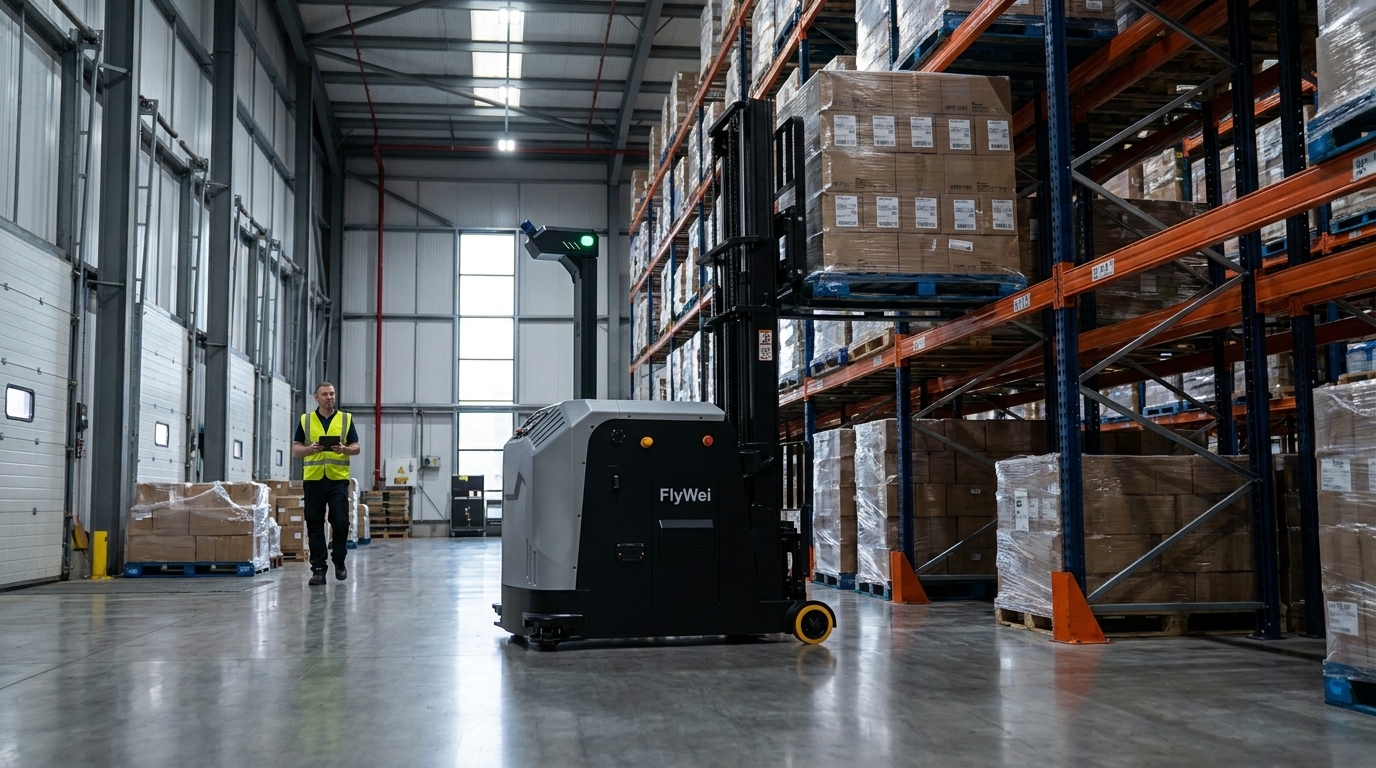
An AGV forklift is a driverless industrial truck that moves palletised loads along fixed, software-controlled routes without an operator on board. The stakes are not abstract: HSE recorded 24 workers killed by moving vehicles in 2025/26, out of 126 work-related fatalities in Great Britain that year, the second-largest category after falls from height. For an Operations Director running a grocery and multi-channel retail distribution centre, though, the pressure this quarter is more mundane and more relentless. The replenishment leg from goods-in to the pick face runs overnight, it depends on whoever the agency sends, and when two reach-truck drivers fail to show at 22:00 the pick faces are short by 06:00 and store orders go out incomplete. In a UK retail distribution centre, an AGV forklift is judged on whether that replenishment leg runs to a fixed timetable, not on how fast it lifts a single pallet.
Why the overnight replenishment leg breaks down
Three UK-specific factors converge on this one leg. First, the labour market for counterbalance and reach-truck operators remains tight across the East Midlands cluster, and sites at Magna Park, DIRFT and SEGRO East Midlands Gateway compete for the same pool within a half-hour drive. Night rates and agency premiums have become the shock absorber, which means the cost of the leg rises exactly when its reliability falls.
Second, the leg is scheduled informally. Picking is planned to the minute because it is measured; replenishment is dispatched by a shift manager reading a short list and judging urgency. That works at eighty per cent volume. At a Q4 grocery peak, with promotional lines landing late and inbound trailers arriving outside their slot, judgement becomes the bottleneck and nobody can say afterwards which decision cost the morning.
Third, the leg is where pedestrians and trucks mix most. Goods-in marshalling, de-stretch-wrapping and pick-face topping-up all put people on foot in the same aisles as moving trucks, at the hour with the fewest supervisors on site. HSE guidance on workplace transport is unambiguous that segregation is the primary control, yet the layouts most retail DCs inherited were designed around manned trucks and human eye contact.
The result is a leg that is simultaneously the most expensive per pallet, the least measured and the most exposed to absence. It is also the cleanest first candidate for automation, because the business case does not depend on changing how anyone picks.
Lever one: timetable the leg before you automate it
Write the replenishment leg down as a schedule rather than a queue. For each pick face, state the trigger quantity, the latest acceptable replenishment time, and the source location. That single document converts an informal activity into a specification an AGV forklift fleet can be sized against, and it has value even if no robot is bought, because it exposes how many moves the leg needs per hour rather than per shift. Most sites discover their peak hour carries two to three times the mean, and that the mean is what they staffed to. Do this first. A fleet sized on an averaged figure will be short exactly when the leg matters, and a fleet sized on the peak will idle for most of the night. The schedule also makes exceptions visible: a late move becomes an event, not a shrug.
Lever two: orchestrate mixed equipment through one layer
Few retail DCs will automate a whole leg in one step, so for a long period autonomous trucks, manned trucks and powered pallet trucks share the same aisles. That is an orchestration problem, not a vehicle problem. A fleet management layer such as FlyWei M4 sits above the warehouse system, takes replenishment work from it over a documented interface, and turns each task into routes, traffic rules and vehicle assignments, writing completions back so the warehouse system remains the record of stock. Where vehicles come from more than one manufacturer, the VDA 5050 open standard lets one fleet manager command them with a common message format instead of a bespoke integration per supplier. The practical test is narrow: ask how long the fleet layer keeps running if the link to the warehouse system drops mid-shift, and how duplicate completions are prevented on reconnection.
Lever three: close the PUWER and pedestrian-interface gap early
Autonomy does not remove the duty holder's obligations; it changes where they bite. PUWER, made under the 1998 Regulations, still requires equipment to be suitable, inspected and used by trained people, and the relevant product standard for driverless industrial trucks is ISO 3691-4, which governs safety requirements and verification for this class of vehicle. Three items account for most retrofit delay in practice. Floor flatness to TR34 tolerances, because navigation and high-level placement are unforgiving of a slab that manned trucks tolerated. Pedestrian segregation at goods-in and at the pick face, designed rather than signposted. And a written scheme covering who may enter an automated zone, under what isolation, with BSI and the published British Standards as the reference point for the safety case. Settle these before ordering vehicles; they set the programme length more often than lead times do.
Lever four: meter the leg, then size the fleet
Instrument the leg before committing capital. A dispatch layer such as FlyWei RDS can log every replenishment move with its request time, start time, completion time and source, which gives a defensible hourly profile within a few weeks. That profile answers the two questions a capex committee will ask and most submissions cannot: how many moves per hour at the ninety-fifth percentile, and what proportion of them were late under the current arrangement. It also settles the vehicle mix honestly, since a leg dominated by low-level dock-to-stock moves needs different trucks from one feeding eight-metre racking. Logistics UK and the wider industry publish useful benchmarks, but a benchmark is not a baseline. Size on your own numbers.
| Lever | What it changes | Capital exposure | Where payback appears | Usual blocker |
|---|---|---|---|---|
| Timetable the leg | Becomes a specification with named exceptions | None; internal effort only | Fewer 06:00 shorts, within one peak | No owner for the document |
| Single orchestration layer | Manned and autonomous trucks share one rule set | Software and integration, costed separately | Less congestion and re-work; one view of the leg | No documented interface available |
| PUWER and pedestrian interface | Segregation designed in rather than signposted | Civils, floor remediation, guarding | Incident exposure; avoids late redesign | Floor flatness found after vehicle order |
| Meter then size | Fleet sized on a percentile, not a shift average | Low; telemetry and reporting | No over-provisioning; defensible capex paper | No hourly data exists today |
In a UK retail distribution centre, an AGV forklift is judged on whether the goods-in to pick-face replenishment leg runs to a fixed timetable, not on how fast it lifts a single pallet.
What FlyWei does here
FlyWei is an independent, vendor-neutral UK systems integrator of autonomous forklifts and AMRs. On a retail DC replenishment leg, that independence is the point: FlyWei selects the truck class the leg actually needs across multiple manufacturers rather than fitting the leg to one catalogue. A leg dominated by dock-to-stock moves is served by low-profile pallet-truck machines; one feeding high-bay pick faces needs narrow-aisle reach trucks; mid-height racking is usually a stacker job. FlyWei specifies the mix against your metered profile, not a standard configuration.
FlyWei designs and delivers the whole leg. M4 provides the fleet management layer, taking replenishment work from your existing ERP and WMS over a documented interface and arbitrating traffic between autonomous and manned trucks in shared aisles. RDS handles robot dispatch and the per-move audit trail that makes the leg measurable. FlyWei's UK engineers survey the site first, including floor condition and the pedestrian interface at goods-in, because those determine programme length far more than vehicle lead times. Where capital timing is the constraint rather than the business case, FlyWei leasing runs over three, five and seven-year terms. Where the leg also involves non-palletised movement, FlyWei lifting robots cover cart and trolley flows alongside the forklift fleet.
Frequently asked questions
What is an AGV forklift?
An AGV forklift is a driverless industrial truck that lifts and moves palletised loads along software-controlled routes with no operator on board. Where a seat and overhead guard would sit there is a sealed electronics enclosure. Navigation, load sensing and safety scanning are onboard; task allocation comes from a fleet management layer above it.
Can an AGV forklift run a night shift without supervision?
It can run without a driver, but not without accountability. A supervised night operation normally keeps one fleet controller who handles exceptions rather than drives. What matters is that every move is logged with its request and completion time, so a missed replenishment raises an exception at 02:00 instead of being discovered as an empty pick face at 06:00.
Do we have to replace our WMS to use an AGV forklift?
Usually not. An orchestration layer sits above your warehouse system and takes work from it, so that system stays the source of truth for stock and orders. Replacement is only worth considering where it cannot expose work through an interface or a scheduled export, and even then middleware is normally cheaper than replacement.
Which UK regulations apply to a driverless forklift?
PUWER governs the provision and use of the equipment, and LOLER applies to the lifting function. The product standard for this class is ISO 3691-4, covering safety requirements and verification for driverless industrial trucks. Floor flatness is normally assessed against TR34, and workplace transport segregation follows HSE guidance.
How many AGV forklifts does a retail DC replenishment leg need?
It is set by moves per hour at your busiest hour, not by shift totals, and by cycle time over your actual travel distances. Sizing on a shift average reliably under-provisions the peak. Meter the leg for a few weeks first; a defensible figure is the ninety-fifth percentile hourly move count divided by achievable moves per vehicle hour.
What does an automated forklift cost in the UK?
Costs split into vehicles, the orchestration and integration layer, and site works such as floor remediation and segregation. Integration should be quoted as visible line items rather than bundled. Where capital timing is the obstacle, leasing over three, five or seven-year terms moves the cost into operating budget without changing the technical scope.
Can autonomous and manned trucks share the same aisles?
Yes, and in a live retail DC they will for a long period. It requires one layer setting traffic rules for both, designed segregation at the points where people are on foot, and a written scheme for entering automated zones. Treating the mixed phase as the normal operating state rather than a transition is what keeps it safe.
If overnight replenishment reliability is on your Q4 risk register, the fastest way to know whether an AGV forklift fleet fits your leg is to have someone walk it with you.
Book a free 30-minute site survey and a FlyWei engineer will walk your goods-in to pick-face leg, check floor condition and the pedestrian interface, and tell you what it would take. You can also see the truck classes we integrate on our autonomous forklifts page.
UK-based engineers. No obligation, and we reply within one business day.