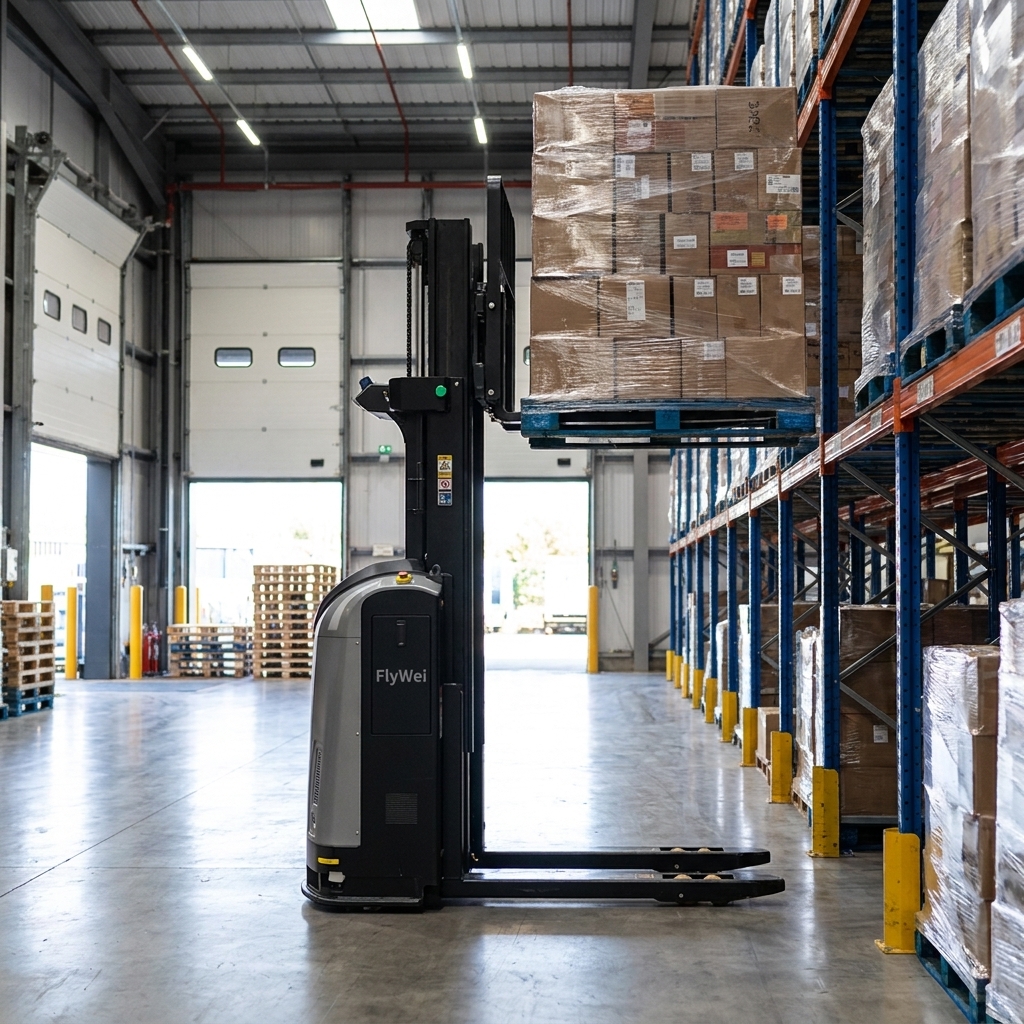
An AGV forklift is a battery-electric lift truck that navigates a live warehouse without a driver, reading laser fixes, camera cues and safety-scanner signals many times per second and taking task assignments from a central fleet manager rather than a supervisor's radio. UK warehousing recorded thousands of reportable workplace-transport injuries in the last full reporting year according to the HSE workplace transport statistics, and every one of them eventually lands on a retail supply-chain director's desk as lost shifts, insurance loading and internal investigation paperwork. Peak 2026 will push the same director further: five to nine brownfield DCs inherited from bolt-on acquisitions, each running a different mix of counterbalanced trucks, reach trucks and pallet movers, all needing to handle 30 to 45 per cent more throughput between mid-October and Boxing Day without adding a full agency shift. Standardising the AGV forklift layer across every DC is how that stops being aspirational and becomes deliverable.
Why the brownfield fleet is at breaking point
UK retail DCs almost never look like the reference architecture in the vendor brochure. The typical retail supply-chain director inherits an estate that grew through acquisitions, distressed-asset takeovers of dark stores and 40-year-old railhead depots repurposed for palletised e-commerce. Each site kept its own OEM: a heavy legacy of counterbalanced trucks from one European maker in the Midlands, a rival brand's reach fleet in a Manchester paper depot, and a third supplier's pallet movers somewhere in the North West around Magna Park or DIRFT. Each site trained its own operators, negotiated its own maintenance contract, and, critically, bought its own racking, floor coatings and dock plates on separate capital cycles.
Layer on top the three shocks of 2024-26. The 2024 Employment Rights Act plus the National Insurance uplift lifted labour cost per pallet moved by roughly 12 per cent at the median UK retail DC according to reporting collated by Logistics UK. HGV shortages spilled downstream, pushing shunter overtime bills past their reasonable ceiling. And peak 2025 revealed the third: the run-rate of same-day and next-day retail orders no longer collapses back to a January flatline. What used to be a 12-week peak is now a 34-week high-load window.
An AGV forklift is a battery-electric lift truck that navigates a live warehouse without a driver, taking task assignments from a central fleet manager instead of a supervisor's radio.
That is what makes the AGV forklift decision structural rather than tactical. Buying more forklifts is not the answer; the answer is buying compatible ones and giving them a control room.
Four levers that standardise the fleet without stopping the DCs
Lever 1, Operational: pilot one aisle, then replicate the pattern
Choose the DC with the ugliest fleet first: the one where three OEMs share an aisle and shunter overtime is worst. Stand up one autonomous forklift lane end-to-end: goods-in reserve, high-bay put-away, order pick-face replenishment, dock-loading buffer. Run it at roughly 60 per cent of peak throughput for six weeks with a supervisor on radio backup, prove the exceptions rate falls below 2 per cent, then replicate the same lane pattern at the next DC. Do not attempt a big-bang standardisation: retail SC directors who tried it in 2024 report stockout events in weeks three to five that eclipse the labour savings for the whole year. A phased rollout also lets you piggyback on natural refresh points: a lease that expires, a partition being demolished for a new pick module, or a slab repour already sitting on the capex plan.
Lever 2, Technical: an M4 fleet manager and VDA 5050 to bridge the mixed fleet
The single biggest technical mistake retail SC directors make is buying autonomous forklifts one OEM at a time. That fragments the control layer and rebuilds the exact silo you inherited. The fix is a fleet manager that speaks VDA 5050, the open interface standard driven through the German automotive industry and now the de-facto lingua franca for mixed-vendor mobile robot estates, so that any compliant AGV forklift or AMR can register, receive task assignments, share aisle right-of-way and log telemetry through one system. That is how you avoid three dashboards, three exception queues and three separate on-call rotas. FlyWei's M4 fleet manager was built around VDA 5050 for exactly this reason: bring the brownfield trucks and the new autonomous forklifts into one orchestration layer, then let the automation ratio climb over three peak cycles rather than in one disruptive year.
Lever 3, Regulatory: PUWER, ISO 3691-4, TR34 and LOLER on one Method Statement
Do not let the supplier write the Method Statement in isolation. Under the Provision and Use of Work Equipment Regulations 1998 (PUWER), Regulations 5 and 6 place the maintenance and inspection duty squarely on the employer, not the OEM. ISO 3691-4 defines the safety envelope for driverless industrial trucks: perimeter scanner performance, emergency-stop response times and operator zone protection. TR34 governs slab tolerance, typically FM2 or better for autonomous forklift lanes, and matters because a slab that fails FM2 forces the AGV to slow to a crawl in the affected zone, eroding the throughput case. And LOLER 1998 kicks in the moment the fleet lifts a load above 300mm, so the LOLER thorough-examination interval belongs in the same document as the PUWER inspection cycle. Codify these on one Method Statement per DC, get the HSE PUWER guidance reflected in your RFP boilerplate, and every site's audit trail becomes portable across the estate.
Lever 4, Commercial: phase capex through leasing across 3, 5 and 7-year terms
Capex committees rarely approve a whole-estate refresh in one financial year, nor should they. The commercial lever is to move the AGV forklift line from capex to opex on a leased basis. FlyWei's leasing programme runs across 3, 5 and 7-year terms so the SC director can align each DC's refresh point with its racking lease-expiry, its expected volume growth and its peak-plus-1 cash cycle. The 3-year term suits a DC you may exit under the next store-portfolio review. The 5-year term suits the workhorse DCs on the current network. The 7-year term suits the two or three anchor DCs where volume only goes up: spread capex, keep the balance-sheet ratio clean, and let the fleet manager scale in place across every peak.
Rollout patterns compared: pick the one that fits your estate
| Rollout pattern | Best-fit estate | Time to first live aisle | Typical payback | Peak-season risk |
|---|---|---|---|---|
| Single-site big bang | 1 greenfield DC only | 16-24 weeks | 28-36 months | High: no fallback if throughput dips |
| Aisle-by-aisle pilot then estate replication (recommended) | 5-9 brownfield DCs | 8-12 weeks per DC | 22-30 months at estate level | Low: supervisor radio backup for 6 weeks per aisle |
| Whole-estate simultaneous rollout | Newly-built network only | 26-40 weeks | 18-24 months (if it works) | Very high: stockouts eclipse savings in year one |
| OEM-by-OEM refresh (do not recommend) | Estates with one dominant OEM | Ongoing | 40+ months | Medium: silo rebuilds itself |
What FlyWei does here
FlyWei supplies the AGV forklift layer for UK retail DCs directly: no reseller in the middle, no OEM lock-in, no per-truck orchestration silo. Our autonomous forklift range covers every retail-DC duty cycle: 2-tonne counterbalanced trucks for reserve-to-pick-face pallet flow, narrow-aisle reach trucks for high-bay racking up to 10m, autonomous pallet stackers for mid-height put-away, and low-profile autonomous pallet trucks for dock-to-stock moves. All of them register into the M4 fleet manager over VDA 5050, sit alongside inherited manned trucks in the same aisle, and stream telemetry into the FlyWei fleet dispatch software that our UK-based engineering team monitors seven days a week. When peak 2026 lands, one control room manages every AGV forklift on the estate, one 48-hour feasibility read tells procurement what the next DC will cost, and one leasing schedule keeps the standardisation programme cash-flow neutral. Adjacent palletiser-feed duties are picked up by the FlyWei lifting robot range on the same M4 backbone; cross-reference the wider retail playbook in the FlyWei solutions library.
Frequently asked questions
What is an AGV forklift?
An AGV forklift (automated guided vehicle forklift, also called an autonomous forklift or driverless forklift) is a battery-electric lift truck that operates without an on-board driver. It uses laser scanners, cameras and inertial sensors to localise itself in a live warehouse, and receives task instructions from a central fleet manager over a wireless link.
How is an AGV forklift different from a manned forklift?
Mechanically the mast, forks and drive are similar; behaviourally they are opposite. A manned forklift is dispatched by a supervisor on a radio; an AGV forklift takes tasks from a fleet manager and reports back after every move. That difference is what makes standardisation across a brownfield UK retail DC estate possible: the fleet becomes queryable rather than anecdotal.
Does an AGV forklift comply with PUWER and ISO 3691-4?
A compliant AGV forklift is designed and tested against ISO 3691-4 (safety requirements for driverless industrial trucks), and once you place it in your workplace PUWER 1998 Regulations 5 and 6 apply: you are responsible for maintenance and inspection. Buy from a supplier that provides the ISO 3691-4 conformity file, then fold PUWER and LOLER cycles into a single site Method Statement.
Can an AGV forklift work in a brownfield retail DC without re-slabbing the floor?
Usually yes, provided the slab meets TR34 FM2 or better in the AGV lanes and any localised birdbaths are patched. A pre-installation floor survey is standard practice; where a zone fails FM2 the AGV will still run but at a reduced velocity, which erodes the throughput case. FlyWei UK engineers run the survey as part of the free 30-minute site read.
How long does a UK retail DC standardisation programme typically take?
An aisle-by-aisle pilot then estate replication approach delivers a live pilot aisle in 8-12 weeks per DC and full estate coverage inside 18-24 months across five to nine DCs. A single-DC big-bang lands in 16-24 weeks but does not scale to the rest of the estate without repeating the effort.
Buy or lease: what does an AGV forklift cost?
A UK retail SC director generally leases rather than buys, so the AGV forklift lands as opex on the P&L rather than capex on the balance sheet. FlyWei leasing runs across 3, 5 and 7-year terms and includes preventive maintenance, safety-scanner recalibration and remote support. Request a fleet-sizing and ROI estimate for a specific DC to see the monthly figure.
What throughput uplift can we expect at peak?
The AGV forklift alone typically lifts pallet-move throughput 15-25 per cent versus a manned baseline; combined with an M4-orchestrated mixed fleet the estate-level uplift is closer to 30-40 per cent because inherited trucks now get task-optimised too. Actual numbers depend on aisle count, dock configuration and how heavy the OEM sprawl was to start with.
If standardising the AGV forklift layer across your brownfield DCs is on your Q3 risk register, the next step is a single-site read, not a multi-DC feasibility marathon.
Book a free 30-minute site survey with FlyWei: our UK-based engineers benchmark one aisle against the ISO 3691-4 envelope and hand back a phased plan and a leasing schedule within one business day. If your Q3 focus is capex-to-opex rather than throughput, jump straight to the FlyWei leasing programme: 3, 5 and 7-year terms across the full autonomous forklift range.
UK-based engineers · no obligation · reply within one business day.