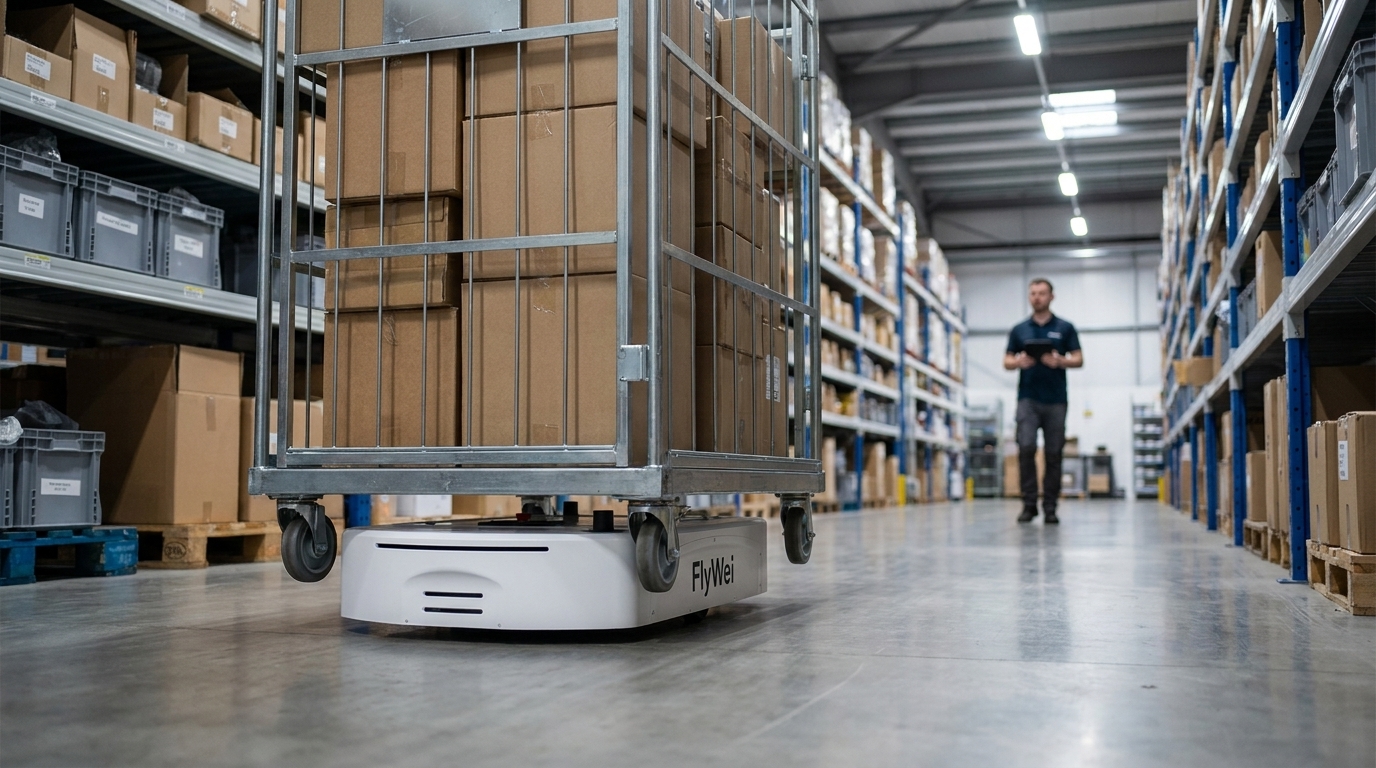
AMR controllers are the onboard computers that make a mobile robot controllable: they run navigation and motion control, enforce the safety interlocks, and carry the messaging link up to a fleet manager. Getting them right is a regulatory duty as well as an engineering one — regulation 4 of PUWER 1998 requires work equipment to be suitable for the purpose it is used for, and ISO 3691-4 sets the safety requirements for driverless industrial trucks. For an operations director in UK third-party logistics, that engineering detail becomes a commercial problem the day a contract moves. Robots bought for a chilled grocery account sit idle when the account goes elsewhere, because the vehicles will only take orders from the control layer their manufacturer shipped with them. The fleet was never the constraint. The controller was, and it was decided years earlier at specification.
Why 3PL robot fleets get stranded when the contract book moves
Third-party logistics is the only warehousing sector where the customer can leave. A grocery account or a bonded spirits flow can be won on a three-year term and gone at the end of it, and the operator carries the asset either way. Automation, meanwhile, is still specified the way a materials handling fleet always was: by truck class, lift height and residual value. That habit is what strands robots.
The gap opens because a mobile robot is two purchases sold as one: the vehicle — mast, drive unit, forks, battery — and the control layer that decides where it goes and what it is allowed to do. Most operators negotiate hard on the first and accept whatever comes with the second. When that layer is proprietary, every capability the fleet has is bounded by one manufacturer's roadmap: which racking it can serve, which host systems it can take work from, whether another manufacturer's trucks can share the aisle.
Then the contract moves. The new client runs different pallet formats at a different site under a different warehouse system. The vehicles are mechanically fine, but re-tasking them means a fresh integration at that manufacturer's rate and timescale — or leaving assets parked. Across the big-shed clusters at Magna Park, DIRFT and SEGRO East Midlands Gateway, where one campus carries several client contracts, the cost is not a stranded truck so much as a stranded aisle. Work equipment duties do not transfer with the client either, and the HSE's workplace transport guidance treats vehicles and pedestrians sharing space as a hazard to be designed out. Re-tasking into a new layout is a change to the safety case, and how easily that change can be made is a property of the controller.
Lever 1 — Specify the control layer before you specify the vehicles
Reverse the usual tender order. Write the requirement for AMR controllers, fleet messaging and host integration first, then invite vehicles that satisfy it. That is four clauses. The vehicle must accept orders from a fleet manager of the operator's choosing, over a documented interface. Maps, traffic rules and mission definitions must be exportable in a format the operator owns. Any capability advertised in the bid must be reachable through that interface, not only the supplier's console. And missions and layouts must be configurable by the operator's engineers after training, with supplier support priced as a visible line item.
This is a commercial lever more than a technical one, and the cheapest of the four: it costs nothing but discipline at tender stage, and it decides who negotiates from strength three years later.
Lever 2 — Make open fleet messaging a requirement, not a feature
The technical lever is the messaging standard between the fleet manager and the vehicles. Among Logistics UK members the pattern repeats: mixed fleets arrive by accretion, one project at a time, and the integration bill lands later. VDA 5050 exists to stop that. It is an open specification for how a central fleet control issues orders to mobile robots, and how those robots report position, load and task state back, in a common message format rather than a bespoke interface per manufacturer.
Ask three questions of any bid. Does the vehicle speak the standard natively, or through an adapter the supplier maintains? Which optional parts of the specification are implemented, and which are stubbed? And if the link to the fleet manager drops, does the truck finish its current order and hold safely, with completions queued and replayed without duplication on reconnection? A supplier who answers those precisely is offering a fleet you can re-task.
Lever 3 — Design re-tasking into the deployment, not into the next project
The operational lever is treating a mission as configuration rather than a bespoke build. In a well-designed deployment, adding a put-away flow for a new client means defining locations, priorities and exception rules in the orchestration layer, not a site visit to reprogramme vehicles. Get that right and a fleet that ran chilled grocery inbound can serve ambient e-commerce outbound within a planning cycle.
Three practices make the difference. Align location naming with the warehouse system from the start, so a new client's stock model maps onto existing addresses instead of forcing a re-survey. Make exception handling explicit — a blocked aisle, a mis-sized pallet, a failed load confirmation — because exceptions are where re-tasking projects stall. And insist on a test environment, so a new flow can be proven against real order data before it touches a live shift.
Lever 4 — Hold the controller to PUWER and ISO 3691-4 from day one
The regulatory lever is to treat the AMR controller as safety-related equipment and evidence it accordingly. ISO 3691-4 sets safety requirements and verification for driverless industrial trucks: how a vehicle detects people and obstacles, how it behaves in shared aisles, and how protective functions are validated. PUWER then requires that equipment is suitable, maintained, and used only by people with adequate instruction and training — including supervisors who now hold a tablet rather than a steering wheel.
For a 3PL there is a specific edge. Because the safety case is site-specific and the site changes when the contract changes, the question at tender is how much validation survives a move. Ask which protective functions are certified at controller level and travel with the truck, which are configured per site and must be re-validated, and what documentation supports a new risk assessment. Certification scopes are published through BSI; a supplier who cannot point to a scope is asking you to take the safety case on trust.
| Decision point | Closed control layer | Open control layer | Effect when the contract moves |
|---|---|---|---|
| Order source | Supplier console only | Any host system, documented interface | New client's system issues work without a new integration |
| Mixed fleets | One manufacturer per aisle | Several manufacturers, one fleet manager | Old and new trucks share the same traffic rules |
| Maps and missions | Held by the supplier | Exportable, owned by the operator | Re-survey becomes configuration, not re-purchase |
| Change control | Supplier engineer visit | Operator engineers, post-training | New flows land in a planning cycle, not a project cycle |
| Safety evidence | Bundled, scope unclear | Named scope per protective function | New site risk assessment starts from evidence, not zero |
AMR controllers are the onboard computers that make a mobile robot controllable: they run navigation and motion control, enforce the safety interlocks, and carry the messaging link up to a fleet manager.
What FlyWei does here
FlyWei is an independent UK systems integrator of autonomous forklifts and AMRs, and that independence is the point for a contract logistics operator. Not being tied to one manufacturer's roadmap means specification starts with what the contract book demands, then selects the vehicles that meet it — across manufacturers where that produces a better fleet.
On the control layer, FlyWei supplies and integrates AMR controllers and AGV controllers as a considered choice rather than a bundled accessory, matching controller capability and safety architecture to the duty cycle and the aisle. Above the vehicles, the M4 fleet manager issues work to mixed fleets over open messaging, holds the traffic rules for shared aisles, and keeps maps and mission definitions where the operator can see them. RDS robot dispatch takes work from the host system the client already runs, so a new account is onboarded by configuration rather than rebuild.
On the floor, FlyWei integrates autonomous forklifts in counterbalanced, reach, stacker and pallet-truck classes alongside lifting robots, under one control layer. For multi-client campuses, deployments are designed so re-tasking is expected: shared maps, named locations aligned to the warehouse system, documented mission libraries. Sector configurations appear in FlyWei's solutions for UK operators, and three, five and seven-year terms under leasing match asset life to contract length.
Frequently asked questions
What are AMR controllers?
AMR controllers are the onboard computers inside an autonomous mobile robot or autonomous forklift. They run navigation, drive and steering control, obstacle detection and protective stops, and the messaging link to the fleet manager that issues work.
What is the difference between AMR controllers and AGV controllers?
The difference is navigation method rather than hardware category. An AGV controller follows a fixed guide path such as magnetic tape; an AMR controller runs onboard SLAM navigation and re-routes around obstructions. Modern controller families often cover both modes.
Can robots from different manufacturers run in the same warehouse?
Yes, where they support a common fleet messaging interface. An open standard such as VDA 5050 lets one fleet manager command vehicles from different suppliers using the same message format. Traffic rules must still be set centrally.
Do we need to replace our warehouse system to deploy AMRs?
Usually not. An orchestration layer sits above the existing warehouse system and takes work from it, so that system stays the source of truth for stock and orders. Middleware is normally cheaper than replacement.
Which regulations apply to autonomous forklifts in a UK warehouse?
PUWER 1998 covers the provision and use of work equipment, including suitability, maintenance and training. LOLER 1998 applies to lifting operations. ISO 3691-4 sets safety requirements for driverless industrial trucks, and HSE workplace transport guidance covers shared vehicle and pedestrian space.
What happens to an autonomous fleet if the network or host system goes down?
A well-designed control layer degrades rather than stops. Vehicles finish the order already issued and then hold safely, while the fleet manager queues completions and replays them once the link returns, without duplicating messages.
How quickly can an autonomous fleet be re-tasked to a new client contract?
It depends on data and configuration far more than on the vehicles. Where locations are uniquely identified and missions are held as configuration, re-tasking is a planning-cycle activity. Where the supplier holds the maps, it becomes a project.
If contract churn and stranded automation assets are on your Q3 risk register, the fastest way to find out how re-taskable your fleet really is, is to walk the aisles with someone who specifies control layers for a living.
Book a free 30-minute site survey of your highest-traffic aisle, and we will tell you what your current control layer would let you change — and what it would not. For the technical detail first, the AMR and AGV controller range sets out the navigation, safety and interface options FlyWei integrates.
UK-based engineers. No obligation. We reply within one business day.