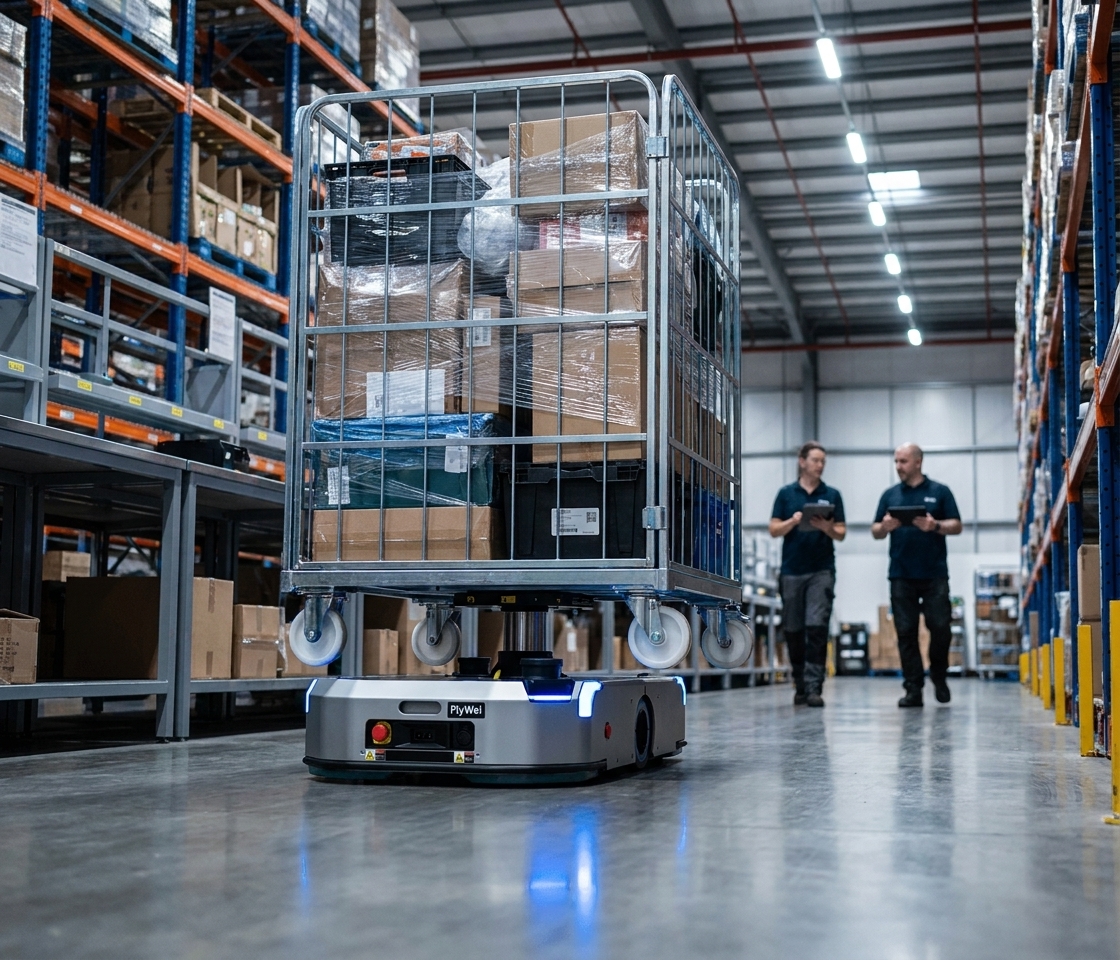
AMR leasing is a full-service financing model that lets UK e-commerce operators deploy autonomous mobile robots as a monthly operating expense rather than a per-unit capital purchase, with the lessor retaining ownership, maintenance liability and end-of-term technology refresh. Logistics UK's 2026 Skills and Employment Report puts warehouse operative vacancies at 8.4% across the sector, and the Health and Safety Executive recorded fifteen workplace-transport fatalities in the 2024/25 reporting year, so the twin cost of peak-season agency labour and manual-handling insurance keeps rising. For a Supply Chain Director at a UK e-commerce fulfilment centre in Magna Park, Daventry or SEGRO East Midlands Gateway, that is the operational picture: peak weeks that need 30-40% more picking throughput than the annual mean, a capex committee that just deferred discretionary spend to the next fiscal, and a WMS roadmap that already consumes the available IT integration bandwidth. AMR leasing is the mechanism that lets you say yes to the robots without saying yes to a six-figure per-unit purchase price.
Why UK e-commerce fulfilment stalls on AMR capex
Every UK fulfilment centre director recognises the pattern. Q3 planning surfaces a Q4 peak that needs 35% more picks per hour than the previous quarter; the automation shortlist has been circulating since March; the capex committee agrees the business case in principle but defers approval until Q1 of the next fiscal, by which point the peak has come and gone and the £120,000 of agency spend that would have funded two leased robots is already off the profit-and-loss account. The root cause is rarely the technology. It is the mismatch between how a fleet of autonomous mobile robots is bought and how a fast-growing UK e-commerce operator can actually afford to buy it.
Three UK-specific pressures compound the mismatch. First, the cost of capital: sustained higher interest rates make conventional asset finance for automation expensive. Second, board risk aversion: after two years of e-commerce contraction, capex committees want shorter payback horizons than a straight-line seven-year depreciation on automation kit can offer. Third, integration bandwidth: a warehouse management system refresh already consumes 60-80% of a mid-market IT roadmap, leaving nothing for the vendor onboarding, controls integration and safety-zone survey that AMR deployment classically demands. The result is systematic under-investment in the very machines that would relieve the peak-season labour crunch the same board is complaining about in the same meeting.
The four levers that unlock AMR deployment without capex approval
Lever 1 — Start with a 4-8 unit pilot fleet on a 5-year full-service lease
The single most under-used deployment shape in UK e-commerce fulfilment is a bounded pilot fleet: four to eight robots contained to a single pick-face or goods-to-person aisle, run for six months against a defined throughput target before scaling. A 5-year full-service lease at £2,800-£4,500 per unit per month puts pilot cost at £11,200-£36,000 monthly, comfortably inside almost any Supply Chain Director's discretionary spend authority and never near the capex committee. The lease terminates or converts at year five, giving the board a clean off-ramp if the technology or the vendor disappoints. Because the lessor owns the asset, the operator's balance sheet stays clean and the pilot never becomes a stranded capex write-down.
Lever 2 — Insist on a vendor-agnostic fleet manager with VDA 5050 interop
Every serious AMR lease should include a fleet management layer that speaks the VDA 5050 open standard, so today's four robots and next year's twelve, potentially from a different chassis form factor, can be dispatched from a single control plane. Locking a lease to a single-vendor proprietary orchestration layer is the fastest way to convert a five-year hedge into a five-year trap. FlyWei's M4 fleet manager ships as part of every leased robot deployment and enforces VDA 5050 dispatch, so the operator retains the freedom to broaden the fleet, negotiate against a competitive quote at year-three refresh, or migrate to a different chassis without ripping out the control layer.
Lever 3 — Move safety, compliance and thorough examination to the lessor's ledger
Under PUWER 1998 and BS EN ISO 3691-4, the operator of a fulfilment centre remains the person in control of the equipment for daily safe use, and no lease structure changes that. What the lease does change is who carries the annual thorough examination burden, the firmware recertification cycle for functional-safety controllers, and the insurance premium against third-party incidents. In a full-service arrangement the lessor performs and documents ISO 3691-4 conformity assessments each year, holds the record of safety patch deployment for the UKCA-marked functional-safety controllers, and carries the product liability insurance certified to BSI standards. That transfers roughly 1.5 full-time equivalents of engineering-manager attention per fleet of twenty robots off the operator's ledger — a saving that rarely appears in a headline lease quote but shows up sharply in the operator's real all-in cost of ownership.
Lever 4 — Reclassify robotics spend from capex to opex and match it to peak revenue
The fourth lever is accounting discipline. IFRS 16 puts most lease liabilities on the balance sheet, but a full-service operating lease with meaningful service content still permits opex treatment for most UK e-commerce operators. That matters for the two ratios every SC director's board watches: return on capital employed and free cash flow conversion. Leasing keeps the robots off the depreciation schedule and lets the monthly cost be matched to the peak revenue that pays for it — a four-week Black Friday and Christmas spike that generates 35-45% of annual gross margin funds four months of otherwise underused robot capacity. The board sees a clean opex line that scales with peak volume; the SC director sees a fleet ready to run 16-24 months earlier than the capex route would have delivered.
| Option | Upfront cost | Monthly cost | Service included | Tech refresh | Balance-sheet treatment | Break option |
|---|---|---|---|---|---|---|
| Capex purchase | a six-figure sum | £350-£550 maintenance only | Bought separately | Operator's cost at year 5-7 | Capex, depreciated straight-line 7 years | Resell used at 25-40% residual |
| 3-year full-service lease | £0 (deposit optional) | £3,600-£5,200 | Maintenance, firmware, thorough exam, insurance | End-of-term chassis swap | IFRS 16 right-of-use, opex-treated service | Break at 24 months on notice |
| 5-year full-service lease | £0 (deposit optional) | £2,800-£4,500 | All of the above plus year-3 battery refresh | Mid-term battery, end-of-term swap | IFRS 16 right-of-use, opex-treated service | Break at 36 months on notice |
| 7-year full-service lease | £0 (deposit optional) | £2,300-£3,700 | All of the above plus two recertifications and one chassis refresh | Rolling: chassis at year 4 | IFRS 16 right-of-use, opex-treated service | Break at 48 months on notice |
AMR leasing lets a UK e-commerce operator deploy autonomous mobile robots as a monthly opex payment rather than a per-unit capex commitment of a six-figure sum, shifting maintenance, safety recertification and technology-refresh risk onto the lessor across 3-, 5- or 7-year full-service terms.
What FlyWei does here
FlyWei designs and delivers autonomous mobile robots and autonomous forklifts to UK e-commerce operators under 3-, 5- and 7-year full-service leasing terms, launched in 2026 to remove the capex barrier that has stalled sensible automation across the sector. Every leased robot ships with the M4 fleet manager for VDA 5050 orchestration, ISO 3691-4 conformity documentation prepared by our UK engineering team, and inclusive service that covers maintenance visits, firmware updates for the UKCA-marked functional-safety controllers, annual thorough examination, mid-term battery refresh on the 5- and 7-year terms, and product liability insurance. A typical UK e-commerce engagement starts with a free 30-minute site survey, produces a 4-8 unit pilot design inside two weeks, and delivers the leased robots to your Midlands or Northamptonshire DC within 10-14 weeks of contract signature. If the pilot misses its throughput target inside six months, the lease terminates and the robots go back. If it succeeds, the fleet scales inside the same commercial framework, without going back to the capex committee.
Frequently asked questions
What is AMR leasing and how does it differ from renting a forklift?
AMR leasing is a multi-year financing arrangement, typically 3, 5 or 7 years, that bundles hardware, software, maintenance, safety compliance, insurance and technology refresh into a single monthly payment. Unlike short-term forklift rental, which is priced daily and comes without fleet management, a full-service AMR lease behaves like a long-term operating partnership: the lessor retains the asset and carries the obsolescence, downtime and safety non-conformity risk.
Can a UK e-commerce operator sign an AMR lease without capex committee approval?
In most cases, yes. A 4-8 unit pilot at £2,800-£4,500 per unit per month sits inside a Supply Chain Director's discretionary opex spend authority, particularly when matched to displaced agency labour cost during peak. Only fleets of 25 or more robots push the annualised commitment into a range requiring formal board approval, and by then the pilot's ROI evidence usually makes that conversation short.
What safety and regulatory obligations transfer to the lessor?
The operator remains the person in control of the equipment under PUWER 1998 for daily safe use, exclusion zones, operator training and near-miss reporting. A full-service lease transfers the following to the lessor: annual thorough examination under LOLER-equivalent inspection for lifting AMRs, firmware recertification for the UKCA-marked functional-safety controllers, BS EN ISO 3691-4 conformity documentation, product liability insurance, and the audit trail that HSE inspectors and the operator's own EHS team need at inspection.
How is the monthly lease priced?
Pricing depends on chassis specification, service scope, term length and fleet size. Indicative 2026 UK ranges are £3,600-£5,200 per unit per month on a 3-year term, £2,800-£4,500 on a 5-year term and £2,300-£3,700 on a 7-year term. Longer terms carry lower monthly cost and can include mid-term battery refresh and, on 7-year deals, a chassis swap.
What happens at the end of the lease?
Three options are typical: return the fleet clean for redeployment; extend the lease for 12-24 months at 40-60% of the original monthly; or buy outright at fair market value. Most UK e-commerce operators extend or return, because the technology refresh cadence in AMR chassis makes a new-term lease of updated equipment more attractive than owning end-of-life kit.
Does AMR leasing include the fleet management software?
With FlyWei it does. Every leased robot ships with the M4 fleet manager for VDA 5050 orchestration, and the M4 licence, updates and UK-based support are part of the monthly payment. Operators who prefer their own fleet management layer can integrate M4 over standard interfaces.
What integration effort should the SC Director budget for?
A 4-8 unit pilot needs 40-80 person-hours of IT integration for the WMS handshake and 20-30 person-hours of facilities work for charging stations, wi-fi validation and floor marking. The lessor's engineers handle robot commissioning, safety zoning, LiDAR mapping and operator training. Elapsed time from contract to first productive shift is 10-14 weeks.
If peak-season throughput risk and the capex freeze are both on your Q3 e-commerce risk register, AMR leasing lets you close the gap without another board paper. Book a free 30-minute site survey with FlyWei's UK engineering team — we will walk your fulfilment floor, size a pilot fleet of four to eight leased robots, and give you a monthly-cost estimate to take to your finance director. See the full 3-, 5- and 7-year term structure on our AMR leasing programme page. UK-based engineers, no obligation, and we will reply to your enquiry within one business day.