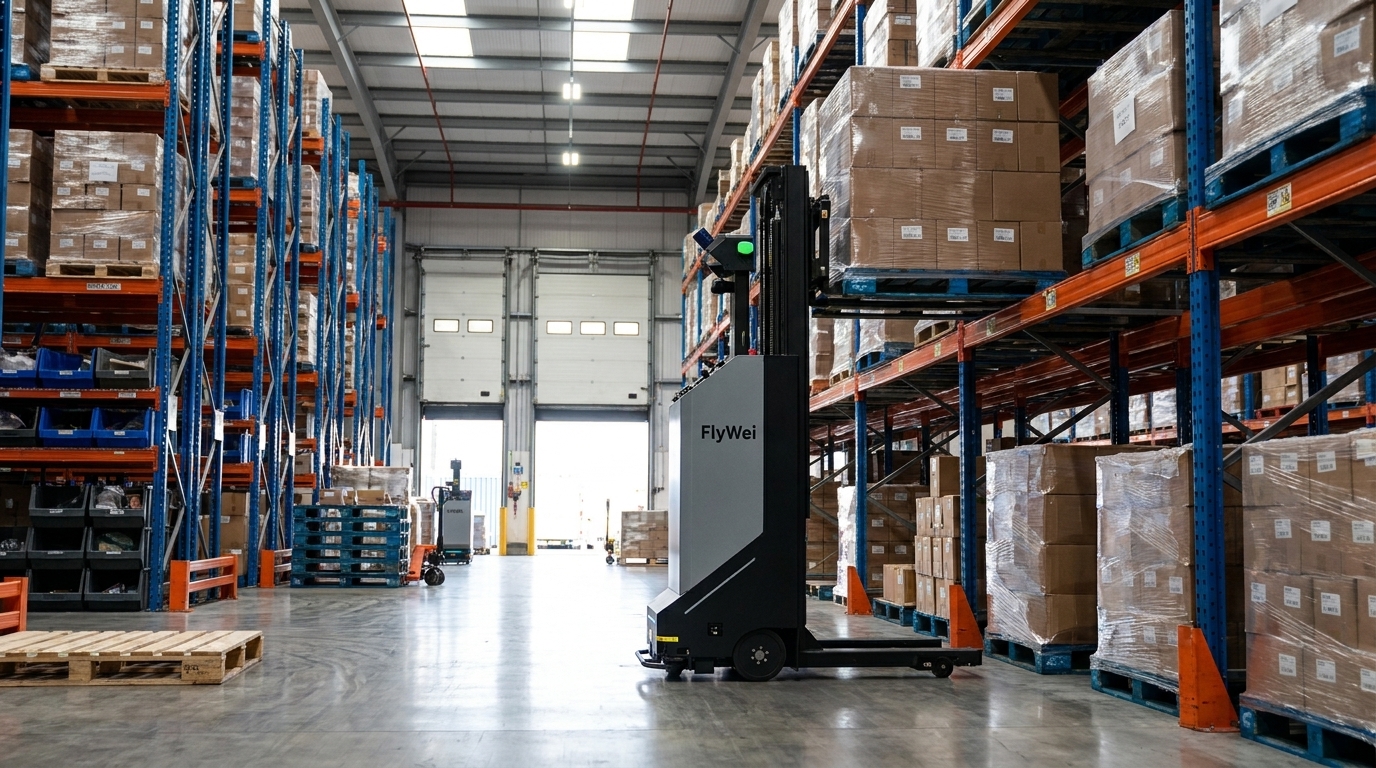
Autonomous forklift leasing is a financing arrangement in which a UK operator pays a fixed monthly charge to use driverless forklift trucks — typically over three, five or seven years — instead of buying the fleet outright as a capital purchase. The equipment sits under the same statutory duties as any other work equipment: the Provision and Use of Work Equipment Regulations 1998 (PUWER 1998) require every employer to ensure work equipment is suitable, maintained and operated by trained people, whoever owns it. For a retail DC procurement lead, that legal continuity is the point. Grocery and multi-channel distribution centres enter a change freeze weeks before peak, and the capex approval cycle rarely closes in time to add mechanical handling capacity for the volumes already forecast. Leasing moves the decision out of the capital budget and into operating cost, where a Q3 sign-off can still put machines on the floor for peak.
Why the capex window closes before peak does
The timing problem in a grocery or multi-channel retail DC is structural rather than administrative. Volume forecasts for the final quarter firm up late in Q3. By the time the numbers are credible enough to defend to a capex committee, the site is already inside its change freeze — the period in which no new equipment or system integration is permitted, because the cost of a failed change during peak dwarfs the benefit of a successful one.
That leaves procurement with a narrow set of options. Agency labour arrives quickly but untrained on site-specific traffic rules, carrying the highest incident exposure when aisles are busiest. Short-term truck hire solves the machine count but not the driver count, and around Magna Park, DIRFT and SEGRO East Midlands Gateway the pool of experienced reach-truck operators tightens at the moment every competitor site is recruiting. Neither builds anything useful in January.
There is also a measurement gap. Capital cases are usually built on a single headline payback figure, inviting a committee to compare automation against an abstract hurdle rate rather than the real alternative — the fully loaded cost of running the same flow manually for another year. Under HSE workplace transport guidance, that baseline carries a risk-management overhead that rarely appears in the comparison. Leasing does not make an unjustified project justified; it changes which budget the decision belongs to, and therefore which approval calendar applies.
Lever 1 — Size the lease to the peak curve, not the annual average
The most common sizing error is to divide annual pallet movements by operating hours and procure to that mean. A retail DC does not run at its mean. It runs at a trough for much of the year and at a sustained ceiling for six to ten weeks, and the ceiling decides whether despatch cut-offs are met.
Size instead to the ceiling flow on the routes automation will take over — the repetitive, long-distance, low-decision moves: goods-in to bulk storage, bulk to pick-face replenishment, and marshalling to despatch lanes. Count those at peak hourly rate, not daily total. Then agree how fleet size can step during the term, because a five-year agreement written against today's ceiling is wrong by year three in a growing operation. A schedule allowing units to be added at a pre-agreed rate turns a lease into a capacity plan, not a fixed asset.
Lever 2 — Put the orchestration layer inside the agreement
This is the technical lever, and the one most often left out of a finance-led procurement. Autonomous trucks execute missions. The value comes from deciding which missions, in what order, against a live picture of dock congestion, pick-face depletion and despatch cut-offs — and from re-pointing the fleet when a shift turns from replenishment-heavy to despatch-heavy.
That decision layer is a fleet manager. FlyWei's M4 fleet manager handles traffic, charging strategy, zone rules and mission assignment across the fleet, while FlyWei RDS dispatches robots against the work the site actually needs done. Both connect to the operator's existing ERP and WMS over documented interfaces, so that system stays the record of stock and no replacement project is triggered.
Two contractual points matter. Insist the fleet layer speaks the VDA 5050 open standard for robot command and control, so the agreement does not silently become a single-manufacturer commitment. And make software updates, interface support and fleet-manager licensing explicit line items rather than assumed inclusions — an unbundled renewal in year four is an unpleasant surprise for a budget holder who has already banked the monthly figure.
Lever 3 — Write the regulatory duties into the lease schedule
Leasing does not transfer the duty of care. Under PUWER 1998 the employer operating the equipment must ensure it is suitable, properly maintained, and used only by people who have received adequate training. Where the machine lifts loads, the Lifting Operations and Lifting Equipment Regulations 1998 (LOLER 1998) add thorough examination duties on a defined schedule. The lessor owns the asset; you carry the obligation.
So the schedule has to say who does what. Name the party responsible for statutory inspection and thorough examination records, the maximum response time for a safety-critical fault, and what happens to the charge when a unit is out of service beyond it. Confirm the machines are supplied to ISO 3691-4, the standard covering driverless industrial trucks, and that UKCA marking and a declaration of conformity are provided per unit, not per model.
Sector guidance from bodies such as Logistics UK is worth reading alongside the standards. Two site-side items belong in the same conversation. Floor flatness to the TR34 concrete standard governs whether high-bay narrow-aisle work is achievable at the lift heights specified — a survey before signature is cheaper than a variation after delivery. And your traffic management plan, in the sense HSE sets out for work equipment, needs rewriting for mixed manual and autonomous operation before the first machine arrives.
Lever 4 — Model the term against the manual baseline
The comparison a capex committee should see is not "lease versus purchase". It is "this agreement versus running the same flow the way we run it now, for the same number of years". That reframing does more for a business case than any discount the finance structure can produce, because the manual baseline is rarely costed honestly. It should include shift premium, agency cover at peak rates, recruitment and induction for churn, operator training, damage, and the cost of the manual trucks replaced.
| Route | Budget line | Term | Usually bundled | Best fit |
|---|---|---|---|---|
| Outright purchase | Capital | Held to end of life | Nothing — maintenance and software contracted separately | Owned sites with settled flow and capital in the right financial year |
| 3-year lease | Operating | 3 years | Maintenance, software updates, fleet management | Contract DCs, sites under review, first deployments |
| 5-year lease | Operating | 5 years | Maintenance, software updates, fleet management | Settled multi-channel DCs with stable high-cycle pallet flows |
| 7-year lease | Operating | 7 years | Maintenance, software updates, fleet management | Long-lease grocery DCs where lowest monthly charge wins |
| Long-term rental | Operating | Rolling | Maintenance; software varies | Seasonal surge cover or bridging a site move — priciest per month |
Autonomous forklift leasing is a financing arrangement in which a UK operator pays a fixed monthly charge to use driverless forklift trucks over three, five or seven years instead of buying the fleet outright as a capital purchase.
What FlyWei does here
FlyWei is an independent, vendor-neutral UK systems integrator of autonomous forklifts and AMRs. FlyWei selects machines across multiple manufacturers to fit the site rather than fitting the site to one catalogue, and structures the agreement around that selection — which is why a FlyWei lease is not tied to any single OEM finance programme.
For a retail DC that starts with a flow study, not a machine list. FlyWei engineers map the peak-hour movement profile on goods-in, replenishment and despatch, and size the fleet to the ceiling on those routes. The machine mix follows from the aisle and the lift height: FlyWei autonomous forklifts in narrow-aisle reach-truck and counterbalance classes for pallet work into high-bay racking, and FlyWei lifting robots where cage and trolley movement between mezzanine pick modules is the constraint.
FlyWei then delivers the layer that makes the fleet useful. M4 handles traffic, charging and mission assignment; RDS dispatches work against live demand; both integrate with your existing ERP and WMS. FlyWei structures the agreement over 3, 5 and 7-year autonomous forklift leasing terms with maintenance, software updates and fleet management inside the monthly charge, and writes the PUWER, LOLER and ISO 3691-4 responsibilities into the schedule. Commissioning is planned around the change freeze, not through it, and support comes from UK-based engineers.
Frequently asked questions
What is autonomous forklift leasing?
Autonomous forklift leasing is an agreement under which a UK operator pays a fixed monthly charge to use driverless forklift trucks over an agreed term — commonly three, five or seven years — rather than buying them outright. Maintenance, software updates and fleet management are normally included.
Does leasing move the health and safety responsibility to the lessor?
No. Under PUWER 1998 the duty sits with the employer operating the equipment, whoever owns it. The lease schedule should set out who performs statutory inspection, who holds thorough examination records under LOLER 1998, and the response time for a safety-critical fault — but the legal obligation remains yours.
Which lease term suits a retail distribution centre?
It depends how settled the flow and the site are. Three years suits a contract DC, a site under network review, or a first deployment. Five and seven-year terms suit settled grocery and multi-channel DCs with stable high-cycle pallet flows, at a lower monthly charge.
What should be bundled into the monthly charge?
At minimum: preventive and corrective maintenance, statutory inspection support, software updates, and fleet-manager licensing. Ask for each as a visible line item. The most common gap is software — an orchestration licence renewing separately in year four changes the cost already committed to.
Can leased autonomous forklifts work with our existing WMS?
Yes, in almost all cases without replacing it. A fleet management layer sits between the robots and your business systems, taking work from your existing ERP or WMS over a documented interface and translating it into robot missions, then writing completions back. That system stays the record of stock.
How does leasing help inside a pre-peak change freeze?
It changes the approval route, usually the binding constraint rather than the engineering. An operating-cost decision follows a shorter approval calendar than a capital bid. It does not remove commissioning time — mapping, traffic-rule configuration, integration testing and operator familiarisation still need a window.
Is a vendor-neutral lease different from a manufacturer's finance offer?
Yes, in what it commits you to. A manufacturer's finance programme is designed to place that manufacturer's machines, so the fleet mix is constrained by the catalogue behind it. A vendor-neutral integrator selects across manufacturers to fit the aisle, the load and the duty cycle, then structures finance around that selection.
If closing the pre-peak capacity gap without a capital bid is on your Q3 risk register, the next step is a number you can take to committee.
Request a fleet-sizing and ROI estimate for your DC — FlyWei engineers will map your peak-hour flow, size the fleet to the ceiling on those routes, and cost it against your current manual baseline. Review the available 3, 5 and 7-year autonomous forklift leasing terms first.
UK-based engineers. No obligation. We reply within one business day.