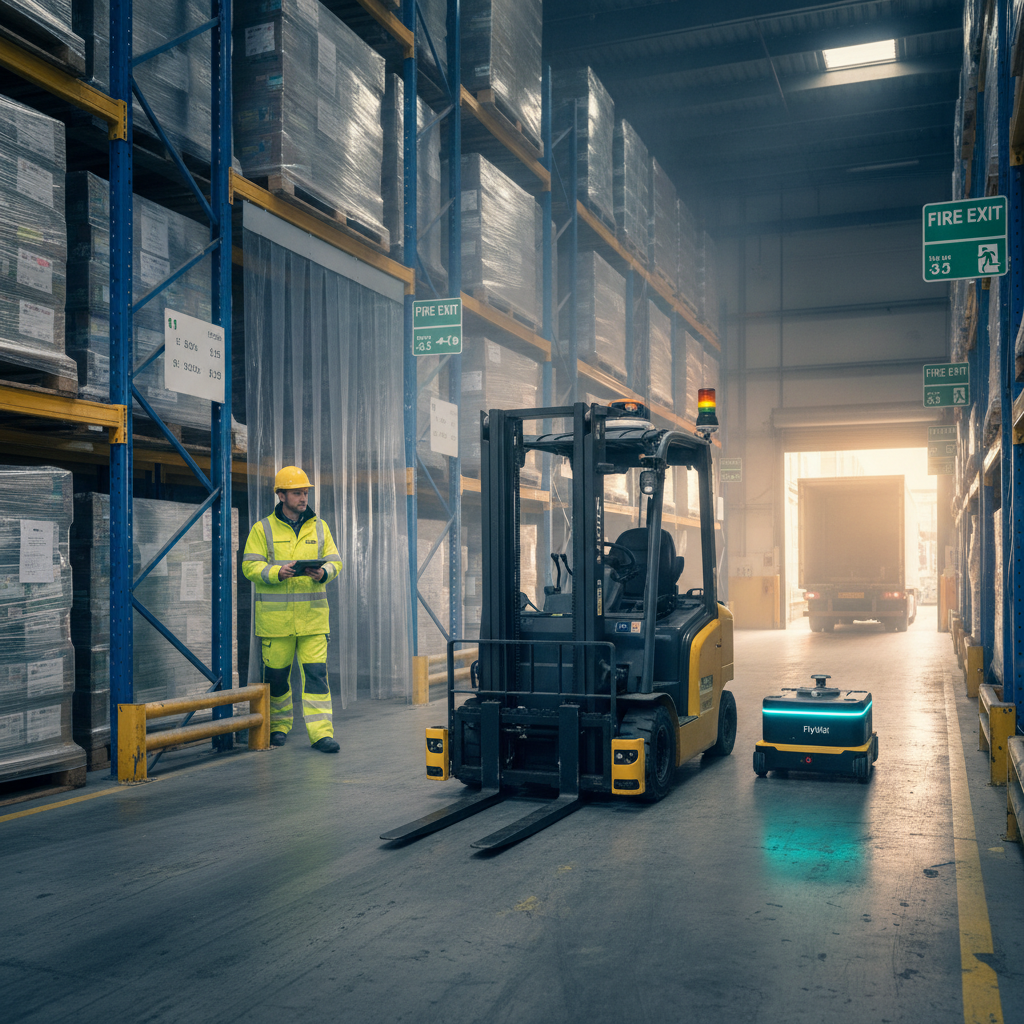
Autonomous forklifts in cold storage are now the practical answer to a UK driver-retention crisis that escalated through 2025 and is still biting chilled and frozen DCs in 2026. The fix is no longer "hire harder"; the fix is to remove the human from the zone, and FlyWei's M4 fleet manager orchestrates mixed autonomous-forklift fleets across chilled and frozen UK warehouses using VDA 5050 messaging, so cold-store operations directors can deploy FlyWei autonomous forklifts without ripping out their existing WMS. This article sets out the four levers a UK ops director should pull this quarter, and where FlyWei autonomous forklifts, the M4 fleet manager and fleet dispatch fit into the answer.
Why UK cold-store warehouses are losing forklift drivers
Cold work is hard to staff and harder to keep staffed, and 2024 to 2026 made the gap acute in the UK. Four forces are pushing in the same direction.
The first is physiological. HSE guidance on cold environments recognises that prolonged exposure below 4°C raises injury risk, dexterity loss and concentration loss; below −18°C operators are limited to short cycles with mandated warm-up breaks, which compress productive hours per shift and push throughput off-target before any other variable is touched.
The second is wage. The cold-and-frozen forklift premium has moved from roughly £1.50 per hour to £3.50 per hour across the East Midlands cold-store corridor running between Daventry, Lutterworth and Burton-on-Trent. Logistics UK skills tracking attributes the shift to post-Brexit labour-supply tightening, the loss of seasonal EU drivers, and competition from new build-to-rent shed roles around Magna Park and DIRFT that pay similar money in ambient conditions and get applicants without a thermal-PPE conversation.
The third is incidents. PPE-laden operators in narrow racking aisles at −25°C make more mistakes per shift. HSE RIDDOR returns from cold-store sites disproportionately involve pedestrian-MHE near misses, racking impacts and slips on ice patches around chiller condensate. Insurers have priced this in: combined liability premiums now bake in an attrition loading, so high-turnover cold sites pay twice; once at the wage line, once at the insurance line.
The fourth is the calendar. Promotional volume into UK grocery and food-service DCs lifts inbound pallet flow by 18 to 25% across Christmas, Easter and the BBQ peak. That forces overtime in the coldest zones, exactly the work people leave to escape, which feeds the turnover the operator is trying to fix.
FlyWei autonomous forklifts run continuous cycles in chilled and frozen UK warehouses, removing the human exposure window that drives turnover above 25% on the worst East Midlands cold-store sites.
The four levers a UK ops director should pull this quarter
1. Operational lever: shift redesign and warm-up zoning
The first move is structural and free. Map your cold-store cycles by temperature band and rebuild shifts so any one operator's −25°C dwell never exceeds the HSE guidance window without a structured warm-up. Group ambient pre-stage, chilled −2°C to 4°C buffer, and frozen −18°C to −25°C blast as three zones, each with its own MHE pool and its own driver pool. The point is not to add headcount; it is to stop pushing the same operators back into the coldest zone shift after shift, which is what produces the leavers list. Pair this with a paid warm-up step that counts as productive time on the operator's tag, not as unpaid break: operators leave when warm-up is unpaid and stay when it is. Combined with autonomous coverage on the longest and coldest cycles, the residual human cycles become tolerable and retention recovers within two quarters on most sites.
2. Technical lever: autonomous forklifts, M4 and VDA 5050
The fix that actually moves the dial is removing the human from the worst zone. FlyWei autonomous forklifts handle continuous put-away, replenishment and pallet retrieval in chilled and frozen environments at the same throughput a human achieves at ambient, without break cycles, without dexterity loss, and without the racking-impact rate that climbs after hour three of a cold shift. Orchestration happens in the M4 fleet manager, which talks to the trucks over the open VDA 5050 standard. That matters because the cold-store WMS, typically an enterprise system already integrated to the customer's ERP, never has to be replaced. M4 sits between the trucks and the WMS, takes orders, schedules, and writes back. Fleet dispatch handles real-time priority calls from the floor: a cold-zone operator presses a request, fleet dispatch software routes the move to the nearest available autonomous forklift, and the move is executed without anyone walking into the −25°C zone unless they choose to. Mixed fleets, autonomous forklifts running alongside existing manned reach trucks, work side by side because VDA 5050 is hardware-agnostic, so the autonomy phases in by zone rather than rip-and-replace.
3. Regulatory lever: PUWER, BS EN ISO 3691-4, ACOP L117 and TR34
The regulator does not exempt autonomous trucks; it changes who carries which duty. Under PUWER 1998 the operator remains the duty-holder for safe equipment use, training and supervision; the autonomous-truck supplier carries the design and conformity duty. The relevant standard is BS EN ISO 3691-4 on driverless industrial trucks, supplied via BSI, and any UK cold-store deployment should be specified to it in the contract with the supplier's technical file delivered at acceptance. ACOP L117 on rider-operated lift trucks still governs the manned fleet sharing the same aisles: pedestrian segregation, line-of-sight, supervisor competence and refresher training are unchanged. Floor flatness under TR34 matters more, not less, with autonomous trucks: a cold-store slab that has drifted out of TR34 tolerance because of ground-heave around freezer foundations will produce navigation drift and mis-picks, which auditors will read as a PUWER fault on the operator rather than the supplier. Brief your facilities team accordingly before the first truck arrives on site, and book the slab survey alongside the kit survey.
4. Financial lever: stop costing the labour line in isolation
UK cold-store TCO comparisons usually pit autonomous-forklift capex against driver wages and lose, because attrition cost, training write-off, insurance loading and overtime premium all sit in different cost centres. Roll them up. A single chilled-DC operator leaving at month nine costs the lost training investment, the agency cover during recruitment, and the productivity gap of the replacement's ramp curve: multiply that by the attrition rate and the picture changes. The table below sets out the line items most UK cold-store ops directors are under-counting.
| Cost line | Manned cold-store forklift | FlyWei autonomous forklift |
|---|---|---|
| Wage and cold premium | £28k to £36k per year per shift seat | n/a |
| Cold-zone attrition cost | £4k to £7k per leaver at ~25% attrition | n/a |
| Warm-up unpaid downtime | ~12% of paid shift hours | 0 |
| Insurance attrition loading | +5 to 10% on EL and CMR premium | Reduced |
| Capex / lease | Lower up-front | Higher up-front, 5 to 7 year amortisation |
| Service and uptime SLA | Variable, multi-vendor | FlyWei UK service contract |
What FlyWei does for UK cold-store operators
FlyWei supplies and integrates autonomous forklifts engineered for continuous chilled and frozen-warehouse operation, with the M4 fleet manager and fleet dispatch as the orchestration layer above them. For a UK ops director running a Daventry, Lutterworth, Burton-on-Trent or Magna Park cold-store site, the practical scope of work looks like this: FlyWei surveys the slab and racking against TR34, specifies the truck count and zone coverage to BS EN ISO 3691-4, integrates M4 to the existing WMS via VDA 5050 and the standard interface set, and runs commissioning while the existing manned fleet keeps the site live. Fleet dispatch software goes in alongside so cold-zone operators can call moves from the floor without entering the freezer unnecessarily. The full picture sits inside the FlyWei solutions stack, which is built for UK industrial sites rather than retro-fitted from an overseas reference. UK service is held by the FlyWei team rather than dropped into a multi-vendor stack, which matters when a chilled site cannot afford a four-hour wait for a third party. The aim is not to remove every job: it is to remove the worst hours of the worst job and let the retained drivers stay. Operators evaluating this against ambient-warehouse decisions should also read the FMCG end-of-line pallet flow guide and the UK 3PL ops director guide for the comparable ambient business cases.
Frequently asked questions
Can autonomous forklifts actually run in a UK frozen warehouse at −25°C?
Yes. FlyWei autonomous forklifts are specified for continuous operation in chilled and frozen environments. Battery chemistry, sensors and lubrication are cold-rated; cycle times are similar to ambient operation because the truck has no dexterity-loss curve and no warm-up break.
Will my WMS need to be replaced?
No. The M4 fleet manager talks to the trucks over the open VDA 5050 standard and integrates to your existing WMS through its standard interfaces. The WMS keeps owning stock state and orders; M4 owns truck scheduling and execution. Most UK cold-store deployments retain the WMS already in place.
How does autonomous forklift use change our PUWER 1998 duties?
PUWER duty stays with you as the operator for safe use, training and supervision of the manned fleet sharing the aisles. The conformity, design and UKCA duty for the autonomous trucks sits with the supplier. Specify to BS EN ISO 3691-4 in the contract and require the supplier's technical file at acceptance.
Do we still need ACOP L117 training for the remaining drivers?
Yes. ACOP L117 governs your rider-operated lift trucks unchanged. Refresh competence regimes, pedestrian segregation and supervisor coverage before the autonomous fleet goes live, because the mixed-fleet phase is where most cold-store incidents happen.
What about TR34 slab tolerance in an older cold store?
TR34 floor flatness matters more, not less, with autonomous trucks. Older cold-store slabs frequently drift out of TR34 tolerance around freezer foundations because of ground-heave; FlyWei's site survey identifies the affected aisles and the remediation needed before commissioning so navigation accuracy is not compromised.
How fast can a UK cold-store site go live?
Typical UK chilled or frozen DC commissioning runs 12 to 20 weeks from contract to first autonomous shift, including site survey, WMS integration, mixed-fleet operator training under ACOP L117 and acceptance testing under BS EN ISO 3691-4. Phased zone-by-zone go-live keeps the site running throughout.
What is the realistic payback period for a UK cold-store deployment?
Most UK chilled-DC business cases break even at 28 to 42 months once attrition cost, warm-up unpaid hours, insurance loading and overtime premium are rolled into the labour line, rather than just the headline wage. Frozen-zone (−25°C) sites tend to pay back faster because the human exposure cost is highest there.
Talk to FlyWei about your cold-store site
If you run a UK chilled or frozen DC and your driver attrition is making the labour line unpredictable, the most useful next step is a site survey. Talk to FlyWei: flywei.co.uk/contact.