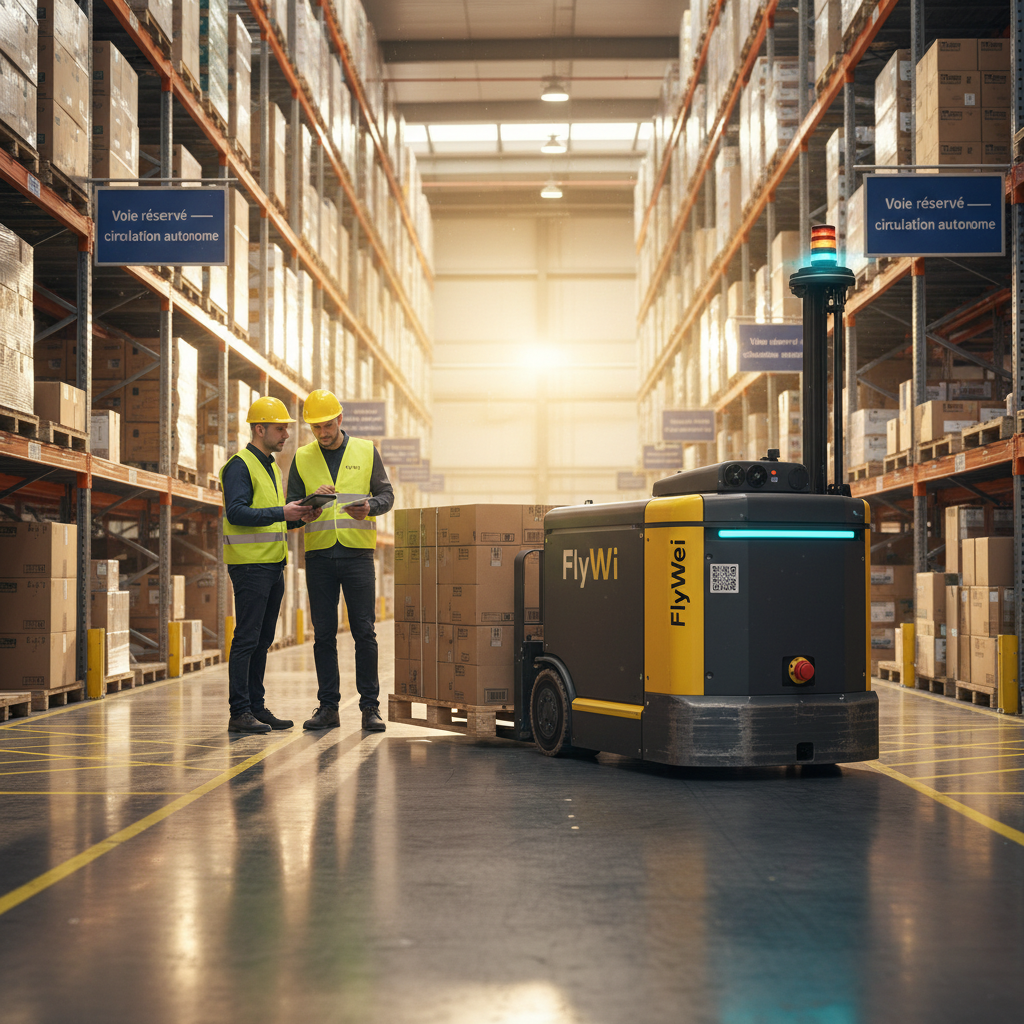
For a logistics director running autonomous forklifts in France, Spain or Italy, the question in 2026 is no longer whether to automate pallet handling: it is how quickly a Southern European multi-site DC network can hit CE-marked autonomy without losing throughput on the way. With Regulation (EU) 2023/1230 fully applicable from 20 January 2027 and warehouse labour costs climbing across Lyon, Madrid, Milan and Poznań, the buying window is narrow and the audit risk is real.
Under Regulation (EU) 2023/1230, autonomous industrial trucks placed on the Southern European market from 20 January 2027 must carry a Declaration of Conformity referencing EN ISO 3691-4:2023, supplied in the operator's national language.
Why pallet automation hits differently in France, Spain and Italy
Southern European logistics is in the middle of three simultaneous shifts. Eurostat transport statistics show pallet volumes through the major DC corridors (Île-de-France around Paris-Sud, the Catalonia-Aragón axis along the AP-2, the Emilia-Romagna belt from Piacenza to Bologna, and the rapidly growing Polish hubs around Poznań and Wrocław) have all risen faster than warehouse headcount since 2023. That gap is filled today by overtime, by agency labour, and by an increasingly expensive third shift that French and Italian operators in particular struggle to staff.
The second shift is regulatory. Regulation (EU) 2023/1230 tightens the technical-file and risk-assessment requirements for driverless industrial trucks, and harmonises the assessment route through EN ISO 3691-4:2023. From 20 January 2027, every new autonomous forklift placed on the market in a Member State must carry a CE-marked Declaration of Conformity built against the new regulation, including translations of the operator manual into the national language of the deployment site.
The third shift is buyer behaviour. A French or Spanish DC director used to evaluate a single piece of automation in isolation: a vertical lift, a goods-to-person shuttle, an under-roof crane. In 2026, the same buyer is asked to evaluate a fleet (autonomous forklift, autonomous pallet truck, latent-jacking AMR, and the orchestration layer that runs them all) as one decision. That makes the technical-file work cumulative, and the procurement timeline shorter than most legacy vendors expect.
Lever 1, Operational: design the shift, not the robot
The single biggest mistake a Southern European retail-DC team makes when piloting autonomous forklifts is treating them as a one-for-one driver replacement. They are not. A counterbalanced autonomous forklift on a 2-tonne pallet duty does roughly 38 to 42 cycles per hour at a steady cadence across a 22-hour operational window: a manual driver in France or Italy will hit higher peaks but cannot sustain that cadence into a third shift. The operational lever is to redesign the shift around the robot's cadence, not the driver's. Move the supervisor off the forklift seat and onto a fleet-control tablet, schedule the heaviest racking moves into the cool overnight band, and reserve the human team for exceptions: receipt anomalies, damaged stretch wrap, OOG pallets the robot legitimately should refuse. Operators on the Piacenza fashion belt running this pattern report consistent picks-per-FTE improvements without changing their racking layout. The key is that the shift design is owned by the logistics director, not the integrator.
Lever 2, Technical: orchestrate with VDA 5050, not a vendor SDK
Vendor lock-in is the single most expensive trap in Southern European warehouse automation right now. Every legacy material-handling vendor would love to sell France or Spain a closed fleet that talks only to its own controller. The lever is to insist on VDA 5050 compliance: the German VDA's open-fleet interface that lets a single master controller speak to autonomous forklifts, latent-jacking AMRs and tugger AMRs from multiple manufacturers. FlyWei's M4 fleet manager runs as that master controller. It maintains the live traffic map, hands jobs to the right machine class, and exposes a single REST endpoint to the operator's existing enterprise WMS and ERP. The technical lever is to write VDA 5050 compliance into the RFQ as a hard pass/fail, not a preference. Without it, the second autonomous brand on site doubles your integration cost.
Lever 3, Regulatory: own the technical file in the local language
French and Italian operators in particular are exposed on documentation. Under Regulation (EU) 2023/1230, the manufacturer is responsible for the Declaration of Conformity, but the operator is responsible for keeping the technical file accessible in the workplace language. A British-supplied autonomous forklift with English-only manuals is a non-conformity finding waiting to happen in a Lyon or Madrid inspection. The regulatory lever is to require, in the purchase order, translated manuals, translated risk assessment, and translated maintenance log templates as part of the delivery. Cross-reference each control measure with the relevant clause of EN ISO 3691-4:2023: clause 4 for general design, clause 5 for personnel safety, clause 6 for stability under load. UK operators familiar with PUWER will recognise the structure: Regulation 2023/1230 is a stricter, harmonised cousin of the same logic.
Lever 4, Financial: capex vs leased fleet under EU rules
Capex committees in Madrid, Milan and Warsaw increasingly ask procurement to model autonomous forklifts on a leased-fleet basis rather than outright purchase. Two reasons. First, Regulation 2023/1230 puts ongoing conformity obligations on the legal possessor of the equipment: a leased fleet keeps that obligation with the lessor. Second, a leased 18-month pilot fits the typical Southern European retail-DC investment cycle better than a five-year depreciation schedule. FlyWei offers both. The financial lever for the logistics director is to model both options against a realistic three-shift labour baseline and a documented downtime allowance, and to insist that the model is published to the capex committee in the local-language template their finance function actually reads.
| Country | Eurostat indicative labour cost, transport & storage | Typical shift-pattern saved | Indicative payback band |
|---|---|---|---|
| France | ~€32/hour | Third shift, 22:00 to 06:00 | 14 to 18 months |
| Italy | ~€28/hour | Weekend pallet pull | 16 to 22 months |
| Spain | ~€22/hour | Peak-season agency cover | 20 to 26 months |
| Poland | ~€13/hour | Driver-shortage gap, not cost | 22 to 30 months (labour-availability driven) |
What FlyWei does for a Southern European DC director
FlyWei supplies and integrates a CE-marked autonomous-forklift fleet for French, Spanish, Italian and Polish distribution centres. The product range covers the counterbalanced autonomous forklift for 2-tonne pallet work in retail DCs, the reach-truck variant for narrow-aisle high-bay racking in fashion DCs around Piacenza and Bologna, and the latent-jacking AMR for sub-assembly trolleys in mixed-flow retail sites. The FlyWei autonomous-forklift range ships with the full technical file referenced against EN ISO 3691-4:2023, and the FlyWei M4 fleet manager sits as the VDA 5050 master controller so a Southern European operator never owes a single vendor exclusive orchestration rights.
For mixed-fleet sites running a combination of autonomous forklifts and FlyWei lifting robots, M4 hands work to the right machine class and exposes a single REST API to the operator's existing enterprise WMS and ERP. The supporting evidence base for European deployments lives in our European 3PL integration brief and the head-to-head against fixed-grid shuttle systems in our autonomous forklifts vs. AMR shuttles comparison. The total-cost picture for a comparable UK DC is laid out in our UK TCO 2026 deep-dive, which Southern European directors find a useful starting point for their own capex case.
Frequently asked questions
What does CE marking actually prove for an autonomous forklift in France?
CE marking under Regulation (EU) 2023/1230 is the manufacturer's declaration that the autonomous forklift meets the essential health and safety requirements of the regulation, supported by a technical file and a risk assessment. For a French DC operator, the practical effect is that the Declaration of Conformity and the operator manual must be available in French, and aligned with EN ISO 3691-4:2023.
When does Regulation (EU) 2023/1230 actually apply?
The regulation entered into force in July 2023 and is fully applicable from 20 January 2027. Equipment placed on the EU market before that date can continue to be assessed under the older Machinery Directive 2006/42/EC, but every new autonomous forklift purchased from 2027 onwards in France, Spain, Italy or Poland will need to ship with the new conformity package.
How does VDA 5050 protect a Spanish operator from vendor lock-in?
VDA 5050 is an open interface that lets a single master controller (in FlyWei's case, M4) issue jobs to autonomous forklifts, AMRs and tugger robots from multiple manufacturers. Writing VDA 5050 compliance into the RFQ means a Spanish DC operator can add a second or third robot brand later without rewriting their orchestration layer.
What is a realistic ROI window for an autonomous forklift in an Italian retail DC?
For a typical Italian retail DC running two-and-a-half shifts at indicative Eurostat labour costs around €28/hour for transport and storage, an autonomous counterbalanced forklift handling 38 to 42 pallets per hour usually pays back inside 16 to 22 months: provided the shift design is rebuilt around the robot's steady cadence rather than the driver's peak-and-rest pattern.
Do I need separate documentation for each Member State?
The Declaration of Conformity itself is a single EU-wide document under Regulation 2023/1230, but the operator manual, safety signage and maintenance log templates must be supplied in the official language of the deployment site. FlyWei ships French, Spanish, Italian and Polish documentation as standard on Southern European orders.
How does the EU Machinery Regulation compare to UK PUWER?
PUWER 1998, enforced by the HSE, is the closest UK analogue: it places duties on the employer to ensure work equipment is safe, suitable and maintained. Regulation (EU) 2023/1230 is broader because it also regulates how the equipment is placed on the market in the first place, and it makes the manufacturer's technical file far more prescriptive than the UK regime currently requires.
Where can a logistics director see the FlyWei autonomous forklift in operation?
FlyWei runs Southern European on-site assessments, typically a two-day pilot scoped to one DC aisle, so a logistics director can see throughput, safety perimeter behaviour and the M4 orchestration layer in their own racking before signing off the capex case. Scope a French, Spanish, Italian or Polish assessment via flywei.co.uk/contact.
Talk to FlyWei about a Southern European autonomous-forklift assessment: flywei.co.uk/contact.