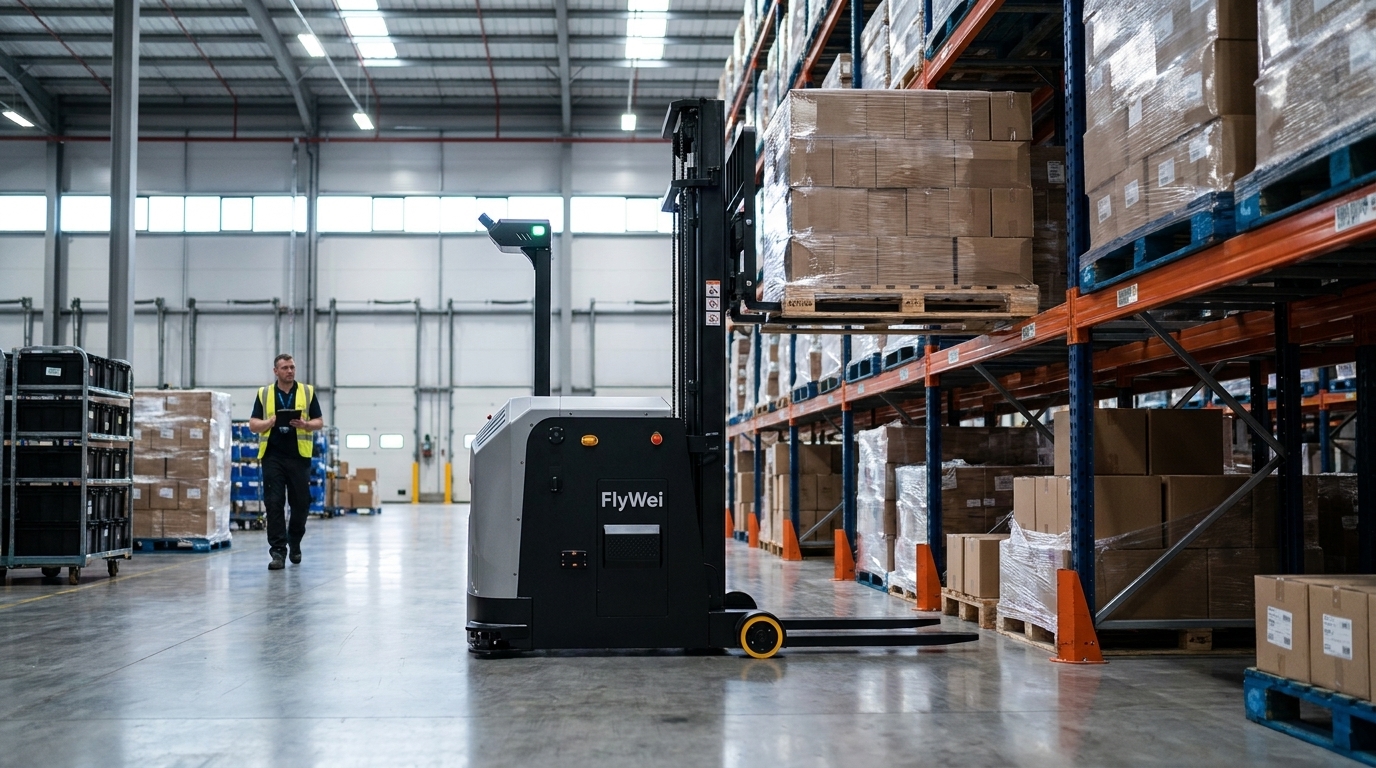
Autonomous forklifts are driverless counterbalance, reach and stacker trucks that navigate a warehouse using on-board laser scanning and a central fleet controller, moving pallets on repeatable routes with no operator on board. They matter in a country where the Health and Safety Executive recorded 24 worker deaths from being struck by a moving vehicle in Great Britain in 2025/26, and 15 of the year's 126 worker fatalities in the transport and storage sector (HSE fatal injury statistics, provisional). For an operations director running contract logistics, though, the pressure this quarter is commercial rather than statistical. A new client contract has been signed with a go-live date eight weeks out, the volume forecast assumes a second trunking wave, and the site needs four more counterbalance drivers on nights that the local agency cannot supply at the rate the bid was priced at. Every week the shortfall persists, service credits creep closer.
Why 3PL sites run short of pallet-movement capacity
Contract logistics has a structural mismatch at its heart. A client contract typically runs three to five years, with break clauses and volume collars. A counterbalance truck is a five to seven year asset, and an accredited operator takes weeks to train and months to retain. The operations director therefore commits labour and equipment on one timescale against revenue certainty on a shorter one.
That mismatch shows up three ways. First, agency reliance: night and weekend premiums are bid at a rate the local market stopped honouring, and churn means the site is permanently re-inducting operators onto a layout they do not yet know. Second, the moves themselves are mostly not skilled work. On a typical multi-client site around the Magna Park and DIRFT corridors, a large share of truck hours go on long, repeatable journeys — dock to bulk store, bulk store to marshalling — rather than on judgement-heavy work such as recovering a collapsed load.
Third, the regulatory baseline is fixed regardless of how thinly a site is staffed. The Provision and Use of Work Equipment Regulations 1998 require that work equipment is suitable, maintained and used only by people who have had adequate training, and HSE guidance on PUWER treats mobile work equipment as a distinct category with its own duties. A short-staffed night shift does not reduce those duties; it concentrates them on fewer people. Operating cost and capacity pressure remains a dominant theme in Logistics UK reporting, which is why most operations directors absorb new volume without a matching headcount line.
Autonomous forklifts move pallets on repeatable routes with no operator on board, in a country where HSE recorded 24 worker deaths from being struck by a moving vehicle in Great Britain in 2025/26.
Lever 1 — Automate the repeatable trunk moves first, not the whole operation
The fastest route to capacity is not a fully automated warehouse. It is identifying the two or three longest repeatable flows and moving those to robots, so accredited operators concentrate on work that genuinely needs a person. Start by pulling a week of truck telemetry or, failing that, a week of manual observation: journey start, journey end, distance, time of day. On most multi-client sites one flow dominates — usually inbound dock to bulk store, or bulk store to the replenishment face.
Automate that single flow end to end rather than a third of three flows. A dedicated loop gives you a clean traffic pattern, predictable charging windows and a measurable before-and-after on moves per hour. It keeps the go-live small enough to commission inside an eight-week window, and it does not disturb the pick face, where your service-level risk and your most experienced people sit. Expand to a second flow only once the first has run a full peak cycle, including a bad week.
Lever 2 — Put one fleet controller above a mixed fleet
A single robot solves a task. A fleet controller solves a business problem, because it makes capacity portable. The M4 fleet manager sits above the trucks and decides which machine takes which move, how traffic resolves at aisle ends, and when a unit comes off task to charge. That matters commercially: when a contract ends or volume shifts between clients on a shared site, re-tasking a fleet is a configuration change rather than a procurement cycle.
Insist on open standards at this layer. VDA 5050 is the published interface for a central fleet controller to command mobile robots from different manufacturers using the same message format, which is what stops you being locked into one machine supplier for the life of the site. Above that, FlyWei RDS robot dispatch takes work from the systems you already run, so your enterprise WMS stays the record of stock. Ask any supplier how long the fleet manager runs if the link to your warehouse system drops, and how duplicate confirmations are prevented on reconnection.
Lever 3 — Build the PUWER and ISO 3691-4 case before the first robot lands
Treat the safety case as a design input. ISO 3691-4 is the international standard covering driverless industrial trucks and their systems, and it is the document your insurer and your client's own health and safety team will expect you to have worked to. PUWER duties continue to apply: equipment must be suitable for the place and purpose, maintained, inspected, and operated and supervised by people with adequate training.
In practice that means four things written down before commissioning. One, a traffic management plan separating robot routes from pedestrian walkways, with marked zones at every crossing point. Two, a documented change-control route, so moving a racking bay or a pedestrian door triggers a mapping review rather than a surprise. Three, floor condition surveyed against TR34 flatness expectations, because navigation accuracy and mast stability at height both depend on it. Four, a competence matrix: your operators become fleet supervisors and exception handlers, which is a different training record from a counterbalance licence.
Lever 4 — Match the funding term to the contract term, not the asset life
The mismatch that creates the problem can be closed on the funding side. If a client contract runs five years, financing a robot fleet over a term aligned to that contract keeps the commitment inside the revenue window you can actually see. FlyWei leasing over 3, 5 and 7-year terms bundles the robots, the fleet-manager licence, maintenance and wear parts, UK support and operator training into one monthly rate, which converts a capex argument your board may not want this year into an operating line a contract P&L can carry.
That framing also changes the internal conversation. A capex committee asked for a seven-figure authorisation against a contract with a break clause will reasonably hesitate. The same committee asked to approve a monthly cost per pallet move, inside a term that ends when the contract does, is answering a question it can take straight from the bid model. Mid-term fleet-mix reviews matter here too: a shared site's client mix at year one is rarely its mix at year four.
| Lever | Main cost driver | Typical time to effect | What it does not fix |
|---|---|---|---|
| Automate one repeatable trunk flow | Robot units plus commissioning | Inside one go-live window | Pick-face labour and exception handling |
| One fleet controller over a mixed fleet | Fleet-manager licence plus integration | Commissioning, then ongoing | Poor master data or unlabelled locations |
| PUWER and ISO 3691-4 case built in | Engineering and survey time | Before commissioning | Volume shortfall on its own |
| Funding term matched to contract term | Monthly operating cost | At contract signature | Layout or floor-condition constraints |
What FlyWei does here
FlyWei is an independent, vendor-neutral UK systems integrator of autonomous forklifts and AMRs. On a multi-client contract logistics site that independence is the point: FlyWei specifies the machine class each flow actually needs rather than the machine one manufacturer happens to sell. A long inbound dock-to-bulk run usually calls for a counterbalanced autonomous forklift; narrow-aisle high-bay replenishment calls for a FlyWei autonomous reach truck; mid-height racking calls for a stacker class. One site can need all three.
FlyWei designs the flow before it supplies a robot — surveying the site, timing candidate moves, checking floor and aisle constraints, and modelling unit count against your actual shift pattern rather than a throughput claim. FlyWei then integrates the fleet under M4, with RDS taking work from the ERP and WMS you already run, so stock stays where your client's reporting expects to find it.
Delivery includes the parts a 3PL go-live lives or dies on: traffic management design, the PUWER and ISO 3691-4 documentation pack your client's auditors will ask for, operator-to-supervisor training, and UK-based engineering support. See FlyWei storage and logistics deployments for how this is sequenced on live sites, and our analysis of automated forklift fleets and 3PL peak variance for the volume-flex side of the question.
Frequently asked questions
What are autonomous forklifts?
Autonomous forklifts are industrial trucks — counterbalance, reach, stacker or pallet-truck classes — that move loads without a driver on board. They locate themselves using on-board laser scanning against a map of your building, take work from a central fleet controller, and stop or re-route when a person enters their path.
Can autonomous forklifts go into an existing 3PL warehouse without rebuilding it?
Usually yes — brownfield deployment is the normal case. What matters is aisle width, floor condition, uniquely identified locations and a traffic pattern that separates robot routes from pedestrian walkways. Unlabelled locations and unreliable stock data are more often the real blocker than racking.
How quickly can a fleet be live for a new contract go-live?
One well-chosen repeatable flow can usually be commissioned inside a typical go-live window, provided the survey happens early and your warehouse system can expose open work. The long pole is agreeing how tasks reach the fleet and testing against live data, not the robots themselves.
Do autonomous forklifts remove the need for accredited operators?
No. Automating the long repeatable moves frees accredited operators for judgement-heavy work such as damaged locations and collapsed loads. PUWER duties on training, supervision and maintenance continue to apply, and you need a fleet-supervisor competence record alongside the counterbalance licence, not instead of it.
What safety standards apply to driverless trucks in the UK?
ISO 3691-4 is the international standard for driverless industrial trucks and their systems, and it is what insurers and client auditors expect the design to have been worked to. PUWER 1998 governs suitability, maintenance, inspection, training and supervision; floor flatness is typically assessed against TR34 expectations.
How many autonomous forklifts does a site actually need?
It depends on cycle time and shift pattern, not pallet volume alone. The calculation is moves required per hour across the target flow, divided by achievable moves per hour per unit at your distances and lift heights, with charging windows and a contingency unit built in.
If flexing pallet-movement capacity for a contract go-live is on your Q4 risk register, the useful next step is small and specific.
Book a free 30-minute site survey and a FlyWei engineer will time your longest repeatable flow, check floor and aisle constraints, and tell you how many units that flow actually needs — or read the specifications first on FlyWei autonomous forklifts.
UK-based engineers · no obligation · reply within one business day.