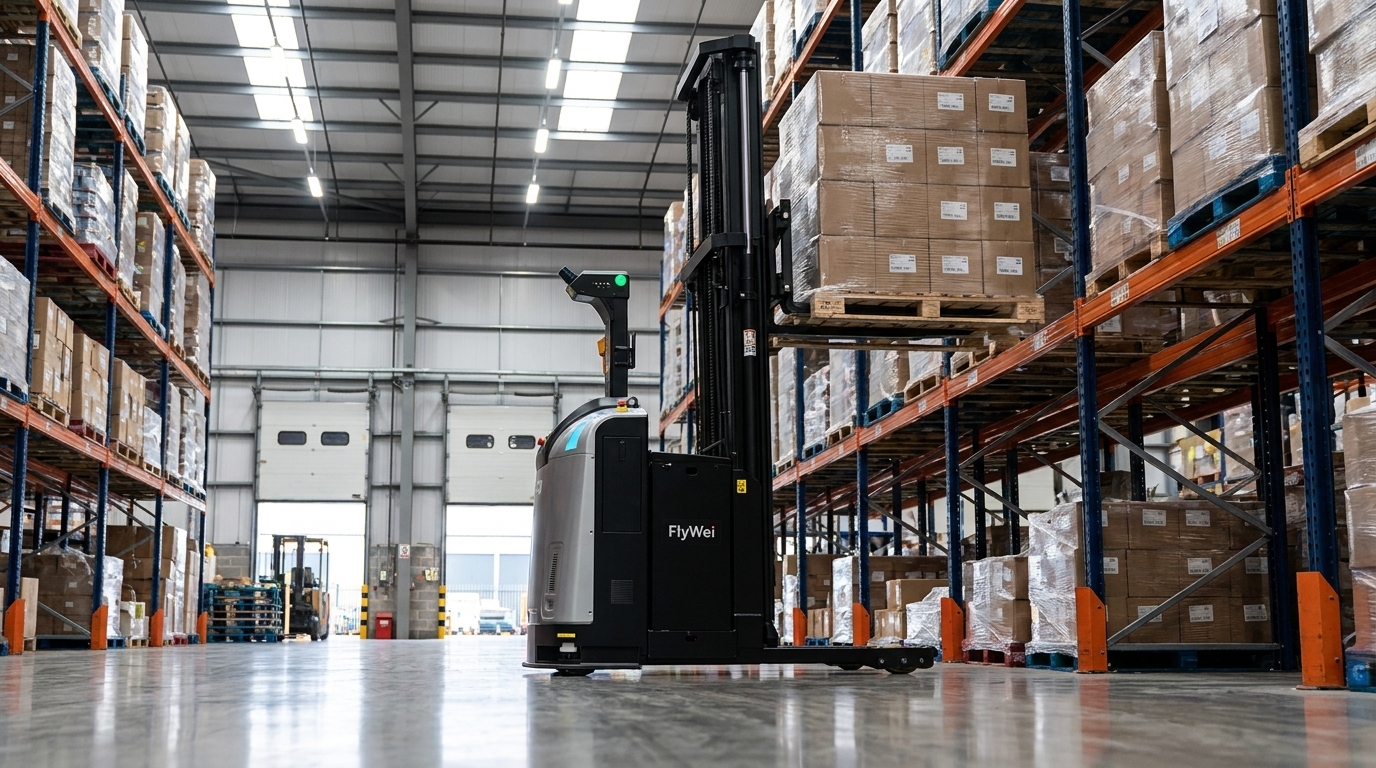
An automated forklift is a driverless industrial truck that lifts, carries and stacks pallets under software control, guided by on-board sensors instead of a seated operator. Handling, lifting or carrying still caused 17% of the 59,219 non-fatal employee injuries UK employers reported to the regulator in 2024/25, according to HSE injury statistics. For a supply chain director running multi-client contract logistics out of the Midlands golden triangle, that figure is only the visible edge of a wider throughput problem. Pallet movement in a 3PL shed is the one flow every client SLA depends on, and the one flow staffed by the least stable labour pool. Agency cover rates climb into Q4, counterbalance tickets expire, and a single unfilled night shift on goods-in pushes putaway into the morning pick window. Average throughput looks acceptable on the monthly report; it is the variance between shifts that triggers penalty clauses and loses contract renewals.
Why 3PL pallet flow breaks before anything else does
Contract logistics runs on a structural mismatch. A client contract lasts three years; the labour that services it turns over far faster. Counterbalance and reach-truck operators are the hardest roles on a UK site to fill at short notice, and the premium for agency cover rises exactly when you need it most — the autumn ramp into peak. Everything downstream inherits that instability, because no pick and no despatch happens until a pallet has been put away.
Site geometry makes it worse. Most contract logistics space around Magna Park, DIRFT and Daventry is brownfield and shared. Aisles were set for the tenant before you and racking has been re-pitched twice. Slab tolerance under BSI-referenced concrete guidance such as TR34 was never specified for high-lift automation. That is why generic automation pitches land badly here: they assume a greenfield flow plan you do not have.
The duty of care does not move either. HSE guidance on workplace transport safety applies to a driverless truck exactly as it does to a manned one, as does the Provision and Use of Work Equipment Regulations 1998. Automating a flow does not transfer that responsibility to a supplier. The cause nobody budgets for is simpler: automation underdelivers when a buyer treats it as a hardware purchase and neglects the workflow, the data and the people around it.
Handling, lifting or carrying caused 17% of the 59,219 non-fatal employee injuries reported by UK employers in 2024/25, which makes pallet movement the single most automatable safety and throughput risk on a 3PL site.
Lever one: automate the trunk moves, not the exceptions
Start where the work is repeatable and the decision content is near zero. On almost every contract logistics site that means two flows: inbound pallets from dock to bulk storage, and replenishment from bulk to the pick face. They run all day and all night, they have fixed origins and destinations, and they are the flows that collapse when an agency booking falls through. Map a fortnight of moves from your warehouse system, rank them by volume and repeatability, then draw a line under the top three.
Leave the awkward work with your operators deliberately. Damaged pallets, non-conforming loads, container devanning and any judgement call about stock condition should stay manual in phase one. A fleet that covers 70% of standard moves reliably beats one that attempts everything and needs a supervisor beside it. Measure the result as SLA breaches per client per week, not as robot utilisation.
Lever two: put a vendor-neutral orchestration layer between your WMS and the trucks
This is the technical decision that determines whether you own the outcome or rent it. Autonomous trucks do not connect to a warehouse management system directly. A fleet management layer sits between them, takes work over a documented interface, translates it into missions, then writes completions and load confirmations back so your existing system stays the record of stock. FlyWei's M4 fleet manager does exactly that, dispatching to trucks from different manufacturers across one map and one traffic plan over the VDA 5050 open standard. Where robots run alongside conveyors and fixed automation, FlyWei RDS robot dispatch handles the wider device mix.
Insist on three things in writing: that the fleet layer speaks an open standard natively rather than through a bespoke adapter per supplier; that it keeps running when the link to your warehouse system drops, queuing completions and replaying them without duplicating stock movements; and that your enterprise WMS is never replaced to make the robots work.
Lever three: build the PUWER and ISO 3691-4 evidence pack before the first truck lands
Treat compliance as a deliverable with a date, not a form signed at handover. Driverless industrial trucks in the UK sit under ISO 3691-4, and the duties in PUWER 1998 — suitable equipment, adequate inspection, competent persons, controlled access — apply to the whole installation, not just the vehicle. Where lifting accessories are involved, LOLER duties come with them. UKCA marking on the trucks is the supplier's job; the site risk assessment is yours.
Build the pack in this order: a segregation plan for pedestrian and vehicle routes; a traffic drawing of every crossing and dock interface; the safety function list with scanner fields and stopping distances per truck type; the inspection regime with named competent persons; and change control for when a client moves out. Handing that file to a client audit team in week one has closed more deals than any throughput figure.
Lever four: fund the fleet against contract length, not asset life
A 3PL capex committee is asked to approve a seven-year asset against a three-year contract, and quite reasonably says no. That mismatch, not the technology, stalls most automation cases in contract logistics. The fix is to move the decision out of capex and match the funding term to the commercial commitment you actually hold. FlyWei autonomous forklift leasing runs over 3, 5 and 7-year terms with the robots, fleet-manager software, full maintenance including wear parts, UK-based support and operator training inside one monthly cost.
Framed that way you are comparing a fixed monthly cost with a volatile agency one, over a term aligned to the client contract. Ask for interface work, commissioning and post-go-live support to be priced as visible line items rather than bundled, and model the downside on shift coverage rather than headcount removal.
| Lever | What changes on the floor | Time to effect | Risk if skipped |
|---|---|---|---|
| Trunk moves first | Goods-in to bulk and bulk to pick face run to the same clock every shift | 8 to 14 weeks survey to go-live, per FlyWei storage and logistics deployments | Scope creep into exceptions; a process problem blamed on the fleet |
| Vendor-neutral orchestration | One map, one traffic plan, mixed truck types dispatched from your existing WMS | Designed at survey; proven at commissioning | Locked to one supplier's roadmap and pricing at expansion |
| Safety evidence pack | Segregation, traffic plan and inspection regime auditable from day one | Drafted before commissioning; issued at handover | Enforcement exposure and client audits stalling rollout |
| Term-matched funding | Fixed monthly cost replaces volatile agency cover | Approval cycle only; 3, 5 or 7-year terms via FlyWei leasing | Seven-year asset judged against a three-year contract |
What FlyWei does on a multi-client contract logistics site
FlyWei is an independent UK systems integrator of autonomous forklifts and AMRs. We are not an OEM and not a reseller, so we specify from across the market and then own the integration — which on a 3PL site matters more than any single truck specification. The FlyWei automated forklift range covers pallet trucks from 300 kg, autonomous pallet stackers, counterbalanced trucks to 3 tonnes and narrow-aisle reach trucks to 10 m, all navigating by natural-feature SLAM with no wires, tape or floor magnets to install. That matters in a shared shed, because the racking will move again.
Work starts with a free site survey: a fortnight of move data, a walk of every dock and crossing, and slab and aisle measurements against what high-lift automation needs. FlyWei then sizes the fleet against your worst shift rather than your average, integrates through M4 so your existing ERP and WMS stay the source of truth, and writes the segregation and traffic plan alongside the commissioning schedule. Where cage and trolley flows sit behind the pallet work, FlyWei lifting robots cover them under the same fleet manager. Support is UK-based: maintenance, reactive repairs, software updates and spare parts, with engineers rather than a call centre. For the technology distinction, see our guide to autonomous forklifts versus AGVs and our earlier piece on AGV forklift trucks holding night-shift putaway.
Frequently asked questions
What is an automated forklift?
An automated forklift is a driverless industrial truck that lifts, carries and stacks pallets under software control. It navigates by on-board laser scanners and a digital map, takes work from a fleet management layer connected to your warehouse system, and reports every completed move back.
How is an automated forklift different from an AGV forklift?
Classic AGV systems follow a fixed path — buried wire, magnetic tape or reflective markers — so changing a route means ground works. An automated forklift navigates from a map built off natural features, so routes are reconfigured in software.
Will an automated forklift work in an existing brownfield 3PL warehouse?
Usually yes, and brownfield is the normal case. What matters is aisle width at full lift height, slab flatness against guidance such as TR34, dock geometry, and whether pedestrian routes can be segregated. All four are measurable at survey.
Do we need to replace our WMS to run automated forklifts?
No. An orchestration layer sits above your warehouse system and takes work from it, so that system stays the source of truth for stock and orders. Replacement is only worth considering where it cannot expose open work at all.
What safety regulations apply to automated forklifts in the UK?
Driverless industrial trucks are covered by ISO 3691-4, and PUWER 1998 site duties apply in full: suitable equipment, adequate inspection, competent persons, controlled access. LOLER applies where lifting accessories are used. UKCA marking is the supplier's job; the site risk assessment is yours.
How long does an automated forklift deployment take?
On a single well-defined flow, 8 to 14 weeks from free site survey to go-live is typical. The long pole is rarely the trucks; it is agreeing how work is handed over and getting a test environment with realistic data.
Can automated forklifts be leased rather than bought?
Yes. Leasing over 3, 5 or 7-year terms bundles robots, fleet-manager software, full maintenance with wear parts, UK-based support and operator training into one monthly cost — over a term you can match to the client contract.
If shift-to-shift pallet throughput variance is on your Q3 risk register, the fastest way to size it is one flow, not the whole site.
Get a 48-hour feasibility read on your highest-volume flow — send a fortnight of move data and we will tell you what an automated forklift fleet would and would not cover. To start with the equipment instead, the FlyWei automated forklift range lists every truck class with payloads and lift heights.
UK-based engineers, no obligation, and a reply within one business day.