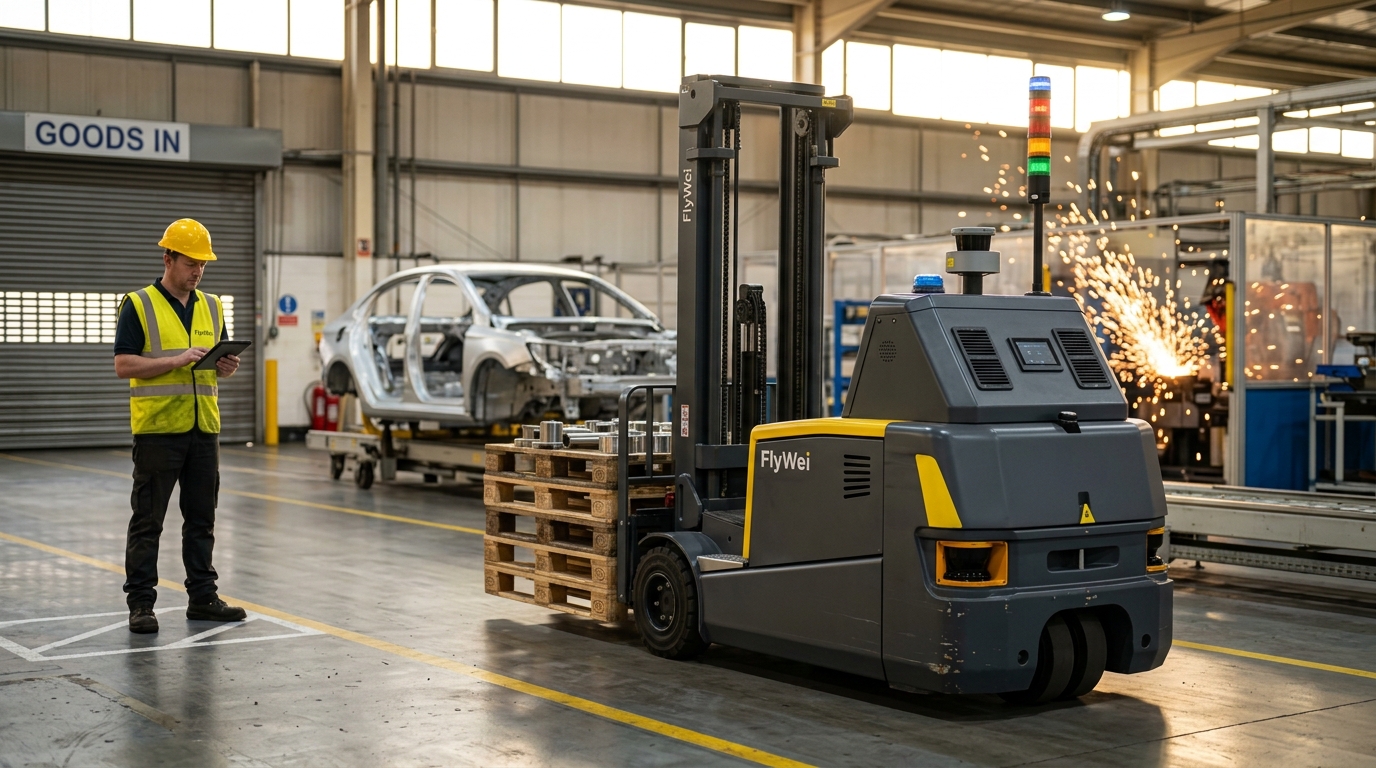
Autonomous forklifts in UK automotive plants are sensor-driven counterbalanced trucks and reach trucks that move engine sub-assemblies, body panels and finished pallets along plant aisles without an onboard driver, guided by site-wide fleet software rather than fixed magnetic tape. The Health and Safety Executive logs around 25 workplace-transport fatalities a year in Great Britain (see the HSE workplace transport guidance), with lift trucks and forklifts the largest single category. For a Plant Director running a 24/7 paint shop or engine assembly line in the West Midlands or Sunderland, the brutal arithmetic is that one missed driver shift means fifteen to thirty minutes of starved line, and one mixed-traffic near-miss triggers a PUWER risk reassessment that can sideline an entire aisle for days. The line keeps running only if the materials keep moving, and the materials only keep moving if the trucks do.
At a 90-second body-in-white takt, twenty minutes of pallet starvation costs thirteen finished vehicles before anyone notices the truck did not show up.
Why automotive plants feel MHE downtime harder than anyone else
The British automotive plant is uniquely exposed to material-handling downtime. UK light-vehicle production sits in a small number of large assembly halls, and the bulk of output is concentrated in fewer than ten major sites: see the Logistics UK industrial freight tracker for the latest picture. At a per-line takt of 60 to 90 seconds for a body-in-white line and around 110 seconds for a powertrain line, a single 20-minute pallet-starvation event costs between 13 and 20 finished units, and at gross margin per vehicle that can run into a five-figure number per minute of stoppage.
The problem is structural. UK automotive plants run lean-pull material flow into supplier parks: tier-one racks dock against the line, sub-assemblies are kitted on milk runs by tugger trains, and pallet-grade finished goods flow back out to the export yard. Every step depends on a counterbalanced forklift or a low-profile pallet truck arriving on cue. The HSE and Logistics UK both flag a structural shortage of CPCS- and RTITB-certified forklift drivers across the Midlands and North-East corridor. Drivers also book holiday, fall ill and take statutory breaks: none of which the line cares about.
Layer regulation on top. The autonomous industrial truck standard, ISO 3691-4, requires a designed safety case for mixed manned and autonomous traffic. PUWER 1998 requires the truck is fit for use and the operator is competent. Together they raise the bar: you cannot bolt a robot into a manned aisle and hope.
The four levers that fix it
Operational lever: design the fleet around cadence, not vehicle counts
Plant Directors who treat autonomy as a vehicle-replacement project tend to under-spec the fleet. The right unit of capacity is not "trucks per shift" but cycles per minute against the takt of each line. Start by mapping the four highest-cycle flows (inbound dock-to-line, line-to-line buffer moves, finished-goods-to-yard and empty-pallet returns) and size the autonomous fleet to clear each at the worst-case takt plus a 15 per cent surge buffer. An autonomous truck working a fixed loop at predictable speed and dwell time is far easier to schedule than a manned truck whose driver may detour to refuel, sign a paper note or pick up a different job. One autonomous counterbalanced unit running 22 hours of a 24-hour day usually replaces 1.7 to 2.0 manned shifts on the same loop, before any savings on training, agency cover or sickness.
Technical lever: VDA 5050 and in-plant fleet orchestration
The single most important question on the technical RFP is "does the truck speak VDA 5050?" VDA 5050 is the open German automotive-industry interface for talking to autonomous mobile vehicles. If your trucks speak it, the same in-plant fleet manager that already directs your tugger AMRs can also dispatch your autonomous counterbalanced forklifts, low-profile pallet trucks and heavy-lift sub-assembly AMRs. That matters because most automotive plants will not run a single-vendor fleet for long, and the moment two vendors share an aisle the absence of a common interface becomes the bottleneck. Pair VDA 5050 with a fleet manager that exposes a clean API to your existing in-plant manufacturing-execution and warehouse stock module, so as soon as a kanban card or electronic pull signal fires on the line, the closest available autonomous truck is already moving toward the pickup. Plant Directors should specify, in writing, that the fleet manager publishes telemetry per truck per minute and exposes an OEE-style availability dashboard at line level.
Regulatory lever: ISO 3691-4 and PUWER risk-assessed lanes
The regulatory lever is where UK automotive plants outperform 3PLs because they already have the safety culture and the risk-assessment team in-house. Build the autonomous lanes the same way you would build a new robotic welding cell: a designed safety case, signed-off zoning, light curtains or scanners at any pedestrian crossing point, segregated charging bays and a documented response procedure for unplanned manual entry. ISO 3691-4 gives you the framework for the safety case itself; it covers braking distance, speed-reduction zones, obstacle-detection performance and emergency-stop behaviour. The HSE PUWER guidance tells you who is competent to sign it off and what records need to live with the truck. The British Standards Institution publishes the harmonised standards behind UKCA marking that the trucks themselves must carry. A clear, documented mixed-traffic safety case pays back twice: first by clearing internal sign-off in days rather than months, second by deterring reportable incidents that would freeze an aisle for days at a time.
Commercial lever: own the fleet manager from day one
The hidden risk in automotive automation is vendor lock-in. If a single integrator owns the dispatch logic, every future change (a new aisle, a retrained kit route, a swapped-in robot for next year's model) runs through their professional-services queue. Plant Directors should insist on owning the fleet-manager licence and the underlying data from day one, even if the integrator commissions the system. Confirm in the contract that the on-site Plant team has direct access to the route editor, the safety-zone editor and the telemetry stream. That way you can re-tune the route map at the next model launch without raising a change request.
What FlyWei does in UK automotive plants
FlyWei integrates mixed-fleet autonomous material-handling solutions for UK automotive plants. The FlyWei autonomous counterbalanced forklift is sized for the 1.5- to 2.0-tonne pallet flows that dominate inbound goods and finished-vehicle yards. The FlyWei heavy-lift autonomous AMR handles engine sub-assemblies and transmission cases on the assembly line, and the FlyWei low-profile pallet-truck autonomous forklift slips under standard EUR pallets at the dock. All variants speak VDA 5050, so the FlyWei M4 fleet manager and the FlyWei fleet dispatch software can also direct a third-party truck or tugger AMR if you choose to dual-source. M4 publishes per-line OEE-style availability metrics straight into your existing manufacturing-execution and warehouse stock systems. Most relevant for Plant Directors: FlyWei runs the safety case with your in-plant safety team to ISO 3691-4 and PUWER 1998 as part of the deployment, not as an add-on. The FlyWei automotive distribution hub consolidates the relevant playbooks, and the autonomous forklift product page covers the full variant range.
Frequently asked questions
Are autonomous forklifts legal to run in a UK automotive plant?
Yes. Autonomous forklifts in UK automotive plants run under PUWER 1998 and the ISO 3691-4 autonomous industrial truck standard. The Plant Director's job is to ensure the designed safety case for mixed manned and autonomous traffic is documented and signed off by a competent person under PUWER, and that the truck carries appropriate UKCA marking under harmonised BSI standards.
How long does deployment take from order to live in a mid-sized engine plant?
A typical UK automotive plant deployment of two to four autonomous counterbalanced forklifts on one line takes 10 to 14 weeks from purchase order to live operation: four weeks of safety-case design, four to six weeks of map build and fleet-manager configuration, and two to four weeks of supervised commissioning. The path shortens to as little as eight weeks for plants that already have an ISO 3691-4 baseline.
What is VDA 5050 and why does it matter for UK plants?
VDA 5050 is the open German automotive-industry interface for instructing autonomous mobile vehicles. It matters because most Plant Directors will end up with a mixed fleet of counterbalanced forklifts, pallet trucks and tugger AMRs from more than one vendor. If every vehicle speaks VDA 5050, one in-plant fleet manager can dispatch all of them, which removes vendor lock-in and lets the plant re-tune the route map at every model launch.
Can autonomous forklifts run safely on the same aisle as pedestrians?
Yes, provided the aisle is designed for mixed traffic to ISO 3691-4. Practically this means scanner-based pedestrian detection on the truck, lighted floor projections at speed-restriction zones, and PUWER-signed-off rules for manual entry into autonomous lanes during planned interventions such as breakdowns or model changeovers.
How does autonomy interact with the existing in-plant manufacturing-execution system?
A modern autonomous forklift fleet manager exposes a clean API to the in-plant manufacturing-execution and warehouse stock systems. When a kanban card or electronic pull signal fires on the line, the fleet manager assigns the closest available autonomous truck to the move. The plant retains its existing pull-signal logic; the fleet manager simply replaces the human driver as the executor of the move.
What is the typical OEE impact in the first year?
UK automotive plants that deploy autonomous forklifts on the highest-cycle inbound and finished-goods loops typically see two to four percentage points of OEE recovered in the first year, almost entirely from eliminated micro-stoppages caused by MHE coverage gaps. The second-year gain comes from the predictable cycle-time data the fleet manager publishes back to the plant.
How does FlyWei differ from a tier-one MHE channel partner?
FlyWei integrates and operates the autonomous fleet end to end, including the safety case under ISO 3691-4 and PUWER 1998, the M4 fleet manager and the FlyWei fleet dispatch software. A traditional channel partner typically supplies trucks and leaves orchestration and the safety case to the customer. The FlyWei approach packages the whole stack so the Plant Director takes delivery of throughput, not just equipment.
Talk to FlyWei about an on-site cadence audit for your UK automotive plant, or browse the FlyWei solutions hub, including our earlier guides on heavy-lift AMRs in UK engineering and autonomous forklifts in UK engineering plants.