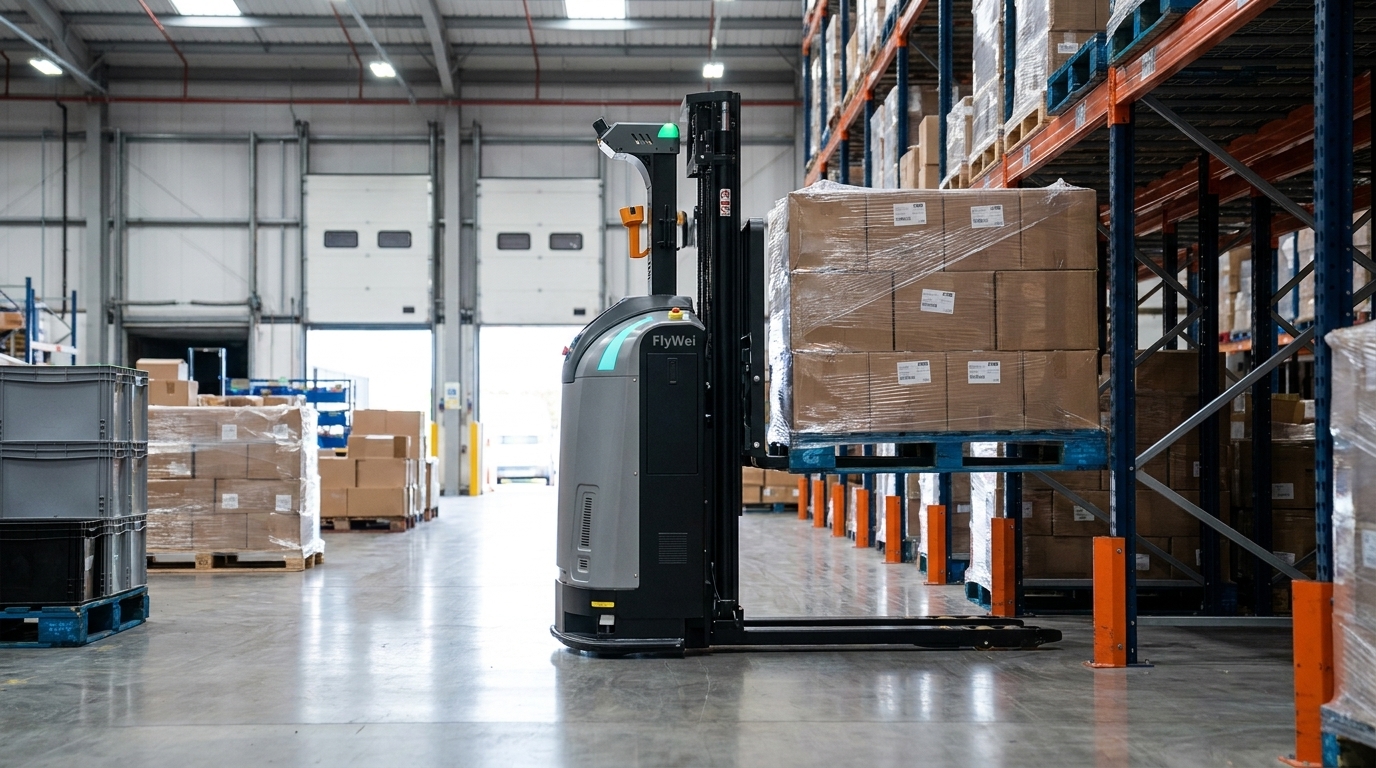
Autonomous forklifts are mast-mounted material-handling trucks that lift and place pallets without a driver, using LiDAR-based SLAM navigation, multi-plane safety scanners and a fleet manager to orchestrate moves across a UK warehouse. They differ from flat-floor automated mobile robots because they have a vertical mast and tines for pallet handling at height — typically 1.5 to 12 metres in current UK deployments. Workplace transport remains a serious risk area: around 1,300 forklift-related injuries are reported each year in Great Britain — see HSE workplace transport guidance, with pallet handling and stacker-truck incidents the largest single category. For UK food, FMCG and 3PL supply chain directors planning fleet renewal in 2026, the operational pain is concrete: dock-to-stack throughput is capped by driver availability, peak season demand still arrives in Week 47, and capex committees now expect a Q1 decision that satisfies LOLER, PUWER and BS EN ISO 3691-4 in one paper.
Why UK directors are formalising fleet renewal in 2026
Three pressures converged this year, and none of them is going away. The first is labour. Logistics UK records a sustained shortfall in qualified forklift operators across Magna Park, DIRFT, SEGRO East Midlands Gateway and Burton-on-Trent — corridors that handle the bulk of UK grocery, drinks and FMCG flow. Trained pallet drivers are now booked weeks in advance, and agency rates for a B1-rated counterbalance operator have climbed faster than CPI for three consecutive years.
The second is regulation. The BS EN ISO 3691-4:2023 standard on driverless industrial trucks tightened the safety envelope around stacking, intersection behaviour and emergency-stop performance. Combined with PUWER 1998 and LOLER 1998, the surface area for risk assessment is significant — but every clause is now well-mapped, which means the paperwork is predictable. The HSE''s PUWER guidance sets the inspection cadence and the supervisor competency requirement; both are well within reach of a director who designs the paper from day one.
The third is finance. With wage inflation persistent and energy bills still elevated, the capex committee at most UK warehouse operators has shifted to opex preference. Full-service leasing on 3, 5 and 7-year terms — with published UK leasing bands — has become the default funding shape for autonomous forklift fleets in 2026. That is the procurement context every buyer guide needs to address before it talks about machines.
Lever one — match the truck class to the workload
The most common procurement mistake is buying a single class for a mixed warehouse. The three UK workloads — outdoor-to-dock, reach-bay storage, and compact mezzanine handling — each ask for a different truck. Mismatching them costs 15-25% in cycle time and quietly erodes payback. The decision tree below is what FlyWei UK engineers use on site survey.
| Truck class | Best workload | Indicative monthly lease (per truck) | Typical payback |
|---|---|---|---|
| Counterbalance autonomous forklift (SCB-2000EU class, 2 t) | Yard-to-dock, pallet putaway, beverage and FMCG cartons | on request | site-specific |
| Reach-truck autonomous forklift (SSR-1400EU class, 1.4 t to 10 m) | High-bay narrow-aisle racking, retail DC long aisles | on request | site-specific |
| Pallet-stacker autonomous forklift (SSS-1500EU / SSS-2000EU class, 1.5 – 2 t) | Mid-height racking, compact stores, chilled mezzanines | on request | site-specific |
| Pallet-truck AMR (SFL-CBD15 class, 1.5 t) | Dock-to-stock pallet shuttling, low-profile flow | on request | site-specific |
Two practical rules apply. Where pallets need to move outdoors or onto trailer beds, the counterbalance is the only sensible answer — flat-floor AMRs lose stability and traction. Where a UK retail DC runs 9-12 m racking, only the reach-truck profile recovers the cubic capacity that justifies the bay in the first place. Both rules are reflected in the FlyWei autonomous forklifts range.
Lever two — pick a VDA 5050 fleet manager and a WMS-agnostic interface
The fleet manager is where 2026 buyer guides earn their keep. A common procurement trap is letting the truck OEM dictate the orchestration layer; that locks the warehouse into single-vendor refresh cycles. The defence is VDA 5050, the open communication interface that lets a fleet manager dispatch mixed-OEM AMRs and autonomous forklifts against a single warehouse map.
FlyWei''s M4 platform is built on VDA 5050 and operates against the operator''s existing enterprise WMS — pallet-arrival events, putaway tasks and replenishment calls flow over a documented API rather than a bespoke connector. That matters at the capex paper stage because it removes single-vendor risk, and it matters in operation because M4 traffic control resolves intersections at sub-second cadence without a human supervisor. The RDS dispatcher layer sits above M4 and routes work to the right truck class automatically — so the counterbalance does the yard moves while the reach-truck stays in the bay.
The integration depth a director should test before signing is bidirectional: tasks in, telemetry out. WMS-agnostic also has to include the operator''s existing ERP for stock and energy reporting. The FlyWei SRC-2000-FS and SRC-3000FS safety controllers carry the SIL-2 rating that capex committees increasingly require for any autonomous lift application.
Lever three — build the LOLER, PUWER and ISO 3691-4 paper at PO stage
The regulatory file is not optional and it is not a post-handover deliverable. UK buyers who build it during procurement save months. The minimum spec at PO stage is: an EC declaration of conformity for BS EN ISO 3691-4:2023 covering the truck and its safety scanner stack; a UKCA marking declaration for the UK-placed-on-market trucks; a documented LOLER inspection cadence (annual for the lift mechanism, six-monthly for the fork tines under heavy duty); and a PUWER risk assessment template that includes traffic-management interactions with manual MHE in the same aisle.
Fork-tine inspection follows BSI guidance for industrial trucks. Daily visual checks plus a competent person inspection at least every 12 months are mandatory; high-cycle FMCG warehouses tend to shorten that to six months. The FlyWei UK support team handles the inspection schedule, the calibration of the safety scanners, and the LOLER record-keeping as a standard inclusion in 3, 5 and 7-year leasing contracts. Directors who delegate this paper to the OEM at handover routinely lose two months recovering missing certificates; building it at PO stage closes that gap.
An autonomous forklift is a mast-mounted material-handling truck that lifts pallets to height without a driver, using LiDAR-based SLAM navigation and a fleet manager to coordinate moves — distinguishing it from flat-floor AMRs that cannot stack.
What FlyWei does here
FlyWei designs, supplies and integrates autonomous forklifts for UK distribution centres across grocery, FMCG, drinks, retail DC, cold chain, engineering and pharmaceutical operations. The range covers counterbalance (SCB-2000EU class, 2 t), reach-truck (SSR-1400EU class, 1.4 t to 10 m), pallet-stacker (SSS-1500EU and SSS-2000EU class) and pallet-truck (SFL-CBD15 class, 1.5 t) profiles — all built on FlyWei controllers and orchestrated by M4. M4 handles traffic control and intersection safety; RDS handles dispatch and SKU-velocity-aware routing.
UK engineers handle deployment, the LOLER and PUWER paper trail, the fork-tine inspection cadence, and the lifecycle service. Full-service leasing on 3, 5 and 7-year terms places the fleet inside opex with a single monthly figure that covers preventive maintenance, software updates, fleet-manager hosting and end-of-contract refresh. For directors who run mixed lifting and autonomous forklift fleets, the leasing contract can cover both — including FlyWei lifting robots for line-side replenishment and goods-to-person work. Live deployments span the Magna Park, DIRFT and SEGRO East Midlands Gateway corridors, where the truck-class mix is set against the operator''s shift pattern at site survey.
Frequently asked questions
How much does an autonomous forklift cost in the UK?
On a full-service leasing contract the monthly cost depends on the truck class, fleet size and software integration; FlyWei scopes the exact figure to your site in a free survey rather than quoting from a price list. Outright purchase cost varies widely with payload, mast height and safety package, so there is no single list price — each truck is specified and costed to the operation. Leasing is currently the dominant procurement shape for 2026 capex committees because it lands the fleet inside opex with a single monthly figure.
Are autonomous forklifts safe under PUWER?
Yes — when configured with multi-plane safety scanners, an emergency-stop chain, a documented PUWER risk assessment and an annual LOLER thorough examination of the lift mechanism. FlyWei trucks ship with SIL-2 safety controllers and the EC declaration of conformity for BS EN ISO 3691-4:2023, which together close most of the PUWER and LOLER paperwork at PO stage.
Do they need bespoke flooring?
No bespoke flooring is required for typical UK distribution centre operations. Standard TR34-compliant warehouse slabs with crack widths under 3 mm are adequate. Reach-trucks operating at 9 m or above benefit from a slab survey to confirm flatness, but no chemical treatment, magnetic strips or guide wires are needed — LiDAR-based SLAM navigates against natural features in the building.
Can they handle cold storage at -28°C?
Yes — cold-store variants are available with sealed sensor housings, heated mast assemblies and battery chemistry suitable for sustained -28°C operation. UK cold-chain deployments typically combine a counterbalance for the dock-to-buffer move with a reach-truck for the deep-freeze racking, both supervised by M4 from outside the freezer envelope.
What is the payback period?
UK warehouses running a two-shift pallet-putaway workload of 240 or more moves per shift typically see payback within a window we quantify per site in a free survey, depending on truck class and leasing term. Cold-chain and high-bay reach-truck deployments tend to sit at the longer end of that band; FMCG dock-to-stack counterbalance work tends to land at the shorter end.
Which WMS do they integrate with?
FlyWei''s M4 fleet manager integrates with the operator''s existing enterprise WMS over a documented VDA 5050 interface — pallet-arrival events, putaway tasks and replenishment calls flow over a standard API. UK buyers commonly deploy against tier-one enterprise WMS platforms; the integration depth tested at PO stage is bidirectional, with tasks flowing in and telemetry flowing out.
What is the difference between an AGV forklift and an autonomous forklift?
An AGV forklift typically follows fixed paths defined by magnetic strips, reflectors or QR codes; an autonomous forklift navigates dynamically using LiDAR-based SLAM against natural warehouse features. The autonomous profile recovers cubic capacity in narrow aisles, copes with seasonal layout changes and removes the civil-works cost of laying guidance infrastructure.
Are they LOLER compliant?
Yes — every FlyWei autonomous forklift is supplied with a LOLER declaration of conformity, an annual thorough-examination schedule for the lift mechanism, and a six-monthly cadence for the fork tines and lifting accessories under heavy duty. Full-service leasing contracts include the LOLER record-keeping and the competent-person inspection schedule.
If 2026 fleet renewal is on your Q3 risk register and the capex paper is due in Q1, the next step is a free 30-minute site survey with one of FlyWei''s UK engineers. We will sketch the truck-class split for your DC, draft the LOLER and PUWER paper to PO standard, and give you a 3, 5 or 7-year leasing band against your shift pattern.
Book a free 30-minute UK site survey · See full 3, 5 and 7-year leasing terms.
UK-based engineers · No obligation · Reply within one business day.