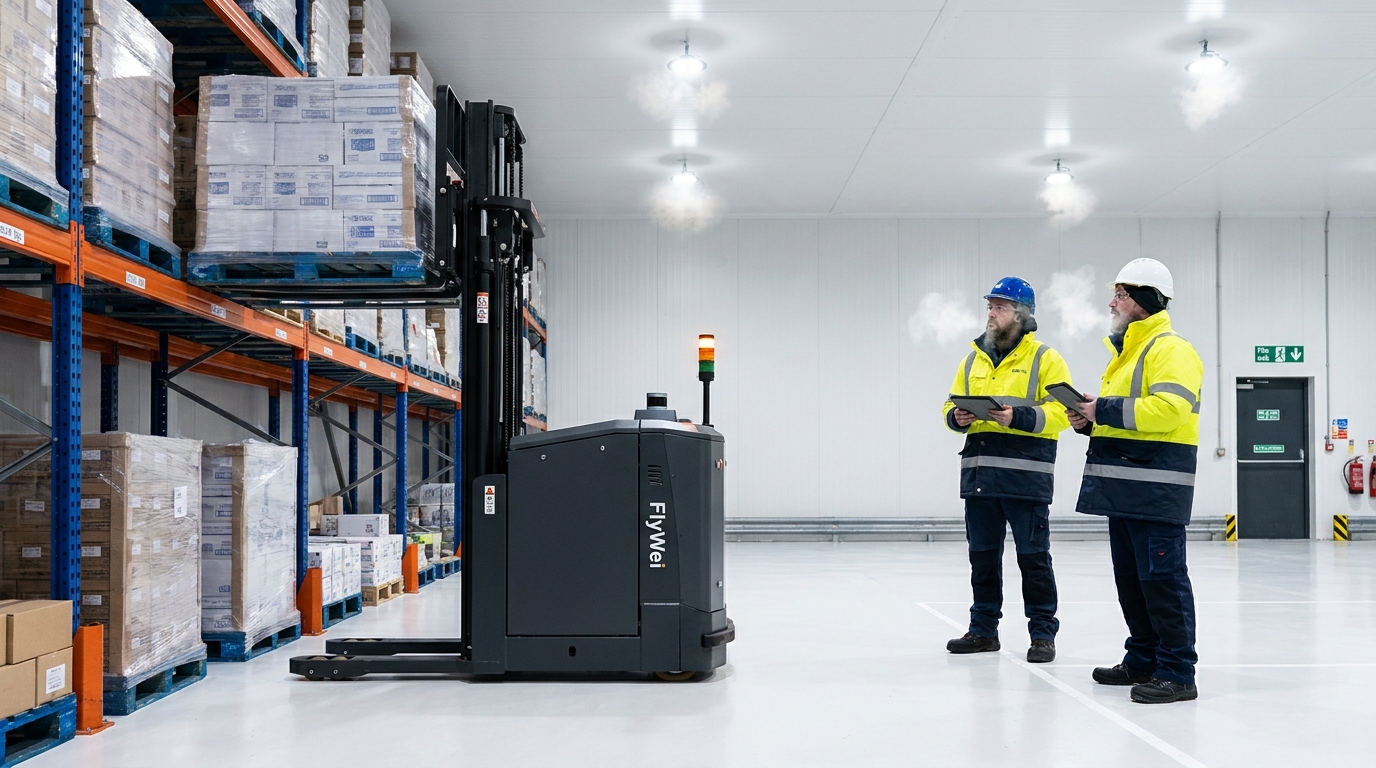
Autonomous pallet stackers are driver-less, battery-electric stacker forklifts that lift pallets up to 1.5 tonnes onto chilled or frozen racking using on-board LiDAR and 3D vision, with no human in the cab. In UK cold storage the procurement case is accelerating: Logistics UK reports HGV and warehouse driver turnover above 30% across multi-site operators in its 2026 Skills and Employment Report, with cold-store sites at the high end. For a procurement lead inside a 100,000 sqft chilled or frozen distribution centre, that turnover translates directly: a £1.6m to £2.4m annual hit composed of overtime stacking premiums, missed-shift productivity and the twelve-week cold-store induction every time a Class 1 driver walks. Standard MHE TCO models miss it because the inputs were written for ambient warehouses. The autonomous pallet stacker is the only capex line that pays back without depending on the labour market staying calm, which is why it is climbing procurement agendas across Daventry, Burton-on-Trent and the East Midlands cold-store cluster.
Why the UK cold-store capex case looks different
The procurement committee in a UK chilled or frozen distribution centre is being asked to defend a robotics line that the finance team has only ever seen modelled in ambient sites. The numbers look the same on the surface (pallets in, pallets out, energy per move) but every input shifts below five degrees Celsius. Driver attrition climbs first. The HSE workplace transport guidance recognises that prolonged exposure to chilled and frozen environments elevates slip and fatigue risk; cold-store operators respond with shorter shifts, mandatory rotation off the freezer and PPE-heavy break cycles that no ambient site needs. Recruitment then fights against the same shortage Logistics UK has tracked since 2021, made worse by the fact that the twelve-week cold-store induction is non-negotiable: an experienced Class 1 driver from an ambient DC cannot simply walk into a −22°C aisle on day one.
Energy economics push in the same direction. Lithium iron phosphate cell capacity drops 18 to 22% at sustained sub-zero ambient, which a manufacturer datasheet quoting 20°C performance never tells procurement. Every transition between chilled storage and the ambient dock generates a condensation cycle that wears bearings, fogs vision sensors and corrodes electrical contacts on standard MHE. TR34 floor flatness, demanded by BSI for narrow-aisle high-bay racking, is rarely retro-fitted; the floor your existing reach trucks tolerate may not satisfy an autonomous stacker at 8 metres lift height. Stack these factors and the conventional TCO model breaks before it is even submitted. The capex case has to be rebuilt with cold-specific inputs or the board will reject a project that would otherwise pay back inside three years.
Lever 1: Rebuild the TCO with cold-specific inputs (operational)
Procurement leads who win cold-store automation business cases share one habit: they tear up the manufacturer TCO sheet and replace every line that assumes ambient operation. Battery capacity in the model should be derated to the worst-case shift profile, not the nameplate; assume an 18 to 22% reduction in usable kWh per pack in a −22°C aisle. Charging strategy follows: opportunity charging at a heated dock-side bay, not in-aisle, because the recharge envelope is hours not minutes once the cells have cold-soaked. Add an explicit line for condensation downtime, typically 1 to 3% of available shift hours on the first six months in service while procedures bed in. Add a separate line for the twelve-week cold-store induction premium: every driver replacement carries a recruitment, PPE and training cost that ambient sites never see, and the autonomous stacker is the only capex line that removes that recurrence permanently. Finally, model the overtime stacking premium that protects fill rates today; freezing it on a three-year run-rate is fairer to the board than projecting a continued increase, and it still produces a defensible payback. Done well, a 100,000 sqft UK cold store with two autonomous stackers running across a two-shift pattern lands between 26 and 34 months to break-even, with a cumulative six-year return between 2.3x and 3.1x. The full input map sits in the companion UK autonomous forklift TCO playbook.
Lever 2: Orchestrate the mixed fleet with M4 and fleet dispatch software, not islands of automation (technical)
Capex committees reject cold-store automation when the engineering plan looks like an island: one robot type, one aisle, one workflow. The board has seen those projects fail. The defensible plan looks different. It assumes a mixed fleet (autonomous pallet stackers on the chilled racking, manned reach trucks staying on the high-bay frozen pockets that need split-second human judgement, manual pallet trucks at the dock) all coordinated by a single fleet manager. FlyWei M4 is a VDA 5050-conformant orchestrator, which means it speaks the open industry standard for autonomous-mobile-robot dispatch and can coordinate equipment from more than one supplier. FlyWei fleet dispatch software handles the dispatch layer: it reads inbound ASN data from the operator's existing ERP and WMS, allocates each pallet to either a manned or autonomous resource depending on temperature zone and SKU class, and re-plans dynamically when a chiller door is opened or a manned truck calls priority. That architecture protects two things the committee cares about: it stops the project becoming hostage to a single robot supplier (open VDA 5050 is the insurance policy), and it lets the operator scale autonomy aisle-by-aisle rather than rip-and-replacing the whole MHE fleet. A staged build delivers payback on aisle one inside year one while year two through three add aisles two and three without further integration risk.
Lever 3: Lock the UK compliance stack early (regulatory)
Procurement teams who park compliance until the post-PO phase are the ones whose payback slides by six months. The UK regulatory stack for cold-store autonomous pallet stackers is well-defined and stable, and the BSI and HSE positions are public. Start with PUWER 1998, which sets the duty for safe work-equipment selection and the conformity assessment regime; the autonomous stacker must be assessed against the operating environment, and the cold-store environment is materially different from ambient: document it. Layer in ISO 3691-4:2023, the specific safety standard for autonomous industrial trucks, which sets sensing, marking, speed and stop-distance requirements that the supplier must demonstrate at commissioning. LOLER 1998 thorough examinations still apply because the stacker is lifting equipment: schedule six-monthly inspections and budget for them. The ACOP L117 code of practice for rider-operated lift trucks informs the training regime even where there is no rider, because the supervisor must understand the equipment. TR34 floor flatness from the Concrete Society is a contractual matter with the developer or landlord: survey before order, not after. UKCA marking, BS EN 1525-equivalent and 13219-aligned conformity declarations should be appended to the supplier's commercial offer; never sign without them.
What FlyWei does here
FlyWei integrates autonomous pallet stackers built for UK cold-storage operations. The stacker variant in our autonomous forklift range is specified with a cold-rated lithium iron phosphate pack, IP54-hardened sensor housings to survive condensation cycles, sealed electronics where a manned cab would normally sit, and a top LiDAR puck plus 3D vision suite that holds positional accuracy at sub-zero ambient. The same chassis appears in the FlyWei lifting robot family alongside latent-jacking AMRs and heavy-lift platforms for sites that need a broader fleet. We deliver the orchestration layer, M4 fleet manager and fleet dispatch, pre-integrated, and we coordinate the PUWER, ISO 3691-4 and LOLER documentation pack so the procurement committee gets a complete compliance bundle with the commercial offer. Project sequencing follows a staged aisle-by-aisle pattern that protects in-flight throughput: one chilled aisle live inside twelve weeks, second and third aisles added on a rolling quarterly cadence as confidence builds. Our solutions catalogue sets out the cold-chain configuration in detail, and recent UK cold-chain procurement decisions are tracked in our multi-site cold-chain automation brief. For boards still weighing capex versus opex routes, our team will model the staged-aisle case against the operator's actual SKU mix and turnover data: no theoretical numbers.
The autonomous pallet stacker is the only cold-store MHE capex line in UK distribution that pays back without depending on the labour market staying calm.
FAQ
Will autonomous pallet stackers work at −22°C?
Yes, when specified for cold-store duty. The chassis needs IP54 sealing, cold-rated lithium iron phosphate batteries, condensation-tolerant sensor housings and a charging strategy that keeps cells above their cold-soak threshold. Standard ambient-spec stackers will run at sub-zero but with significant capacity loss and accelerated wear; budget for the cold-spec variant from the start.
What is the typical payback for an autonomous pallet stacker in a UK cold store?
A two-shift, 100,000 sqft UK chilled or frozen DC with two autonomous stackers typically lands between 26 and 34 months to break-even when the TCO is built with cold-specific inputs. Six-year cumulative return sits between 2.3x and 3.1x. Ambient-warehouse TCO models understate this by 18 to 22% by missing the cold-store induction premium.
How does battery derating affect cold-store autonomous forklift TCO?
Lithium iron phosphate cells lose 18 to 22% of usable capacity at sustained −22°C ambient. Procurement should model the worst-case shift profile, plan opportunity charging at a heated dock-side bay rather than in-aisle, and budget one or two additional pack rotations per year if shifts run continuously through frozen zones.
Does ISO 3691-4 cover cold-store autonomous trucks?
Yes. ISO 3691-4:2023 is the applicable safety standard for driver-less industrial trucks and their systems; it sets sensing, marking, speed and stop-distance requirements that the supplier must demonstrate at commissioning. The standard does not list cold-store-specific clauses, so PUWER conformity assessment must explicitly cover the −22°C environment.
Can autonomous pallet stackers share aisles with manned reach trucks?
Yes, when the fleet is coordinated by a VDA 5050-conformant orchestrator such as M4. The orchestrator allocates aisles dynamically and grants priority to manned trucks when called. Mixed-fleet operation is the recommended pattern for cold stores because frozen high-bay pockets often still need split-second human judgement.
What floor flatness do I need for an autonomous pallet stacker?
The BSI-referenced TR34 categories apply. For narrow-aisle stacking above 6 metres lift, Category 1 or DM1 flatness is normally required; survey the existing slab before ordering. Floor grinding is feasible but adds project time, so include it in the capex case rather than discovering it post-PO.
What insurance and LOLER cover applies?
The autonomous pallet stacker is lifting equipment under LOLER 1998 and requires six-monthly thorough examinations. Public liability and product liability cover for the autonomy stack should be confirmed with the broker before commissioning; UKCA marking and the manufacturer conformity declaration form the basis of the cover.
Talk to FlyWei. Our team will model the staged-aisle capex case against your actual SKU mix, turnover data and shift pattern, and bundle the PUWER, ISO 3691-4 and LOLER compliance pack with the commercial offer. Book a procurement-grade scoping call.