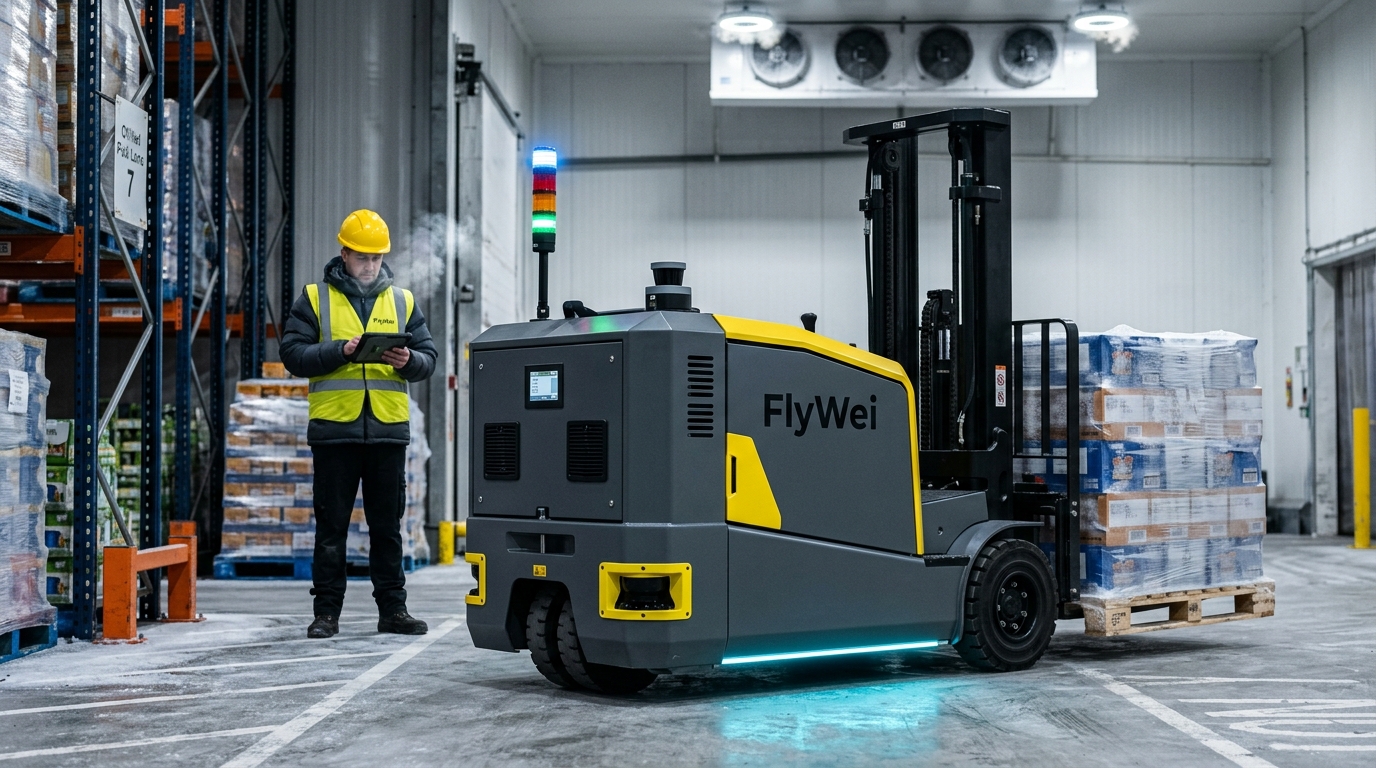
Cold chain warehouse automation in the UK is no longer a single-site decision: it is the operating model that decides whether a multi-site supply chain director hits next quarter's service-level targets. Across the chilled and frozen network that flows through Magna Park, DIRFT and SEGRO East Midlands Gateway, the same pattern repeats every quarter: two sites are about to enter a BRCGS audit window, one has just lost a third of its forklift drivers to road haulage, and capex governance is asking you to sign off three different automation specs in eight weeks. You are accountable for service, audit and capital at the same time, in temperatures that no one wants to work in for forty hours a week, and the levers you have are not the ones the brochures advertise.
Why the pain repeats across every chilled and frozen UK DC
The pain is not local. It comes from three structural forces that hit every UK chilled and frozen distribution centre at once, and they compound rather than offsetting each other.
The first is the cold-chain labour gap. Logistics UK has tracked a persistent shortfall of qualified MHE operators across the sector, and that shortfall is sharper in chilled and frozen sites where HSE cold-environment guidance recommends rotation breaks, heated rest rooms and a higher PPE specification. Pay differentials follow: a counterbalance driver willing to work a full shift at -25 °C is paid materially more than the same role in ambient, and the demographic is ageing. When that driver leaves, they are not always replaced. Sites near Daventry and the East Midlands cold-chain cluster feel this earliest because the road-haulage labour market is on the doorstep.
The second is audit weight. BRCGS Storage & Distribution Issue 5 sets traceability and storage-condition requirements that bite hardest on temperature-controlled sites. MHRA cold-chain expectations layer on top for any site that handles pharmaceutical product. PUWER and its Approved Code of Practice L22 require thorough examination of every truck, autonomous or not. None of this is optional, and audit teams now expect a digital, continuous evidence chain: paper logs and forklift checklists are no longer sufficient.
The third is the capex cycle. UK cold storage is energy-intensive, and the same boards that are funding refrigeration upgrades, regulatory carbon reporting and depot consolidation are being asked to fund automation in parallel. Capex governance prefers programmes with one repeatable unit cost and a clear phase-gate plan; it does not enjoy reviewing nine bespoke vendor quotes with nine different ROI methodologies.
The four levers that fix cold chain warehouse automation across a UK network
1. Standardise inbound and putaway BEFORE you talk to a vendor
Most automation programmes stumble before a single robot ships because the operator has not standardised what each site is actually doing. Before you go to market, lock the inbound and putaway SKU profile per site, costed at the local cold-chain labour rate including PPE, hot drinks, rotation breaks and shift premium. Define the dock-to-stock SLA per temperature zone (ambient, +2 to +8 °C chilled, -18 to -25 °C frozen) separately, because the throughput economics in each are different. Run one labour-hour audit per site, then aggregate. The output is a single specification document that says, in plain terms, what every site needs an autonomous forklift to do, and what an acceptable cycle time looks like. Without it, every vendor quote is an apples-and-pears comparison. With it, the rest of the programme follows.
2. Run one fleet manager across every site, not one per site
Running a fleet manager per site is the single most expensive mistake a multi-site programme can make. Three sites mean three consoles, three integration projects, three sets of upgrade cycles and three ways to lose visibility. The alternative is one fleet manager, the FlyWei M4 fleet manager, running across every site, with fleet dispatch software dispatching missions inside each site. VDA 5050 is the open interface that makes this practical: it lets the operator's existing ERP and enterprise WMS keep talking, with the autonomous fleet joining as a standardised participant. There is no rip-and-replace. The hardware specification matters here too. Cold-chain autonomous forklifts must use sealed electronics enclosures rated for the room, not a retrofit of an ambient truck. There is no driver, no overhead cab to heat, no seat, no steering wheel: only the load-handling envelope and the sensor pack. LiDAR and camera fusion holds in -25 °C provided the optics package is correctly rated, which is a specification question, not a debate.
3. Bake the audit trail in before installation, not after
The audit trail decides whether the programme survives its first inspection cycle, so build it in before installation, not after. BRCGS Storage & Distribution Issue 5 expects continuous evidence of temperature integrity and stock movement; MHRA cold-chain expectations layer on top wherever pharma is held. PUWER and the Approved Code of Practice L22 require thorough examination: autonomous trucks are not exempt, and the examiner needs a defined set of inspection points. ISO 3691-4, the standard for driverless industrial trucks, sets the safety baseline that procurement should write into every order. BS EN 1525 is sometimes cited but ISO 3691-4 has superseded it in practice. TR34 floor flatness is the regulatory landmine in older cold stores: a 30-year-old freezer slab can fail an autonomous reach truck before the first pallet is moved, so survey early. Make BSI, BRCGS-aware project gating and PUWER thorough examination part of the deployment plan, with documented evidence written from M4 direct into the operator's quality system.
4. Present capex as a programme, not nine projects
Capex governance approves programmes; it tolerates projects. The supply chain director who arrives at the capex committee with one repeatable per-site unit cost, a phase-gate rollout (pilot → three sites → full network) and a clear total-cost-of-ownership model will close approval faster than the one who presents nine separate vendor proposals. Build the business case around total cost of ownership rather than capex: depreciation across an eight-year asset life, energy at sub-zero rather than ambient (autonomous trucks do not heat a cab), maintenance under a UK service contract, software licence fees for M4 and fleet dispatch software, and the labour-hour avoidance modelled at the actual cold-chain rate, not a national average. Lay the BSI and BRCGS audit calendar across the rollout so each phase-gate exit aligns with an audit window, then negotiate with the audit body once for the entire programme.
| Dimension | Single-site decision | Network-wide programme |
|---|---|---|
| Fleet manager consoles | One per site | One (M4) across all sites |
| WMS / ERP integration | Repeated per site | Once, over VDA 5050 |
| PUWER thorough examination | Vendor-by-vendor | Single repeatable methodology |
| Capex committee review | Nine bespoke quotes | One phase-gated programme |
| Audit alignment | Reactive | Designed in |
| Labour-hour model | Site rate | Aggregated network rate |
In a UK cold-chain network of three or more sites, a supply chain director can recover up to eighteen months of forklift driver attrition through autonomous forklift deployment on inbound dock-to-stock and frozen pallet putaway routes, while keeping every pallet inside the BRCGS Storage & Distribution traceability envelope.
What FlyWei does here
FlyWei supplies, integrates and services autonomous forklift fleets across UK cold-chain networks. FlyWei autonomous forklifts (counterbalanced, reach and pallet-truck variants) are specified for sub-zero operation: sealed electronics enclosures, optics rated for chilled and frozen rooms, sealed bearings, no driver cab to heat. There is no seat, no steering wheel, no overhead-guard cab; where a seat would be there is a sealed enclosure. The M4 fleet manager runs across every site in the operator's network so the supply chain director sees one cockpit, not nine. Fleet dispatch software sits underneath M4, dispatching missions per temperature zone and holding the audit-grade history of every pallet move.
FlyWei integrates with the operator's existing ERP and enterprise WMS over VDA 5050: no rip-and-replace, no proprietary message bus. UK-based commissioning, BRCGS-aware project methodology and PUWER thorough examination are scoped from day one of the programme, and pilot deployment at the first site is typically running within eight weeks of contract signature. The same hardware specification, the same software stack and the same project method are used across Magna Park, DIRFT, SEGRO East Midlands Gateway, Daventry and the regional satellites, which is what gives capex governance its repeatable unit cost. For sites where lifting envelopes vary, FlyWei lifting robots and the wider solutions portfolio sit alongside the forklift fleet under the same M4 cockpit. The supply chain director gets one programme, one cockpit, one audit trail, and a path to scale. For a deeper look at the labour-side economics that drove most of last winter's cold-store conversations, the cold-storage driver crisis brief is the companion piece to this playbook.
Frequently asked questions
How does autonomous forklift hardware survive -25 °C?
Cold-store autonomous forklifts are not retrofits of ambient trucks. The electronics are housed in sealed enclosures rated for the room, sensors use optics packages specified for the temperature range, and lubricants and bearings are sub-zero-rated from the factory. Battery chemistry is matched to the duty cycle. The biggest specification mistake is ordering an ambient truck and bolting on a cold-chain “kit” it does not hold up across a year.
Will an autonomous forklift pass BRCGS Storage & Distribution audit?
Yes, provided the project has been built around the audit trail from day one. BRCGS Issue 5 expects continuous, digital traceability of stock movement and storage conditions. An autonomous forklift fleet managed by M4 with fleet dispatch software dispatching gives the auditor a higher evidence standard than a paper-based manual operation, because every mission is logged at machine-level granularity and time-stamped against the temperature record.
How long does a multi-site cold-chain rollout take?
Pilot at the first site runs within eight weeks of contract signature. A three-site phase-gate exit takes eighteen to twenty-four weeks. A nine-site programme sequences across twelve to eighteen months with phase-gate reviews at each exit.
Does an autonomous fleet integrate with our existing ERP and WMS?
Yes. FlyWei autonomous forklifts are orchestrated by M4 and fleet dispatch software, which speak VDA 5050: the open interface standard for driverless industrial trucks. The operator's existing ERP and enterprise WMS continue to manage stock; the autonomous fleet joins as a standardised participant. There is no rip-and-replace.
How do PUWER and ISO 3691-4 apply to autonomous forklifts?
PUWER and its Approved Code of Practice L22 require every work-equipment item to be suitable, maintained and thoroughly examined: autonomous forklifts are not exempt. ISO 3691-4 is the safety standard for driverless industrial trucks and should be written into procurement. Together they form the regulatory backbone of any UK autonomous forklift deployment.
What is the most common deployment-blocker we should pre-empt?
TR34 floor flatness in older cold stores. Surface tolerances that work for a manned reach truck can fail an autonomous one. Survey early and budget for either remedial work or a different truck specification.
How does capex governance prefer this presented?
As a programme with one repeatable per-site unit cost, a defined phase-gate plan, a TCO-based business case rather than capex-only, and an audit-window alignment for each phase-gate. Capex committees move faster on one defensible programme than on nine bespoke vendor quotes.
Talk to FlyWei about a single, network-wide cold-chain autonomous forklift programme: one cockpit, one audit trail. Contact the FlyWei team.