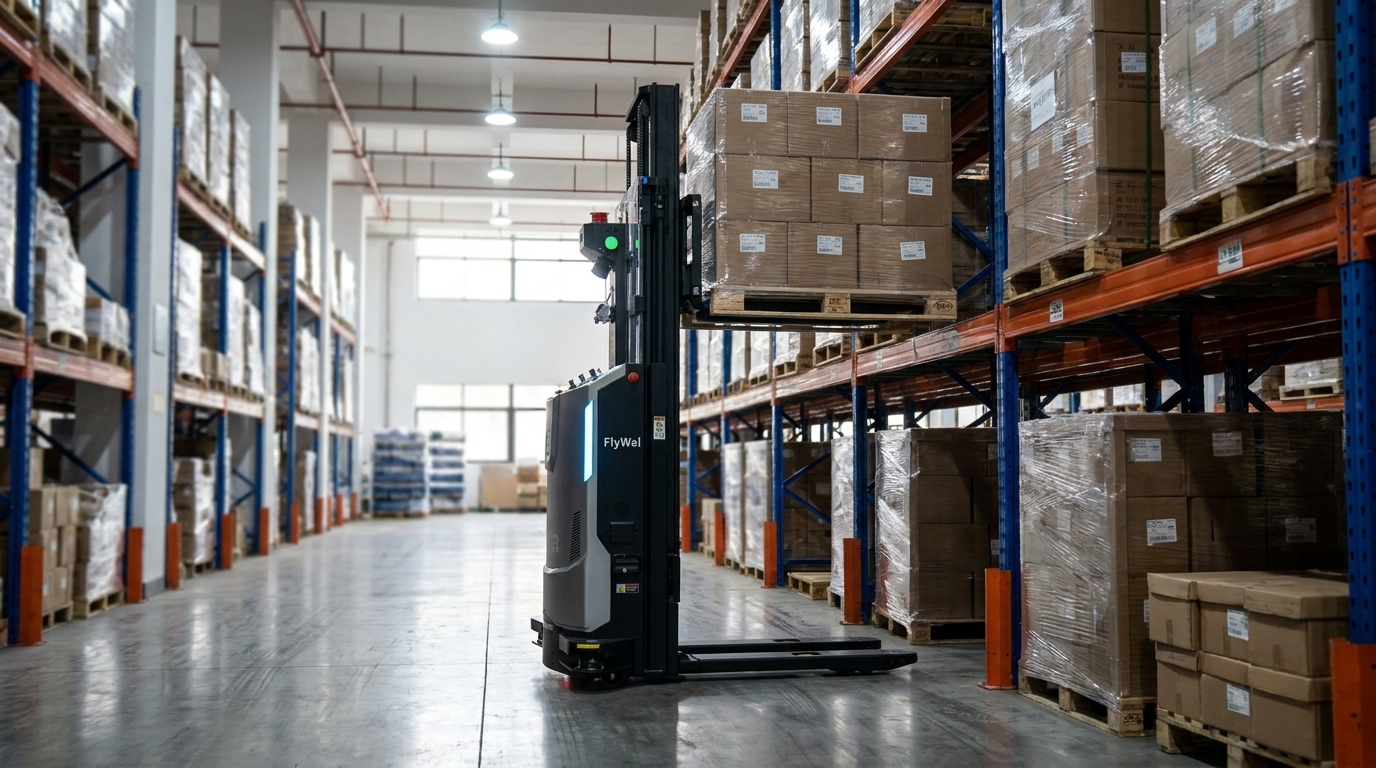
An autonomous pallet stacker is a driverless stacker truck that lifts pallets into mid-height racking using onboard sensors and fleet software. The Health and Safety Executive records 59,219 RIDDOR-reportable injuries to employees and 40.1 million working days lost to workplace injury and ill health across Great Britain in its latest published figures. For a warehouse manager running more than 100,000 sq ft of e-commerce fulfilment, those figures land in one specific place: the replenishment lane between reserve racking and the pick face. Peak does not break picking; it breaks feeding. A manual stacker queues for a narrow aisle, waits behind a trailer unload, then gets pulled to a hot job, and the pick face quietly drains. By late October the corrections are all expensive: overtime, agency cover, and a short-pick rate that turns a promised next-day service into a customer-service backlog nobody budgeted for.
Why the replenishment lane breaks first
Replenishment is the only warehouse task that is simultaneously essential and endlessly deferrable. Picking has a customer waiting, goods-in has a driver waiting, and despatch has a trailer waiting. Reserve-to-pick-face replenishment has none of those, so on a busy shift it is always the job that gets stood down. That is a scheduling problem rather than a labour problem, and hiring rarely fixes it, because the extra headcount is absorbed by the same urgent queue that displaced replenishment in the first place.
UK e-commerce sheds make this worse in three structural ways. The first is geometry. Much of the big-box estate around Magna Park, DIRFT and SEGRO East Midlands Gateway was specified for pallet throughput, so reserve racking sits in narrow aisles that a counterbalance truck cannot enter and a ride-on stacker can only enter slowly, one machine at a time. The second is floor condition. Mast stability at height depends on floor flatness to the Concrete Society's TR34 guidance, and in a brownfield shed the aisles that most need high-level replenishment are often the ones with the worst slab history. The third is duty of care. Every manual truck movement in a mixed-traffic aisle is an exposure that operators are expected to design out rather than supervise around, and HSE's workplace transport guidance places the segregation of pedestrians and vehicles above signage and training in the hierarchy of control.
The result is a site that looks well staffed on paper and still runs dry at the pick face by mid-afternoon. The cost never appears as a replenishment line in the management accounts: it appears as overtime, agency hours, and short picks that despatch reconciles by hand. Because it is spread across three other budgets, it survives scrutiny year after year.
Peak does not break picking; it breaks feeding. An autonomous pallet stacker holds the replenishment lane between reserve racking and the pick face, so the pick face never runs dry.
Lever one: give replenishment its own protected lane
Stop treating replenishment as spare capacity. Split the fleet, on paper first, into a reactive pool that answers radio calls and a protected pool whose only job is moving stock from reserve racking to the pick face. The protected pool must not be borrowable. The moment it is, it stops being a pool and becomes the same contended resource you started with.
An autonomous pallet stacker suits the protected role for a reason that has nothing to do with clever navigation: it cannot be reassigned by a supervisor under pressure. A driverless forklift runs the queue it was given. That constraint looks like a limitation while you are specifying the machine and becomes the operational benefit once it is running. Begin by instrumenting the lane you cannot currently see. Log replenishment tasks raised against tasks completed per shift, broken down by aisle. If the gap widens through the afternoon, you have found your protected-pool sizing, and you have found it from your own data rather than from a supplier's simulation.
Lever two: trigger replenishment from stock thresholds, not radio calls
The truck is the visible part of the project and the least interesting one. What decides whether a protected replenishment lane actually holds is dispatch: where the task comes from, and who sets its priority. If a supervisor still raises the task, you have automated the driving and left the bottleneck untouched.
The pattern that works has three layers. Your enterprise WMS holds stock records and determines that a pick location has fallen below its threshold. A fleet manager such as M4 takes that work over a documented interface and turns it into a mission: which machine, which route, which aisle priority, and what to do when the aisle is blocked. The machines report position, load and completion back over the VDA 5050 open standard, and each completion posts as a stock movement so your existing system remains the record of truth. Nothing is replaced. RDS carries the exception paths, such as a blocked aisle, a pallet that will not scan, or a mission abandoned mid-route, and exception handling is where most replenishment automation quietly fails.
Lever three: design the aisle to PUWER and ISO 3691-4 before you buy
Automation does not reduce your duties under the Provision and Use of Work Equipment Regulations 1998. It changes what you inspect. A driverless stacker is still work equipment, so the PUWER obligations covering suitability, inspection, maintenance and the competence of the people working around it apply in full. ISO 3691-4, the standard for driverless industrial trucks and their systems, is where the safety case for the machine itself lives: protective field geometry, speed limitation, and how the truck behaves when a person enters its path. BSI publishes the UK-adopted text.
Do this work before purchase rather than at commissioning, for commercial reasons as much as safety ones. Aisle width, pedestrian segregation, charging position and the location of manual truck crossings all constrain which machines can be specified, and discovering that after an order is placed is how a replenishment project becomes a programme. Ask for the protective field drawings and the mixed-traffic risk assessment as pre-order deliverables, and have your own safety team sign them off rather than the supplier's.
Lever four: size the fleet on the replenishment curve, not the peak day
Most fleet-sizing conversations anchor on the worst hour of the worst day, which produces a quote nobody signs. Replenishment has a flatter, far more predictable curve than picking, because it is driven by what has already been picked rather than what customers might order next. That makes it one of the few flows you can size honestly.
Pull a full year of pick-location replenishment events, plot them by hour and by aisle, and size the protected pool against the routine shape of that curve rather than its maximum. Cover the tail with the manual trucks you already own, which are paid for and are genuinely good at exceptions. This produces a smaller fleet, a shorter approval route, and a first phase that can be judged inside a single peak. It also changes the funding conversation, because a fixed monthly cost under 3, 5 and 7-year leasing terms maps onto a predictable replenishment curve far more comfortably than a capital request sized for an hour that occurs only at peak.
| Lever | What it costs | What it changes | When you know |
|---|---|---|---|
| Protected pool, manual trucks | No capital; rota discipline | Removes task contention, not aisle queuing | A few shifts |
| Autonomous pallet stacker in that lane | Monthly lease or capital, plus aisle survey | Replenishment stops competing with reactive work | One peak season |
| Threshold-triggered dispatch | Integration against your existing WMS | Removes the supervisor from task-raising | First integration cycle |
| Aisle redesign to ISO 3691-4 and PUWER | Survey, possible racking or floor works | Widens the machines you can specify | Before purchase, by design |
| Recruiting more operators | Recurring salary, recruitment, churn | Adds capacity the urgent queue reabsorbs | Within one quarter |
What FlyWei does here
FlyWei is an independent, vendor-neutral UK systems integrator. FlyWei does not manufacture robots and is not tied to any one maker's range, which matters more in replenishment than in almost any other flow, because the right machine is decided by your aisle width and your beam heights rather than by a catalogue. FlyWei designs the replenishment lane first and specifies the machines that fit it second.
For a 100,000 sq ft e-commerce site that usually means a FlyWei autonomous pallet stacker working the narrow reserve aisles at mid-height, with lift height and payload matched to your existing racking rather than to a standard demonstration configuration. Where the same flow includes cages, totes or trolleys feeding a goods-to-person station, a FlyWei lifting robot joins the same fleet. Both run under M4, so replenishment missions, reactive moves and charging are arbitrated centrally instead of machine by machine.
The integration work is the part worth scrutinising, and FlyWei prices it as a visible line item. FlyWei connects the fleet to the ERP and WMS you already run, over a documented interface, keeping that system as the record of stock. FlyWei also produces the PUWER-facing documentation and the ISO 3691-4 protective field drawings, and provides UK-based engineering support and operator training. Sector context from nine industry solution sets informs the aisle design, and our guide to AGV forklift classes sets out how the classes differ if you are still narrowing the specification.
Frequently asked questions
What is an autonomous pallet stacker?
A driverless stacker truck with a mast that lifts pallets into racking without an operator aboard. It navigates by onboard sensors and a building map, and takes its work from fleet software.
How high can an autonomous pallet stacker lift?
Stacker-class machines serve mid-height racking rather than high bay; FlyWei's four models are listed on the stacker page. The real limit is usually floor flatness and aisle width, not the mast itself.
Will one work in our existing narrow aisles?
Often yes, which is why the class suits brownfield sheds. Check aisle width against the machine's protective fields, the slab condition, and where manual trucks and pedestrians cross the lane.
Do we have to replace our WMS?
Usually not. An orchestration layer sits above your warehouse system and takes work from it, so that system stays the source of truth for stock. Middleware is normally cheaper than replacement.
Is a driverless stacker safe around pedestrians and manual trucks?
It can be, by design rather than assumption. ISO 3691-4 governs protective fields and stopping behaviour; PUWER covers suitability, inspection and competence. HSE guidance ranks segregation above signage and training.
What does it cost, and can it be leased?
It is quoted per site, because machine class, fleet size and integration scope all move the figure. Leasing over 3, 5 and 7 years bundles robots, M4, maintenance, UK support and training into one monthly cost.
If keeping the pick face fed through peak is on your Q3 risk register, the fastest way to size the problem is to have someone walk the reserve aisles with you.
Book a free 30-minute site survey and FlyWei will map your replenishment lane aisle by aisle, then tell you which flows an autonomous pallet stacker can take today and which need racking or floor work first.
UK-based engineers, no obligation, and a reply within one business day.