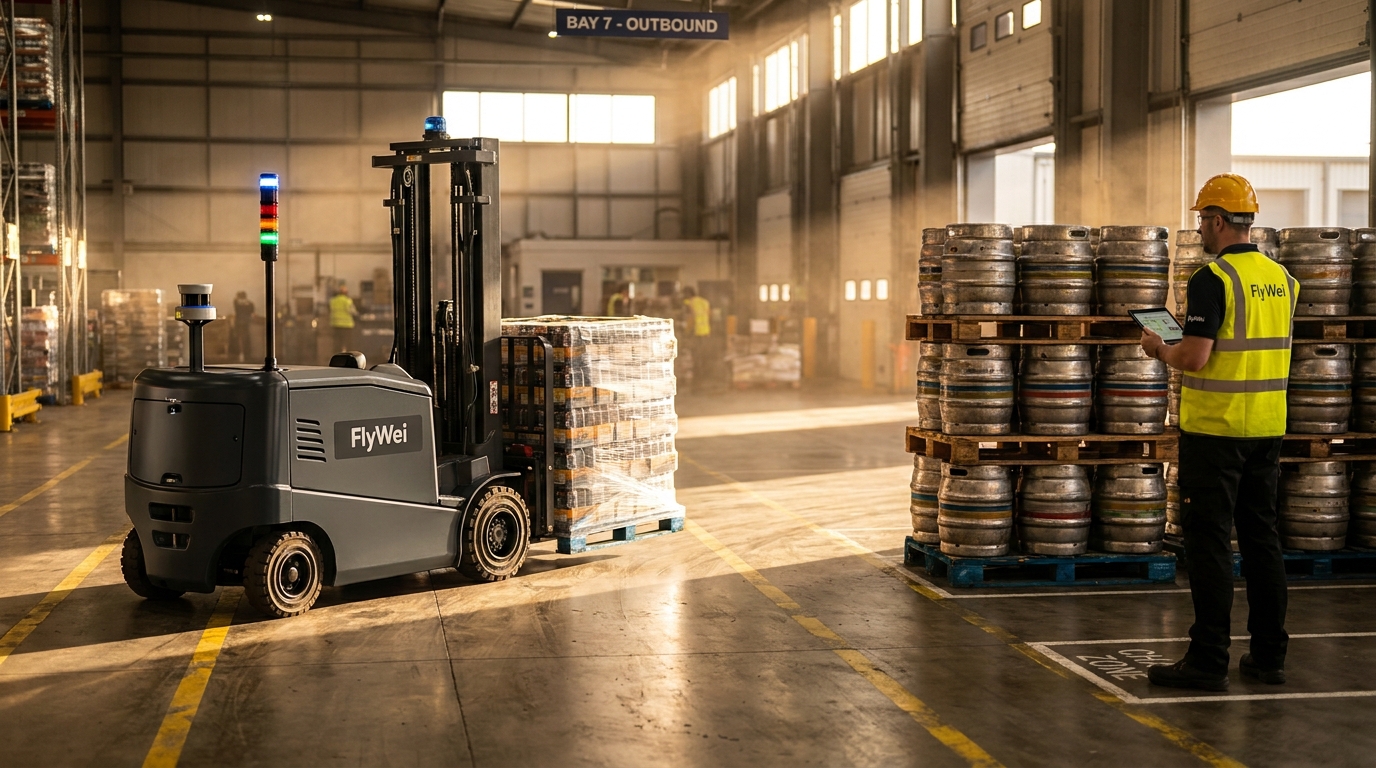
Drinks warehouse autonomous forklifts in the UK are LiDAR-guided counterbalanced trucks that move palletised cans, kegs and crates inside a beverages distribution centre without an on-board driver, taking instructions from a fleet manager rather than a hand-held terminal. Logistics UK records that the country is still short of around 100,000 HGV and warehouse drivers across food and drink logistics, and the same skills cliff hits forklift cover in summer. For the warehouse manager running a 120,000 sq ft drinks DC in Burton-on-Trent, Magna Park or Daventry, the pain is concrete and predictable: every Friday in July the returnable keg trailers stack up at the dock, the palletised outbound for Saturday delivery slips by two hours, and four agency drivers have to be called to cover holiday gaps. Autonomous forklifts shift that maths because the trucks do not stop for tea, holidays or hand-overs.
Why Friday-afternoon dock chaos happens in a UK drinks DC
The summer-peak drinks DC has a structural mismatch between inbound and outbound work. Inbound is dominated by returnable assets (empty kegs, dollies and pallet collars) coming back from on-trade venues on multi-stop trailers. Outbound is full palletised loads of cans, RTDs and bottled beverages for grocery DCs and wholesalers. The two flows compete for the same dock doors, drivers and yard slots inside a single shift envelope.
When demand stays inside a normal range, a skilled warehouse manager balances both flows by hand: flex the late shift, hold a returnable trailer at gate, send a counterbalance driver from outbound to inbound for an hour, day ends thirty minutes late. UK warehouses operate within HSE workplace transport guidance: the constraint is a person and a clock, not a regulation.
The summer peak breaks the model in four places. July and August Fridays add roughly fifty per cent volume in three weeks. Holiday cover is brittle: one driver call-off at 11:00 loses 200 outbound pallets by 16:00. Returnable kegs cannot be left in the yard because bonded-duty, hygiene and cask-condition rules mean the brewery wants them back the same shift. And the labour market still has a structural shortage; Logistics UK records that recruitment lead times for counterbalance-licensed drivers in the Midlands have lengthened to four to six weeks.
The result is the Friday-dock-chaos pattern: yard congestion at 14:00, returns trailers queueing at gate, outbound slots slipping past cut-off, overtime authorised at 16:30, manager exhaustion by 18:00. It is not a software or process problem: it is a labour-capacity problem with a clock attached.
Lever 1: A 24/6 autonomous keg-return shuttle on the inbound dock
The first lever is operational: dedicate two autonomous counterbalanced forklifts to the returnable-assets loop, gate-to-empty-cage-store and back, and remove the inbound queue from the manned outbound shift entirely. The autonomous trucks run a fixed route, every hour, 24/6. Returnable trailers are unloaded as they land, not when a driver is free. The 14:00 shift handover no longer steals a counterbalance driver from outbound for forty-five minutes. The route uses the LiDAR puck on the truck and reads pallet-collar codes against the WMS, so a missing or damaged keg is logged in real time, not reconciled in week four.
The warehouse manager sees the inbound queue length on the M4 dashboard. If returns volume spikes after a bank holiday, a third autonomous truck is added by clicking 'commission unit 3' from a tablet. The 11:00 driver call-off no longer changes inbound throughput, because the inbound loop is no longer carrying a driver. The lever is not a productivity uplift per truck; it is a decoupling of inbound throughput from outbound labour supply. That decoupling is what makes Friday afternoons predictable again.
Lever 2: An M4-orchestrated outbound palletising loop tied to the WMS over VDA 5050
The outbound loop determines whether Saturday delivery makes the cut. The second lever is technical: put the M4 fleet manager between the WMS and the autonomous trucks, so a pallet ticket released by the WMS becomes a move-order the trucks execute under VDA 5050 messaging without a forklift driver in the loop. VDA 5050 is the open AGV/AMR interface standard, ISO 3691-4 references it for autonomous industrial trucks, and it lets one fleet manager talk to mixed-vendor robots without per-vendor integration.
In a UK drinks DC the orchestration sequence is concrete. The WMS releases a palletising order. M4 issues taskCreate. An autonomous truck collects the finished pallet from the end-of-line palletiser the moment stretch-wrap completes. It drops the pallet to an outbound dock lane keyed to trailer registration. The WMS confirms 'loaded' against the cut-off. The warehouse manager intervenes only on exceptions: damaged pallet, non-conforming label, missing seal. End-of-line dwell time falls because the truck is already at the palletiser when the pallet wraps.
The FlyWei fleet dispatch software prioritises outbound moves against trailer cut-off so SLA-critical Saturday loads always go first. The 16:00 Friday-in-July peak is now a queue the fleet manager has already sequenced.
Lever 3: A PUWER-compliant zoning model for a shared dock yard
The third lever is regulatory. PUWER 1998 (the Provision and Use of Work Equipment Regulations) requires that work equipment be 'suitable, safe and properly maintained' and that operators be protected from contact with moving parts. For a mixed manned/autonomous drinks DC the practical lever is a zoning model: the dock yard is divided into autonomous-only lanes, manned-only lanes and joint-use zones, with the joint-use zones run under HSE PUWER guidance. Autonomous trucks compliant with ISO 3691-4 already have category-3 safety LiDAR, redundant brakes and audible/visible warnings; the zoning model is what makes the configuration defensible to the HSE inspector who walks in unannounced on a Tuesday morning.
The zoning model lets the manager keep two manned reach trucks on hand for damaged-pallet recovery and for any move the autonomous fleet has not been mapped against. The autonomous fleet handles the high-volume predictable loops, the inbound returns shuttle and the outbound palletising loop, under their own ACOP-aligned safe system of work, signed by the site safety officer. PUWER is not a barrier to autonomous forklifts in a drinks DC. It is the design framework that makes a mixed-fleet model auditable.
Lever 4: Real-time returnable-asset reconciliation
The fourth lever is a data lever. Every keg, dolly and pallet collar is reconciled in real time against the brewery's deposit ledger by reading the asset code at the autonomous truck's onboard scanner the moment the pallet moves. This is not a forklift feature: it is a software outcome of the M4 fleet manager logging every move with payload identity, time, location and operator (autonomous or named driver). Most drinks distribution losses sit in returnable-asset shrinkage, not in product damage; Logistics UK industry briefings consistently flag returnable-asset loss as a top-three margin leak for beverages 3PLs. A real-time ledger turns a 30-day reconciliation cycle into a 30-minute one, removes the manual paperwork the warehouse manager runs on Friday at 17:00, and gives the brewery a defensible audit trail for any disputed cask.
What FlyWei does in a UK drinks DC
FlyWei commissions a drinks DC as a single integration project, not a hardware sale. FlyWei designs the route layout against the existing dock-and-aisle plan, supplies the counterbalanced autonomous forklifts, typically the two-tonne class for palletised drinks loads, installs M4 on the operator's network and integrates it with the existing WMS over VDA 5050. Fleet dispatch software queues outbound moves against trailer cut-off so SLA-critical Saturday loads always go first.
A 120,000 sq ft drinks DC commissioning runs eight to twelve weeks. Weeks one to two are site survey and route design against an HSE workplace-transport assessment. Weeks three to six are truck delivery, mapping run and M4 install. Weeks seven to nine are supervised live running on the inbound keg-return shuttle. Weeks ten to twelve are full outbound orchestration cut-over with fleet dispatch software sequencing. The warehouse manager keeps shift-level control through the M4 dashboard, sees every truck position in real time, and can commission, decommission or re-route any unit without calling FlyWei. The integration, the M4 fleet manager and live operations support are FlyWei's responsibility end to end. There is no third-party operator on the dock, and no fleet handover at week thirteen. Service, spares and route changes for the life of the fleet are handled through a single named FlyWei engineer assigned to the site, with second-line support through the M4 dashboard for any change the manager can specify without a site visit.
Drinks warehouse autonomous forklifts in the UK are LiDAR-guided counterbalanced trucks that move palletised cans, kegs and crates inside a beverages distribution centre without an on-board driver.
| Metric | Manned-only fleet | FlyWei autonomous + M4 |
|---|---|---|
| Inbound keg-return throughput on a Friday | Depends on free counterbalance driver | Continuous on a fixed loop, 24/6 |
| Outbound cut-off slippage in July peak | 1 to 2 hours typical | 0 minutes when the loop is fully orchestrated |
| Holiday-cover dependency | 4 to 6 week recruitment lead time | None for the autonomous loops |
| Returnable-asset reconciliation cycle | 30 days | 30 minutes (real-time via M4) |
| HSE / PUWER audit position | Workplace-transport plan | Workplace-transport plan + ISO 3691-4 zoning |
FAQ
Will FlyWei autonomous forklifts share the dock yard with manned trucks safely?
Yes. They carry category-3 safety LiDAR, redundant brakes and audible/visible warnings as required by ISO 3691-4 and PUWER 1998. A zoning model separates autonomous-only from manned lanes, and the M4 fleet manager logs every interaction for HSE evidence on demand.
How long does commissioning take in a UK drinks distribution centre?
Eight to twelve weeks for a 120,000 sq ft single-site project, from site survey to full outbound orchestration cut-over. The first live loop, the inbound keg-return shuttle, runs in week seven.
Can the autonomous forklifts talk to my existing WMS?
Yes. M4 sits between the WMS and the trucks and translates pallet tickets into VDA 5050 move orders. ISO 3691-4 references VDA 5050 as the open interface standard, so no vendor-specific integration is required.
What happens during peak when an autonomous truck breaks down?
The M4 dashboard alerts the warehouse manager, the unit is decommissioned with one click, and the remaining fleet re-balances automatically. A manned reach truck covers the gap until the autonomous unit returns to service.
Do my warehouse operators need new licences to work alongside autonomous forklifts?
No. The trucks are PUWER-compliant work equipment, and operators retain existing in-house transport authorisations under the site's ACOP-aligned safe system of work. FlyWei provides one-day operator orientation and two-day supervisor training.
Can I scale from two trucks to ten without re-buying the fleet manager?
Yes. M4 licences scale per unit, not per site, and fleet dispatch handles the additional traffic by route rebalancing. The warehouse manager retains the same dashboard regardless of fleet size.
How does FlyWei reconcile returnable kegs against the brewery deposit ledger?
Every autonomous-truck move records payload identity, time, location and operator. M4 exposes the move log as a structured feed which integrates with the brewery's returnable-asset system on a real-time basis.
Talk to FlyWei about your drinks-DC autonomous forklift deployment: arrange a site visit and route survey, and see how the M4 fleet manager handles a Friday afternoon without overtime. More on adjacent UK use cases in our drinks logistics peak-season analysis and the wider cold-chain automation guide.