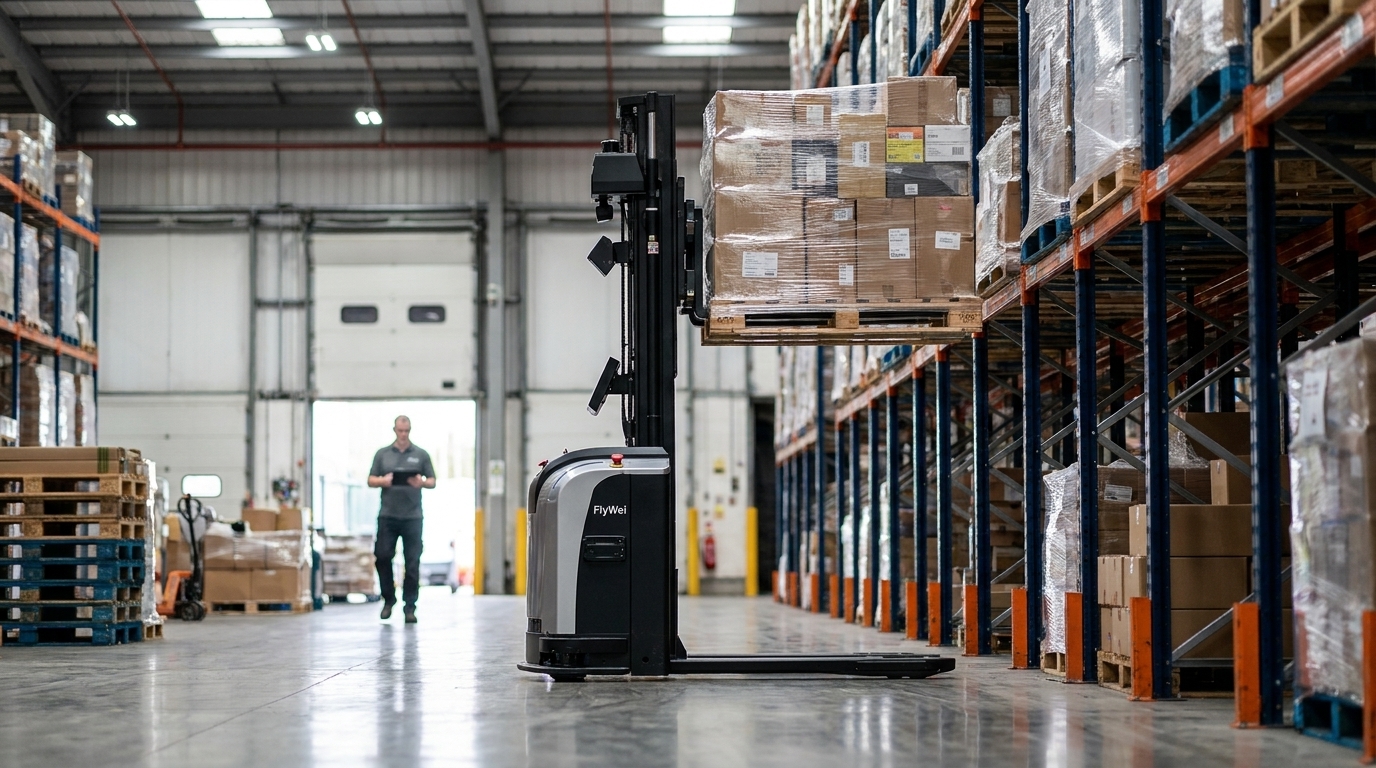
A driverless forklift is an autonomous industrial truck that lifts, carries and stacks pallets without an operator on board, guided by on-board sensing. The Health and Safety Executive reports that workplace transport incidents kill around 50 people and injure roughly 5,000 more in Great Britain every year, and cold stores concentrate exactly the conditions that cause them. If you run a chilled or frozen plant, the number that actually keeps you awake is not the accident rate — it is cover. Blast-freeze-to-despatch is the leg that decides whether tonight's production reaches the trailer, and it is staffed by the shift that loses people fastest: −25°C, mandatory warm-up rotations, agency cover that arrives untrained on your racking. A driverless forklift holds the same cycle time at −25°C as it does at ambient, which is why UK cold-chain plants deploy them first on the blast-freeze-to-despatch leg rather than on picking.
Why cold-side throughput fails before anything else does
Chilled and frozen manufacturing runs two clocks that do not agree. Production is a batch process: a line finishes a run, pallets build, and the blast freezer takes them in tranches on its own thermal cycle. Despatch is continuous, governed by a booking slot that does not move. The transfer between those clocks is the only elastic part of the plant, so it absorbs every variance upstream and downstream — using people.
Those people work in the least attractive environment on site. Sustained work at −25°C requires rotation, insulated PPE and warm-up breaks that cut the productive fraction of every shift. Recruitment is harder and retention worse than for ambient roles, so the cold-side rota carries a structurally higher share of short-tenure cover — competent, but unfamiliar with which aisle has the tight upright or which dock leveller ices first.
The failure pattern is predictable. Cycle times drift up as tenure drops, and racking impacts cluster in the cold aisles. The Provision and Use of Work Equipment Regulations 1998 require that equipment is used only by adequately trained people, so every cover shift adds a supervision load falling on your shift managers rather than the agency. When the transfer slows by a few minutes per pallet, the despatch window breaks — not the freezer, and not the line. This holds whether the site sits in the East Midlands corridor around Magna Park and DIRFT or on a standalone chilled plant further north, and Logistics UK has flagged warehouse skills shortages as structural.
A driverless forklift holds the same cycle time at −25°C as it does at ambient, which is why UK cold-chain plants deploy them first on the blast-freeze-to-despatch leg rather than on picking.
Lever 1 — Automate blast-freeze-to-despatch before anything else
The operational lever is scope discipline. A chilled or frozen site has four candidate flows: line-side pallet removal, blast-freeze in and out, frozen-store put-away, and marshalling to the dock. Only one is at once repetitive, time-critical and staffed by your hardest-to-fill rota.
Scope it as a fixed route set, not a general-purpose fleet: pick points at the freezer exit, drop points in the marshalling lanes, and the exception rule for a pallet that fails temperature check. Everything else stays manual in phase one. The case for a driverless forklift in cold chain is not headcount removal — those staff are almost always redeployed into ambient roles you struggle to fill — it is variance removal. A machine that performs the same transfer at the same speed on a Tuesday in July and a Sunday night in December is what protects the despatch slot.
Measure the right thing from day one: pallets transferred per hour against the despatch booking, not truck utilisation.
Lever 2 — Put the decision in the orchestration layer, not the robot
The technical lever is where cold-chain deployments are won or lost. A robot that navigates well but takes instructions from a spreadsheet will not hold a despatch window. An orchestration layer will.
That means three tiers. Your existing production and warehouse systems decide what work exists — which batch has cleared its blast cycle, which trailer is booked. A fleet manager such as FlyWei M4 converts that into routes, traffic rules, charging windows and vehicle assignments across both zones. A dispatch layer such as FlyWei RDS sequences missions and handles exceptions, while vehicles report position, load state and task status upwards.
Insist on an open interface between fleet manager and vehicles. VDA 5050 is the published standard for exactly this: one fleet control commanding vehicles from more than one manufacturer without a bespoke integration for each. That is what lets you add a truck class in phase two — an autonomous lifting robot for cage work, say — without rebuilding what you paid for. Ask any supplier whether their fleet manager speaks the standard natively or through an adapter.
Lever 3 — Build the PUWER and ISO 3691-4 evidence pack before the pilot
The regulatory lever is most often deferred, and deferring it turns a successful pilot into a stalled rollout. Under the Provision and Use of Work Equipment Regulations 1998 the duty to ensure equipment is suitable, maintained and safely used rests with the employer operating it. A supplier can provide evidence; it cannot hold that duty.
The relevant product standard is ISO 3691-4, covering driverless industrial trucks and the safety functions that stop a truck when a person enters its protective field. Build a pack containing, at minimum: UKCA declarations per truck class; safety-function validation for your route speeds and loads; drawings showing protective fields against actual aisle widths; the pedestrian segregation plan; and a maintenance schedule with cold-specific intervals.
Do this before commissioning, because the answers change the design. If your frozen-store aisles cannot take the protective field at the speed you need, you widen the aisle, slow the truck, or change truck class — and you want that on a drawing, not on a Tuesday night with a trailer waiting. Standards are available through BSI; LOLER covers lifting operations.
Lever 4 — Engineer for the cold, or the fleet will drift
Three physical factors separate a cold-chain deployment from a warehouse one.
Condensation cycling. Every transit between ambient and frozen air puts moisture on sensors, contacts and lenses. Design the route set so machines dwell on one side of the boundary where possible, use sealed or heated sensor housings, and treat the airlock as process equipment with its own maintenance regime, not a doorway.
Floor flatness. Autonomous trucks lifting to height in narrow aisles are more sensitive to floor tolerance than a driver who compensates without noticing. UK floor flatness is normally specified to the Concrete Society's TR34 guidance, and cold-store slabs move with thermal history. Survey the floor before fixing mast heights.
Charging strategy. Battery performance falls in the cold, and opportunity charging inside the frozen store is rarely right. Site chargers in the ambient buffer, size the fleet for charging overhead rather than the theoretical duty cycle, and schedule charging so trucks are full when the booking window opens.
| Candidate flow | Why it looks attractive | Why it is usually not first | Right robot class | Evidence needed at sign-off |
|---|---|---|---|---|
| Blast-freeze to despatch | Time-boxed; protects the booking slot; worst rota to staff | Recommended first flow | Counterbalanced or reach-truck driverless forklift | Cycle-time baseline; slot adherence |
| Line-side pallet removal | Visible headcount | High variation; frequent layout change; ambient anyway | Pallet-truck class or tugger | Changeover frequency; line-stop data |
| Frozen-store put-away | Largest labour pool in the cold | Aisle width and protective fields force redesign | Narrow-aisle reach-truck class | TR34 floor survey; aisle-width check |
| Marshalling to dock | Simple, short, flat | Congested with manual traffic and visiting drivers | Pallet-truck class | Segregation plan; dock traffic study |
What FlyWei does here
FlyWei is an independent UK systems integrator of autonomous forklifts and AMRs. We are vendor-neutral by design, integrating machines across multiple manufacturers — which matters in cold chain, because no single truck class covers blast-freeze transfer, narrow-aisle frozen storage and dock marshalling.
On a chilled or frozen plant, FlyWei starts with a route-level study of the blast-freeze-to-despatch leg: pallet volumes by hour, the booking profile, aisle geometry and floor condition. From that we size the fleet against charging overhead rather than theoretical duty cycle, and specify truck class per route.
FlyWei M4 manages the fleet across the thermal boundary — traffic rules keeping autonomous and manual trucks apart in the marshalling lanes, charging scheduled against your despatch windows, and an open VDA 5050 interface so a second truck class can join in phase two. FlyWei RDS sequences missions and surfaces exceptions to your shift team rather than burying them. Your existing production and warehouse systems remain the record of stock. Because the compliance pack is built during design rather than after commissioning, the evidence is ready when your safety committee asks. Where capex timing is the constraint, our three, five and seven-year leasing terms move the fleet onto operating budget; our guide to what an autonomous forklift actually is covers the basics.
Frequently asked questions
What is a driverless forklift?
A driverless forklift is an autonomous industrial truck that lifts, carries and stacks pallets without an operator on board. It navigates using on-board sensing rather than wire or tape, and takes its work from a fleet management layer connected to your warehouse system.
Can a driverless forklift operate at −25°C?
Yes, with cold-specific engineering: sealed or heated sensor housings, cold-rated hydraulics, a charging regime sized for reduced battery performance, and a route design limiting crossings of the thermal boundary. The dominant failure mode is condensation on sensors, not the low temperature itself.
Where should a chilled or frozen plant start?
On the blast-freeze-to-despatch transfer. It is repetitive, time-critical, low in variation and staffed by the rota hardest to cover. Starting there protects the booking window and gives a clean before-and-after measurement, because the flow has a defined start, end and clock.
Do we have to replace our warehouse system to use autonomous forklifts?
Usually not. An orchestration layer sits above your existing system and takes work from it, so that system remains the source of truth for stock and orders. Replacement is only worth considering where the incumbent cannot expose work through an interface or a scheduled export.
Who is legally responsible for safety once the robots are running?
The employer operating the equipment. Under the Provision and Use of Work Equipment Regulations 1998 the duty to ensure work equipment is suitable, maintained and used only by adequately trained people rests with the plant, not the supplier. An integrator supplies evidence and training but does not assume the duty.
What standard applies to driverless industrial trucks?
ISO 3691-4 covers driverless industrial trucks and the safety functions that detect a person entering a truck's protective field and bring it to a controlled stop. It sits alongside PUWER, which governs how you use the equipment, and LOLER, which covers lifting operations.
If blast-freeze-to-despatch throughput is on your Q3 risk register, look at one flow rather than the whole plant.
Get a 48-hour feasibility read on your highest-volume flow — send the pallet volumes by hour and the despatch booking profile for one leg, and we will tell you whether it is a candidate, what truck class fits, and what would have to change on the floor. Or browse our driverless forklift range.
UK-based engineers. No obligation. We reply within one business day.