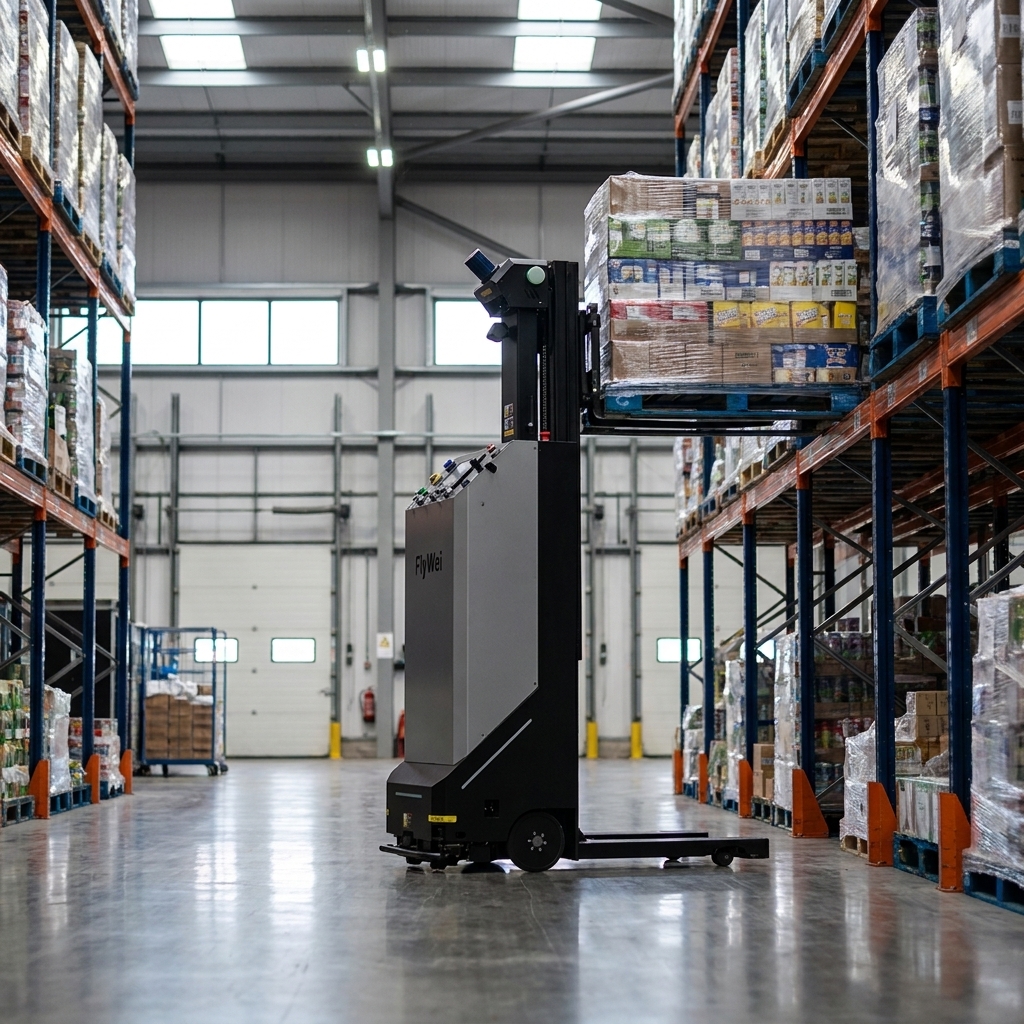
An FMCG robot is a driverless machine that moves finished pallets between palletising lines, bulk store and despatch without an operator on board. The stakes are not abstract: in Great Britain, 24 of the 126 workers killed in work-related accidents in 2025/26 were struck by a moving vehicle, the second most common cause of workplace death. For a supply chain director running three or four UK FMCG plants, that risk sits alongside a harder commercial problem. Pallet-movement capacity on nights and weekends is the least forecastable input in the whole network. Counterbalance-ticketed cover varies site to site and week to week, so the same production plan yields different despatch performance depending on who turns up. In the Q3 promotional and festive build, that variance lands directly on customer service levels, and no amount of line-side efficiency compensates for finished pallets standing on the floor because nobody was free to move them.
Why night-shift pallet capacity is the weak link in an FMCG network
The root cause is structural rather than local. UK FMCG plants were laid out around human drivers, and the material-flow model assumes a counterbalance truck is available whenever a pallet lands. That assumption held when a site could staff its own bench. It holds far less reliably now, because the ticketed, site-familiarised driver is a scarce and mobile resource, and the sites competing for that resource sit within a few miles of each other around Magna Park, DIRFT, Daventry and Burton-on-Trent.
Three UK-specific factors compound it. First, competence is not portable in practice: a driver may hold the ticket, but site familiarisation, racking layout and traffic rules mean a new face is not immediately productive on a busy night shift. Second, demand is spiky in a way labour supply is not. The promotional and festive build asks a plant to sustain peak despatch for a fixed window, and agency cover is least dependable in exactly that window. Third, the safety expectation has tightened, and segregating people from moving plant is now a board-level duty rather than a site-level habit: HSE records 59,219 employer-reported non-fatal injuries in 2024/25, with handling, lifting or carrying accounting for 17 per cent and being struck by a moving object a further 10 per cent.
The consequence is that plan and outcome drift apart. Production performs; despatch does not. The variance is invisible in a weekly report and painfully visible in an on-time-in-full conversation with a grocery customer.
In Great Britain, 24 of the 126 workers killed in work-related accidents in 2025/26 were struck by a moving vehicle, the second most common cause of workplace death, and the single risk an FMCG robot removes by taking the driver off the truck.
Lever one: take the repeatable moves off the roster first
The operational lever is scope discipline. An FMCG plant's movement profile splits into repeatable work and judgement work. Repeatable work is the pallet leaving the wrapper, travelling a fixed route to a bulk-store aisle, and being set down at a known height. Judgement work is trailer loading, damaged-pallet recovery, unplanned re-slotting and anything customer-facing.
Automate the first category and leave the second with your team. This converts an availability problem into a capacity problem you can schedule. A driverless forklift running a fixed palletiser-to-bulk-store loop delivers the same moves per hour at 03:00 on a bank holiday as at 10:00 on a Tuesday. That predictability is the point, more than any single-machine cycle time.
Start by mapping every move in one full production week, tagging each as fixed-route or exception, and measuring how many fixed-route moves happen late. That figure, not a supplier throughput claim, is the honest size of the prize. It also sizes the fleet, which is almost always smaller than an initial enquiry assumes.
Lever two: put one orchestration layer above the machines
The technical lever is control, and it is where multi-site programmes are won or lost. One automated cell is a pilot. Four cells, each with its own control software and its own interface into a different local system, are four maintenance liabilities. The unit of value for a network is a common orchestration layer.
That layer does three things. It converts work from the operator's existing ERP and WMS into missions, so those systems remain the record of stock rather than being replaced. It arbitrates traffic, charging and priority, which stops machines queueing at a shared aisle mouth during peak. And it reports the same metrics in the same shape everywhere, so Plant A and Plant C compare without reconciling two data models by hand.
Insist on open interfaces. VDA 5050 is the published standard for command and control between a fleet manager and mobile robots, and it lets machines from different manufacturers sit under one controller rather than forcing a single-vendor estate. FlyWei's M4 fleet manager is built on that principle, with RDS robot dispatch handling task allocation. Ask any supplier whether adding a second manufacturer's machine in year three needs a new integration, and get it in writing.
Lever three: design to PUWER and ISO 3691-4 at concept, not handover
The regulatory lever is the one most often deferred, and deferring it is expensive. Autonomous trucks are work equipment, so the Provision and Use of Work Equipment Regulations 1998 apply in full, including Part III on mobile work equipment. HSE guidance sets the duties out plainly: equipment must be suitable, maintained, inspected and operated by competent people.
For an FMCG robot that becomes concrete design work before a machine arrives. Floor condition and joint tolerance must suit automated travel, and a TR34-compliant slab is a reasonable benchmark. Safe-stop and restart behaviour must be defined for every failure mode, including loss of the network link. Pedestrian routes must be physically resolved, not managed by signage. BS EN ISO 3691-4 is the reference standard for driverless industrial trucks and belongs in your specification, not in a post-commissioning gap analysis.
The competence duty changes shape rather than disappearing. Your team stops driving and starts supervising, which needs different training, a documented inspection regime and a clear escalation route. Write that into scope at the outset.
Lever four: prove one cell, then clone the standard across the network
The commercial lever is sequencing. Four sites at once multiplies risk and delays every payback. One site then nothing produces an orphan. The pattern that works is a single reference cell, specified deliberately so everything about it is reusable: the same control layer, interface pattern, safety case structure and training package.
Choose that site for representativeness rather than convenience. The plant with the most typical layout and the worst night-shift gap produces transferable evidence; the newest site with the best floor flatters the result. Run it through a full promotional peak before committing to rollout, because peak is the condition the business case rests on.
Funding matters too. Automation that competes with production capex tends to lose, which is why many FMCG operators route these projects through operating budgets instead. Autonomous forklift leasing over three, five or seven-year terms keeps cost aligned to the contract it supports and removes the largest reason multi-site rollouts stall between the pilot and the second plant.
| Decision factor | Manual counterbalance cover | FMCG robot on fixed routes | What changes for the SC Director |
|---|---|---|---|
| Night and weekend capacity | Depends on ticketed cover that week | Identical every shift, bank holidays too | Despatch becomes a planned figure |
| Peak ramp | Agency supply tightest at peak | Extra hours without extra headcount | Promotional commitments can be underwritten |
| Vehicle and pedestrian risk | Managed by rules and supervision | Driver off the truck; routes fixed | Addresses the second-largest cause of workplace death |
| Cross-site comparability | Each plant reports its own way | One orchestration layer, one metric set | Plants become genuinely comparable |
| Cost treatment | Variable cost, volatile rates | Fixed lease term, or capital purchase | Cost per pallet move becomes predictable |
| Scaling to site two | Rehire and retrain locally | Clone the reference cell and safety case | Rollout time falls at each further plant |
What FlyWei does here
FlyWei is an independent UK systems integrator of autonomous forklifts and AMRs. We are vendor-neutral by design: we integrate the machines that suit the flow rather than the ones a single manufacturer happens to sell, which is what makes a multi-site FMCG standard practical rather than aspirational.
That work usually begins with a movement study at one plant, identifying which palletiser-to-bulk-store loops are genuinely fixed-route and how much current lateness is availability-driven. FlyWei then specifies the machine class against the real duty, most often a counterbalanced or reach-truck FlyWei autonomous forklift for palletised finished goods, with lifting robots where trolley movement sits alongside pallet work.
The orchestration layer is where the network benefit is realised. M4 takes work from the operator's existing ERP and WMS, converts it into missions, arbitrates traffic and charging, and reports identically at every site. RDS handles dispatch and priority so a promotional build does not starve routine replenishment. FlyWei engineers deliver the safety case, floor and interface work alongside it, then hand over a documented standard the second and third plants adopt without redesign. That is the difference between an automated cell and FMCG robot deployments that scale across a UK manufacturing network.
Frequently asked questions
What is an FMCG robot?
An FMCG robot is an autonomous machine that moves finished pallets, cases or trolleys without a driver in consumer goods manufacturing and warehousing, most often a driverless forklift on the palletiser-to-bulk-store route.
Do we have to replace our WMS to deploy an FMCG robot?
No. A fleet-management layer sits between your existing systems and the machines, taking work over a documented interface and writing completions back. Your ERP and WMS stay the record of stock.
How many machines does a single FMCG plant need?
Fewer than most first enquiries assume. The number follows from the fixed-route moves in a production week and the hours available to complete them, not from headcount.
Will an autonomous forklift work on our existing floor?
It must be surveyed, not assumed. Joint condition, flatness and racking tolerance affect travel and lift accuracy. Specifying a benchmark such as TR34 at concept stage avoids remedial work later.
Can machines from different manufacturers run under one controller?
Yes, where they support a common interface. VDA 5050 lets one fleet manager command vehicles from different suppliers using one message format, the practical safeguard against single-manufacturer lock-in.
What regulations apply to autonomous forklifts in a UK plant?
PUWER 1998 applies in full, including Part III on mobile work equipment. BS EN ISO 3691-4 is the reference standard for driverless industrial trucks and belongs in the specification.
If unpredictable night-shift and weekend pallet capacity is on your Q3 risk register, the fastest way to size the opportunity is to look at one real flow rather than a generic business case.
Get a 48-hour feasibility read on your highest-volume flow and we will tell you which moves are automatable, how many machines the duty requires, and what the floor and interface work involves. Our autonomous forklifts page lists the machine classes we integrate for palletised finished goods.
UK-based engineers, no obligation, and a reply within one business day.