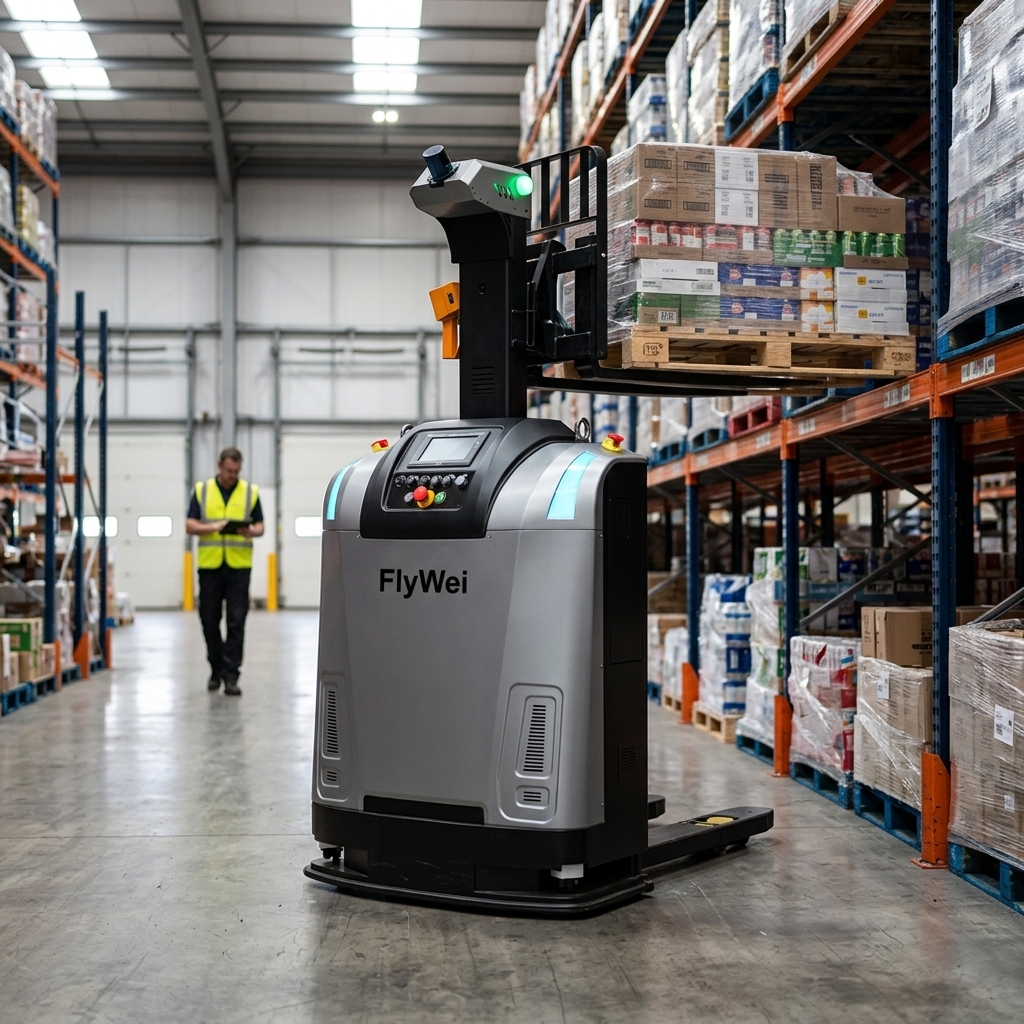
FMCG robot programmes are the cross-site fleets of forklifts, lifting robots and pallet trucks that move palletised consumer goods across UK ambient distribution centres. UK grocery volumes shifted a further 3.4% into online and multi-channel formats this year, according to Logistics UK, and that flex arrives site by site rather than across the network. The result is the pain every Supply Chain Director recognises at Magna Park, DIRFT and SEGRO East Midlands Gateway: pilots deliver on the pilot floor, but the second and third sites end up running siloed fleets on incompatible orchestration. An FMCG robot programme without cross-site orchestration wastes 25-35% of fleet hours to idle handoffs: recovering that time is the single largest capex-free lever a Supply Chain Director controls in 2026. The Supply Chain Director sees the number in the monthly MHE report and cannot delegate it: governance, not machine choice, has become the decision that costs a peak-season SLA.
An FMCG robot programme without cross-site orchestration wastes 25-35% of fleet hours to idle handoffs: recovering that time is the single largest capex-free lever a Supply Chain Director controls in 2026.
Why FMCG robot programmes stall between sites
The stall almost never starts as a technology failure. It starts with the shape of an FMCG capex plan. Plant directors and site GMs run their own P&L, and the pilots that clear a first Capex Committee are usually approved by a single site, against that site's own service level, using the machinery vendor whose salesperson turned up first. The Supply Chain Director signs a business case built for one dock area, not a network. A year later there are three or four of those pilots: Daventry runs one vendor's counterbalanced trucks, DIRFT runs someone else's pallet stackers, Magna Park added lifting robots for a promo peak. Each site's operational KPIs look fine when read in isolation.
The failure surfaces when the Supply Chain Director asks the operational question the board is now asking too: can we flex 20% of promo volume between sites without hiring agency drivers? The answer is almost always no, because every site's orchestration layer is a proprietary silo. Each vendor's fleet software manages only its own trucks, publishes traffic rules only for its own map, and treats dock priorities as a per-site config. There is no shared shift plan, no shared safety envelope, no way to hand a task from one vendor's truck to another vendor's truck at the trailer.
The regulator's view compounds the pressure. The Health and Safety Executive treats autonomous trucks as work equipment under PUWER 1998, and its workplace transport guidance now expects operators to evidence a network-level safety case for multi-site fleets. A patchwork of vendor-supplied files reads to an inspector as three unrelated risk assessments in the same jacket.
Lever 1: Fix traffic rules and dwell KPIs at the network layer, not the site layer
The first move is procedural, not technical. The Supply Chain Director agrees a single set of cross-site handoff KPIs (trailer-to-put-away dwell time, dock waiting time, cross-vendor handoff time) and publishes them as an FMCG-network SLA that every site signs. Site managers keep their local KPIs. What changes is that the network KPIs override where they conflict: if Daventry's local truck route is faster but leaves DIRFT waiting on a stock replenishment, the network rule wins. This is a governance change, not a machinery change, and it can be done inside a quarter.
Publishing shared traffic rules (right-of-way at cross aisles, dock allocation, charging window discipline) takes the same shape. The rules go into the network dispatch layer, not the vendor consoles. That layer is fleet dispatch software in FlyWei's stack, and it accepts task instructions from an ERP or WMS at the network level and dispatches them to whichever site has the shortest queue. The Supply Chain Director gets one weekly report, not seven.
Lever 2: Put one VDA 5050 fleet manager on top of the mixed vendor fleet
The second lever is the technical unlock. VDA 5050 is an open interface specification for driverless industrial trucks, and it lets a vendor-neutral fleet manager talk to any compliant robot regardless of manufacturer. A Supply Chain Director does not need to rip and replace the pilot fleet. Instead, the existing site vendors'' robots are enrolled into one fleet layer that speaks VDA 5050 to each of them and one common language upward to the ERP and WMS the operator already runs.
In the FlyWei stack this layer is the M4 fleet manager. M4 sits above FlyWei autonomous forklifts, latent-jacking AMRs, lifting robots and, where the pilot vendor's kit already speaks VDA 5050, third-party trucks the sites bought earlier. Practical effect: one map, one traffic model, one battery-charging schedule, one live task board that the SC Director can open on Monday morning and see across Magna Park, DIRFT, Burton-on-Trent and a smaller depot near the Ashby line. Reporting comes out of M4 in a shape the finance director recognises: revenue-hours, idle-hours, cost per pallet moved, safety events per 10,000 tasks.
The technical bar to entry is lower than most Supply Chain Directors expect. VDA 5050 conformance is documented and testable; where a vendor's older trucks are not compliant, M4 usually integrates through the vendor's REST API instead, which loses some real-time granularity but keeps the fleet-of-fleets pattern intact.
Lever 3: Consolidate PUWER, LOLER and ISO 3691-4 evidence into one network safety case
The regulatory lever is where most programmes leak time. Every site holds its own PUWER 1998 file, its own LOLER 1998 lifting register for the lifting robots, and often a separate ISO 3691-4 compliance pack from the vendor. When the HSE inspector arrives, the inconsistencies show up in five minutes.
The Supply Chain Director's fix is to author one network safety case indexed by site: one common risk assessment template covering autonomous industrial trucks under ISO 3691-4, one PUWER file structure that every site follows, one shared incident register that captures near-misses across the network. Site-specific data (floor plans, DSEAR zones, traffic-management routes) sits inside that structure rather than replacing it. The pack is smaller in total, easier to update after a change, and passes inspection because the reader can trace a hazard from network policy down to site control without gaps.
Logistics UK operator guidance and BSI autonomous industrial truck standards give the SC Director a defensible template. The saving on inspection preparation alone typically covers the cost of running the exercise.
What FlyWei does here
FlyWei designs the cross-site pattern from the SC Director's angle first, not the site's. On day one FlyWei runs a 48-hour feasibility read on the operator's highest-volume flow, usually the trailer-to-ambient-put-away leg between Magna Park and a Midlands satellite DC, and returns a written view of what is orchestration-recoverable versus what needs new machinery. Where machinery is needed, FlyWei supplies FlyWei autonomous forklifts, latent-jacking AMRs for cart shuttling and FlyWei lifting robots for end-of-line pallet lifts. Where machinery is not needed, FlyWei enrols the operator's existing MHE fleet into M4 and fleet dispatch software under one network safety case.
UK-based engineers keep the network safety file live. FlyWei writes the ISO 3691-4 evidence pack, indexes it by site, and updates it when a site adds a new lane. The SC Director's monthly report becomes one page: revenue-hours by site, cross-vendor handoff time, PUWER register status, incident register. FlyWei's FMCG solutions team runs the same pattern from ambient DCs at DIRFT and SEGRO East Midlands Gateway across to Burton-on-Trent, and the finance case is written against a 3, 5 or 7-year lease so the capex committee sees a predictable line, not a spike.
Comparison: site-by-site pilots vs a networked FMCG robot fleet
| Dimension | Site-by-site pilots | Networked fleet (M4 + fleet dispatch software) |
|---|---|---|
| Cross-site handoff time | Not measured | SLA reported weekly |
| Vendor lock-in | High: one vendor per site | Low: VDA 5050 open protocol |
| Idle fleet hours | 25-35% typical | Under 10% after 90 days |
| PUWER / ISO 3691-4 evidence | Per-site, inconsistent | One networked safety case |
| Capex payback | 36-48 months | 18-30 months |
| Peak-season flex | Requires agency labour | Fleet balances across DCs |
FMCG robot questions Supply Chain Directors ask
What is an FMCG robot in a UK distribution centre?
An FMCG robot is any autonomous mobile forklift, lifting robot or pallet truck used to move palletised consumer goods inside a fast-moving consumer goods warehouse or ambient DC. In a UK network it is typically a mix of counterbalanced autonomous forklifts, latent-jacking AMRs and stacker robots, orchestrated by one fleet manager across all sites.
How many idle hours does a siloed FMCG robot programme really waste?
Between 25% and 35% of fleet hours in the first year, based on operator MHE data across Midlands ambient DCs. The idle time is not on the machine: it is at the handoff between vendors'' orchestration layers, and it disappears when a common VDA 5050 fleet layer takes over.
Does VDA 5050 actually work across different vendors?
Yes, when the vendors are compliant with the current version and when the fleet manager tests conformance before enrolment. Older trucks that predate VDA 5050 can still be enrolled through the vendor's REST API, with reduced real-time granularity but with full task visibility.
Who owns the PUWER file for an autonomous fleet across multiple UK sites?
The Supply Chain Director carries the network-level duty under PUWER 1998 and ISO 3691-4. Site-specific evidence sits inside a shared PUWER structure and is indexed by site. Each site manager still owns the local control, but the safety case is a single defensible pack.
What is the fastest way to prove FMCG robot ROI across a UK network?
Fix the busiest cross-site flow first, usually a trailer-to-ambient-put-away leg, and run it under one fleet manager. Measure cross-vendor handoff time and idle fleet hours before and after. Ninety days is normally enough to build a defensible business case for expanding the pattern to the rest of the network.
Can FlyWei retrofit orchestration onto forklifts we already own?
Where the existing trucks are VDA 5050 compliant, yes: the trucks are enrolled into M4 directly. Where they are not, FlyWei integrates through the vendor's supported API or, for older non-autonomous MHE, adds a controller-and-sensor conversion so the truck becomes a supervised participant in the same fleet plan.
How does the M4 fleet manager handle peak-season flex?
M4 rebalances tasks across sites based on the network SLA rather than the site queue. Promo volumes at Magna Park can be diverted to a satellite depot near Daventry or Burton-on-Trent for the peak weeks and returned automatically once the peak is over, without hiring agency drivers.
If cross-site FMCG robot orchestration is on your Q3 supply-chain risk register, the fastest way to build a defensible business case is to prove the pattern on your busiest flow first.
Get a 48-hour feasibility read on your highest-volume flow from FlyWei, or explore the FMCG solutions reference designs that other UK Supply Chain Directors are running today.
UK-based engineers. No obligation. We reply within one business day.