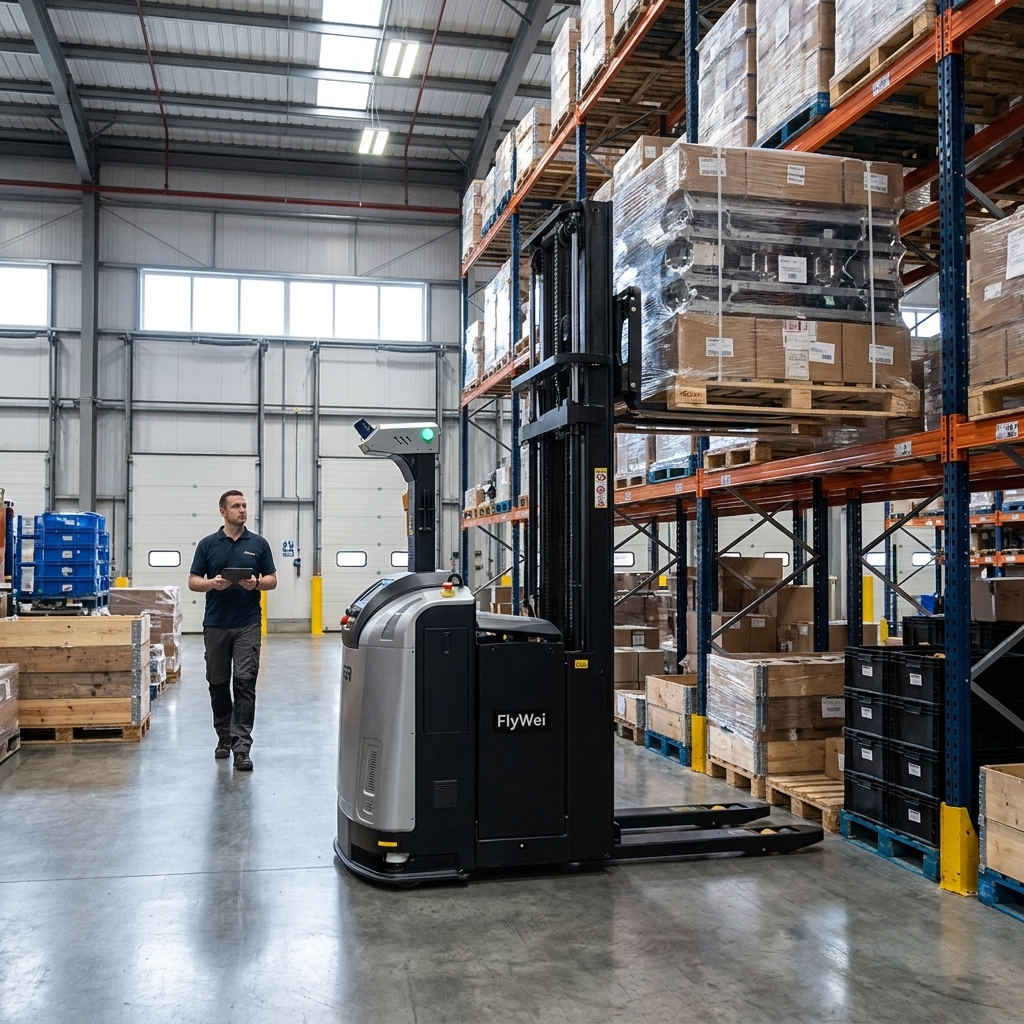
A forklift AGV is an automated guided vehicle built on a lift-truck chassis that moves palletised loads and heavy work-in-progress without a driver on board. Handling, lifting or carrying caused 17% of the 59,219 employee non-fatal injuries UK employers reported under RIDDOR in 2024/25, with struck by moving object a further 10%, according to HSE statistics. For a supply chain director in engineering and heavy industrial parts, that risk sits on the same shift pattern as the throughput problem: machined castings, gearbox housings and fabricated assemblies get double-handled between machining cells, the plating or paint queue and despatch, and every one of those moves depends on counterbalance driver cover that thins the moment a shift runs short, an agency booking falls through or a licence renewal lapses mid-week. By the Friday of a short-cover week, the despatch bay is the plant's most expensive queue.
Why heavy work-in-progress keeps stalling
Engineering and heavy industrial parts sites carry a flow profile that suits automation badly on paper and very well in practice. The loads are dense, irregular and expensive. A single stillage of machined housings can be worth more than a week of finished FMCG pallets, and it moves between operations several times before it is packed. Each move is short, repetitive and non-value-adding — yet each needs a ticketed counterbalance operator.
That operator is the scarce resource. UK logistics and manufacturing employers report persistent difficulty recruiting and retaining licensed material-handling staff, a pressure Logistics UK has tracked through its skills work for years. The effect inside a machining hall is not a dramatic shortage but a quiet one: days are covered, the back shift by overtime, and nights run one driver short roughly once a week. On those nights the cells keep cutting and nothing moves. Work-in-progress builds at the end of the line, despatch starts the morning behind, and the cost lands as expedited transport rather than a labour variance.
Three UK-specific factors sharpen it. Older heavy-engineering buildings have mixed floors and narrow cross-aisles, so adding trucks adds congestion rather than throughput. Pedestrian and vehicle segregation in a machining environment is genuinely difficult, which is why HSE workplace transport guidance treats it as a standing control rather than a one-off project. And committees used to machine tools with twenty-year lives scrutinise a five-year material-handling asset harder than its value warrants.
Handling, lifting or carrying accounted for 17% of the 59,219 employee non-fatal injuries reported by UK employers under RIDDOR in 2024/25, with struck by moving object a further 10%.
Lever one: scope the single heaviest repeatable flow, not the whole plant
The operational lever is ruthless narrowing. Pull twelve weeks of movement data and rank every internal move by volume, distance and load weight. In most heavy-engineering plants one flow dominates: finished machined parts leaving a cell group for a consolidation buffer, or that buffer feeding despatch. That flow is fixed-origin, fixed-destination, runs every shift and carries no decision-making. It is the only candidate worth automating first.
Scope it as a lane, not a fleet. Measure the move count per shift, dwell time at each end, aisle width at its narrowest point and floor flatness along the route — TR34 is the reference for the last of these, and a brownfield route often needs localised remediation rather than a new slab. Then size the forklift AGV requirement against measured moves with headroom for charging, not against peak-day ambition. A two-truck lane that clears every shift beats a six-truck programme that never leaves pilot.
Lever two: orchestration is the asset — one traffic model, mixed manufacturers
The technical lever is the fleet layer, and it is where most automated forklift projects quietly fail. A driverless forklift does not take instructions from an enterprise WMS directly. A fleet manager sits between them, taking work over a documented interface, converting it into routes, traffic rules and vehicle assignments, and writing completions back so the existing system stays the record of stock.
This matters more in engineering because the vehicle mix is unavoidable. A machining hall needs a counterbalance class for heavy stillages and a narrow-aisle reach or stacker class for component racking. VDA 5050 — the open standard published by the VDA and VDMA for communication between mobile robot fleets and a central fleet control — is what lets those classes answer to one traffic model instead of three bespoke integrations. FlyWei's M4 fleet manager is built on that principle, and RDS robot dispatch handles the task-level decisions above it: which load, which vehicle, which priority, and what to do when a crane lift blocks a route.
Lever three: build the regulatory file before procurement, not after
The regulatory lever is the one that most often delays go-live. A driverless lift truck is work equipment, so the Provision and Use of Work Equipment Regulations 1998 apply in full — suitability, inspection, and competence of anyone who supervises or intervenes. HSE's PUWER guidance is the practical reference, and ISO 3691-4 sets the safety requirements specific to driverless industrial trucks and their systems.
Three documents are worth producing before the purchase order rather than during commissioning. First, a route risk assessment covering pedestrian interaction at every crossing, with segregation controls named. Second, a rescue-and-intervention procedure defining who may approach a stopped vehicle and under what isolation. Third, a training record mapping which staff hold which competence — ACOP L117 remains the reference for lift-truck operator competence, and supervisors of an automated lane still need demonstrable understanding of the system. Producing these early sharpens the specification, because each control you commit to becomes a requirement the vehicle must meet.
Lever four: decide what counts as done, and make the systems agree
The fourth lever is data discipline, and it is cheap. Define before commissioning what a completed move means: load identifier, origin, destination and timestamp. Every completion should post as a stock movement in the system that already holds your inventory, and every failed move should raise a visible exception rather than disappear.
Get this wrong and the lane runs well while the records drift — in a plant handling serialised parts, a far more expensive problem than a slow pallet. Get it right and work-in-progress ageing becomes measurable per location rather than estimated at a shift-end walk, while the business case stops resting on labour displacement alone and starts including the stock accuracy your quality function already wants.
| Lever | Typical capital exposure | What it returns | Owner |
|---|---|---|---|
| Scope one heavy repeatable lane | Survey and data time only | Removes the main cause of stalled pilots; sizes fleet from measured moves | Supply chain director, plant engineering |
| Fleet orchestration layer | Software and integration, costed separately | One traffic model across mixed vehicle classes; completions written back to existing systems | Supply chain director, IT |
| Regulatory file written early | Internal effort, weeks not months | Protects the go-live date; firms up the specification before commitment | SHEQ, operations |
| Completion and exception definitions | Negligible | Stock accuracy and work-in-progress visibility; a second strand to the business case | Supply chain director, quality |
What FlyWei does here
FlyWei is an independent, vendor-neutral UK systems integrator of autonomous forklifts and AMRs. In a heavy-engineering context that independence is the point: FlyWei specifies the vehicle class each move actually needs rather than the one a single manufacturer happens to build. A cell-to-buffer flow carrying dense machined parts is usually a FlyWei autonomous counterbalance truck; the component racking behind it is a FlyWei autonomous reach truck or stacker; sub-assembly trolleys between operations are better served by a FlyWei heavy-lift or tugger AMR than by a forklift at all.
FlyWei designs the lane, integrates the vehicles under the M4 fleet manager so one traffic model governs every class on the floor, and connects RDS robot dispatch to the operator's existing ERP and WMS so the plant's current system stays the record of stock. FlyWei engineers run the site survey, the route and floor assessment, and the commissioning, and they produce the route risk assessment and intervention procedure alongside the client's own SHEQ team. Where capital timing is the obstacle rather than the business case, FlyWei leasing covers the same equipment over three, five or seven-year terms. For moves that are lifts rather than transports, FlyWei lifting robots cover the same ground.
Frequently asked questions
What is a forklift AGV?
A forklift AGV is an automated guided vehicle built on a lift-truck chassis — counterbalance, reach, stacker or pallet-truck class — that lifts and transports loads without an operator on board. It navigates from onboard sensing and a site map, taking work from a fleet management layer rather than a driver.
How is a forklift AGV different from an AMR?
Largely form factor. A forklift AGV has forks and a mast, so it handles palletised and racked loads at height. An AMR usually carries or tows at low level, slipping under a cart or lifting on its deck. Both now navigate freely rather than following fixed guidance. Our guide to autonomous forklifts and AGVs compares them.
Can a forklift AGV work in an older engineering plant without new racking?
Usually yes — brownfield deployment is the normal case. What matters is aisle width at the narrowest point, floor flatness along the route, lighting consistency and pedestrian crossing points. Localised floor remediation is common; wholesale reracking rarely is. The survey tells you which before any commitment.
Which regulations apply to a forklift AGV in Great Britain?
PUWER 1998 applies because the vehicle is work equipment, covering suitability, inspection and the competence of anyone supervising it. ISO 3691-4 sets safety requirements for driverless industrial trucks and their systems. LOLER covers the lifting function and UKCA marking covers conformity. ACOP L117 remains the reference for lift-truck operator competence.
How long does a forklift AGV deployment take?
Vehicle commissioning is rarely the long pole. Mapping loads and locations, agreeing what a completed move means, handling exception paths and testing against live data take longer. Projects move fastest where the existing system already exposes a documented interface and the risk assessment predates the order.
Can a forklift AGV handle non-standard engineering loads like castings and fabrications?
It depends on presentation, not weight alone. A casting on a consistent steel stillage with defined fork pockets is straightforward; the same casting presented loose, or on a stillage that varies between suppliers, is not. Standardising the carrier is usually cheaper than specifying an exotic vehicle.
Does a forklift AGV need to connect to our ERP or WMS?
For anything beyond a single fixed lane, yes — but not directly, and not by replacing it. A fleet layer takes work from your existing system over an interface or a scheduled export and writes completions back, so that system remains the record of stock. Where none exists, file-based exchange with middleware is a workable start.
If stalled work-in-progress on a short-cover shift is on your Q4 risk register, the fastest way to size the opportunity is to put numbers on one flow rather than the whole plant.
Get a 48-hour feasibility read on your highest-volume flow — send the move counts, load weights and aisle dimensions for one lane and FlyWei will return an indicative vehicle class, count and throughput. You can also compare payloads across the FlyWei autonomous forklift range.
UK-based engineers, no obligation, and a reply within one business day.