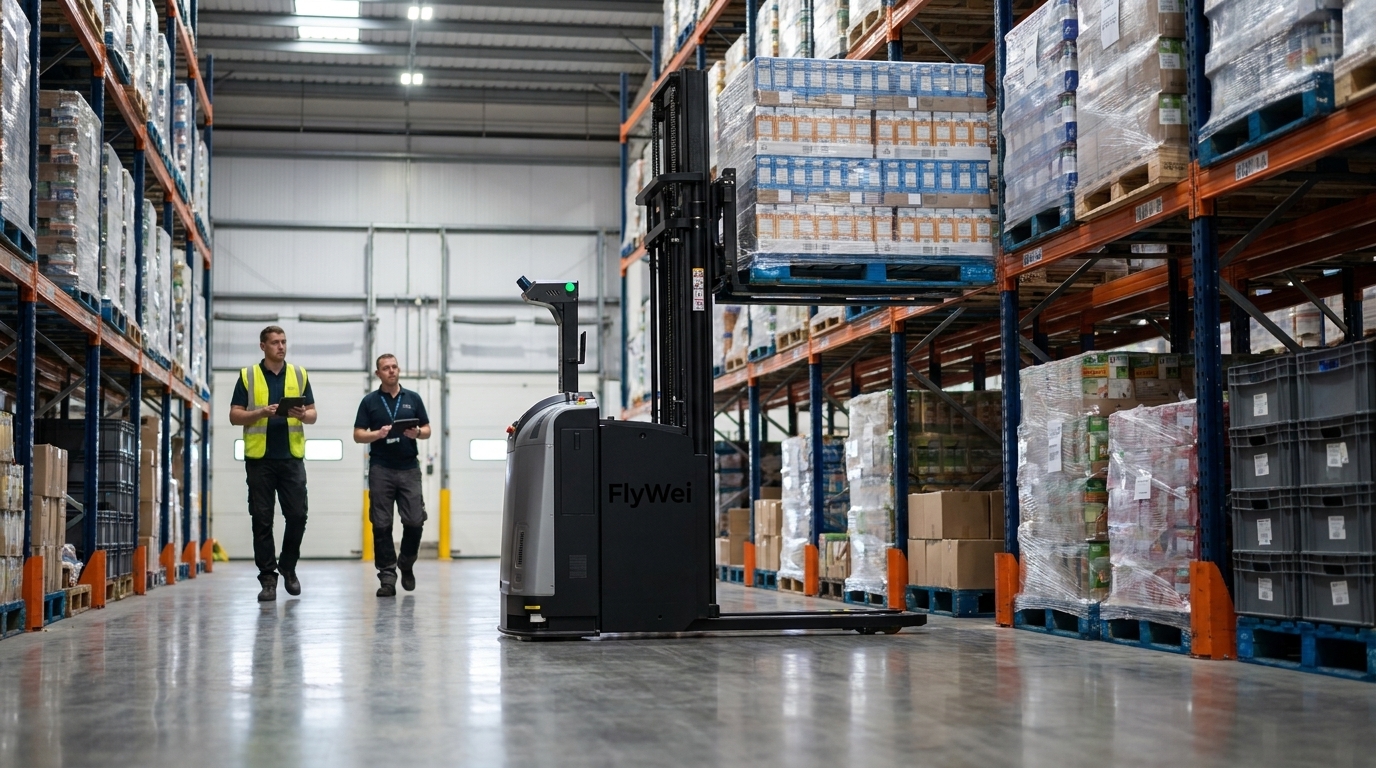
A forklift AGV is a driverless counterbalance, stacker or reach truck that moves palletised loads along mapped routes under central fleet control, with no operator on board. Two sets of 1998 regulations govern how one may run in Great Britain: PUWER (SI 1998/2306) for the truck itself and LOLER (SI 1998/2307) for the lifting it performs, and neither exempts a machine because nobody is sitting on it. For an Operations Director in FMCG manufacturing, the pain is rarely the robot. It is the metre of floor between the palletiser and the dispatch lane. Line output is stable; the pallet flow away from it is not. One late truck backs a full pallet up onto the discharge conveyor, the palletiser stops, and a line rated in cases per minute loses its shift target to a labour problem nobody can solve with more agency drivers.
Why line-end pallet flow stalls in FMCG plants
FMCG manufacturing has a structural mismatch built into it. Production is engineered to a rate and held there. Internal transport is staffed to an average — precisely the wrong tool for a process that arrives in bursts.
A palletiser at the end of a fast line produces a pallet on a fixed cadence. The truck that clears it does not. It is doing something else — a trailer, a replenishment, a quality hold — and it arrives when it arrives. Most plants absorb that variance with a discharge buffer of two or three pallet positions. That buffer is the entire safety margin, and it is measured in minutes.
Labour supply compounds it. Counterbalance work is trained, certified and licensed, so cover cannot be improvised from the packing hall. Logistics UK has tracked operator availability as a persistent sector constraint. A shift starting two operators short does not lose two operators' worth of output — it loses the buffer, and once the buffer is gone the line stops.
Transport work is also invisible in most plants. Production is measured to the case; internal moves are not measured at all. Nobody can say how often the buffer hit zero last month. Without that data every proposal is a matter of opinion, and opinion loses to capex discipline.
Seasonality closes the trap. Volume swings with promotions and the autumn build into Christmas trading, and plants around Burton-on-Trent, Magna Park and DIRFT are planning that build now. Adding heads for a ten-week peak is expensive and slow to train; not adding them means running the peak with no buffer at all.
A forklift AGV is a driverless counterbalance, stacker or reach truck that moves palletised loads along mapped routes under central fleet control, and UK work equipment law applies to it exactly as it applies to a truck with a driver on board.
Lever 1 (operational): size the fleet against the buffer, not the pallet count
The instinct is to count pallets per shift and divide by truck throughput. That arithmetic produces a fleet that copes with the average and fails at the peak, which is the only time anyone notices.
Size against buffer starvation instead. Instrument the discharge for two weeks and record one thing: how long the buffer sits at zero free positions. That figure is your real service-level requirement, and it is almost always driven by a narrow band of the shift — changeover, the hour after a break, the run-up to a trailer cut-off.
Then specify the fleet to hold the buffer through that band with one truck spare. The spare is not slack; it is what lets a machine charge, fault or come out for inspection without the line noticing. A three-truck fleet that never lets the buffer reach zero beats a four-truck fleet sized on averages — and it settles most internal arguments before they start, because a committee can dispute a productivity assumption but not a fortnight of recorded starvation minutes from its own floor.
Lever 2 (technical): put the orchestration above the trucks, not inside them
The failure mode in brownfield FMCG deployments is almost never navigation — modern trucks map and localise reliably in a working plant. It is task allocation: a fleet that does not know which move matters most right now.
That decision belongs in a fleet management layer above the vehicles. M4 holds the plant model — routes, traffic rules, charging strategy, vehicle assignment — and takes work from the systems the plant already runs rather than replacing them. RDS handles dispatch: which truck takes which job, in what order, against what priority. So a line-end move can outrank a replenishment move by rule rather than by radio call. When the buffer drops to one free position, the next available truck is committed to that lane regardless of what else is queued — a single rule often worth more than an extra vehicle.
Insist on open interfaces at both boundaries. ISO 3691-4 governs the truck side; VDA 5050 lets one fleet manager command vehicles from different manufacturers. Without it, every new machine class becomes a bespoke integration.
Lever 3 (regulatory): specify the PUWER evidence up front, not at handover
A conformity mark records the manufacturer's declaration against the directives applying to the machine. It says nothing about your aisle widths, your pedestrian routes or your traffic. PUWER places the duty on the user, and that duty does not transfer with the invoice.
This matters more in an FMCG plant than in a storage warehouse, because the line end is where people and pallet movement are least separated. Operators clear jams, change film reels and take samples in the same square metres the trucks work in. HSE guidance on workplace transport is consistent: separating people and vehicles is the first control.
Write four things into the specification before you order. The performance level achieved by each safety function, stated per function rather than as a blanket claim. The validation record showing those functions were tested at your aisle widths and speeds. The floor tolerance the trucks require, referenced to TR34, because a floor that passed for manned trucks may not hold for automated lifting at height. And the inspection regime that keeps the PUWER duty discharged after month one. Suppliers who can produce these at tender are the ones whose deployments do not stall at qualification.
Lever 4 (commercial): prove one lane, then size the plant
The most common reason an FMCG automation business case dies is that it was written for the whole plant. It carries every assumption and every unknown into one number, and the committee reasonably declines it.
Take one lane instead — palletiser to dispatch, the highest-volume flow you have. It is the shortest route, the most repetitive move, and the one whose failure you can already cost, because you know what an hour of line downtime is worth. Instrument it, automate it, run it for a quarter against the baseline from Lever 1. That gives you what the plant-wide case never had: a measured throughput figure from your own floor, a real integration cost, and a safety case that has survived contact with your operators.
It also changes the funding conversation. A single-lane deployment sits within most plants' operational authority, and where capital is the constraint, three, five and seven-year leasing terms move the cost into opex and let the fleet grow with volume rather than ahead of it.
| Option | Capital profile | Time to effect | Flexibility on layout change | Evidence burden |
|---|---|---|---|---|
| Agency drivers for peak | Opex, rises every peak | Days, if cover exists | High | Low; licence records recur |
| Extend the manned fleet | Capital plus headcount | Weeks to months | High | Existing PUWER regime |
| Fixed conveyor to dispatch | Heavy capital, civil works | Months, usually a shutdown | Low — the route is concrete | Moderate, permanent |
| Forklift AGV fleet, central control | Capital or lease; no headcount | Weeks per lane after mapping | Moderate to high; routes re-mapped | Highest at specification, then stable |
What FlyWei does here
FlyWei is an independent, vendor-neutral UK systems integrator. We are not an OEM and not a reseller, so the fleet we design for a line end is chosen for the flow rather than the badge — and in a plant with a mature manned fleet, that independence is what usually makes the project viable.
For FMCG line-end work we start with the buffer, not the truck. We instrument the discharge, capture the arrival distribution and the starvation minutes, and size from that. Where pallets are full-weight and the route is short and repetitive, the answer is normally counterbalance or stacker-class forklift AGV machines on a fixed loop; where line-side totes and trolleys are in scope too, lifting AMRs run under the same fleet manager.
M4 holds the plant model and traffic rules; RDS carries the priority logic that lets a line-end move pre-empt everything else when the buffer drops. Both take work from existing systems over documented interfaces — the ERP and WMS stay the record of stock.
We deliver the evidence pack with the fleet: performance level per safety function, site validation records, floor survey against TR34, and an inspection schedule that keeps the PUWER duty discharged. Our UK-based engineers work across manufacturing and distribution sites, including the corridor around Magna Park, DIRFT and SEGRO East Midlands Gateway.
Frequently asked questions
What is a forklift AGV?
A forklift AGV is a driverless counterbalance, stacker or reach truck that moves palletised loads along mapped routes under central fleet control, with no operator on board. It handles standard pallets at standard heights.
How is a forklift AGV different from an autonomous forklift?
The terms overlap heavily. AGV historically described a truck following a fixed guide path; autonomous described one navigating by onboard mapping. Nearly all machines sold today are the latter, so judge suppliers on navigation, safety rating and fleet interface, not the label.
Does PUWER apply to a driverless forklift?
Yes, in full. PUWER 1998 applies to work equipment provided for use at work and draws no distinction between a truck with a driver and one without. The duty sits with you as the user; a supplier's declaration does not discharge it.
How many forklift AGVs does an FMCG line end need?
Size against buffer starvation rather than pallet count. Record how long the discharge buffer sits at zero free positions across a fortnight, specify a fleet that holds it through the worst band of the shift, then add one machine to cover charging and faults.
Can a forklift AGV work in an existing plant without new infrastructure?
Usually yes. Modern trucks map and localise against the building as it stands, so guide wires and floor magnets are not needed. The real constraints are floor condition, surveyed against TR34, and pedestrian separation at the line end.
How do forklift AGVs connect to the systems we already run?
Through a fleet management layer, not directly. It takes work from your ERP or warehouse system over a documented interface, translates it into robot missions, then writes completions back so that system remains the record of stock.
If line-end buffer starvation is on your Q3 risk register, the fastest way to size the fix is to walk the lane with someone who does it for a living.
Book a free 30-minute site survey — or compare machine classes and payloads across our forklift AGV and autonomous forklift range first.
UK-based engineers. No obligation. We reply within one business day.