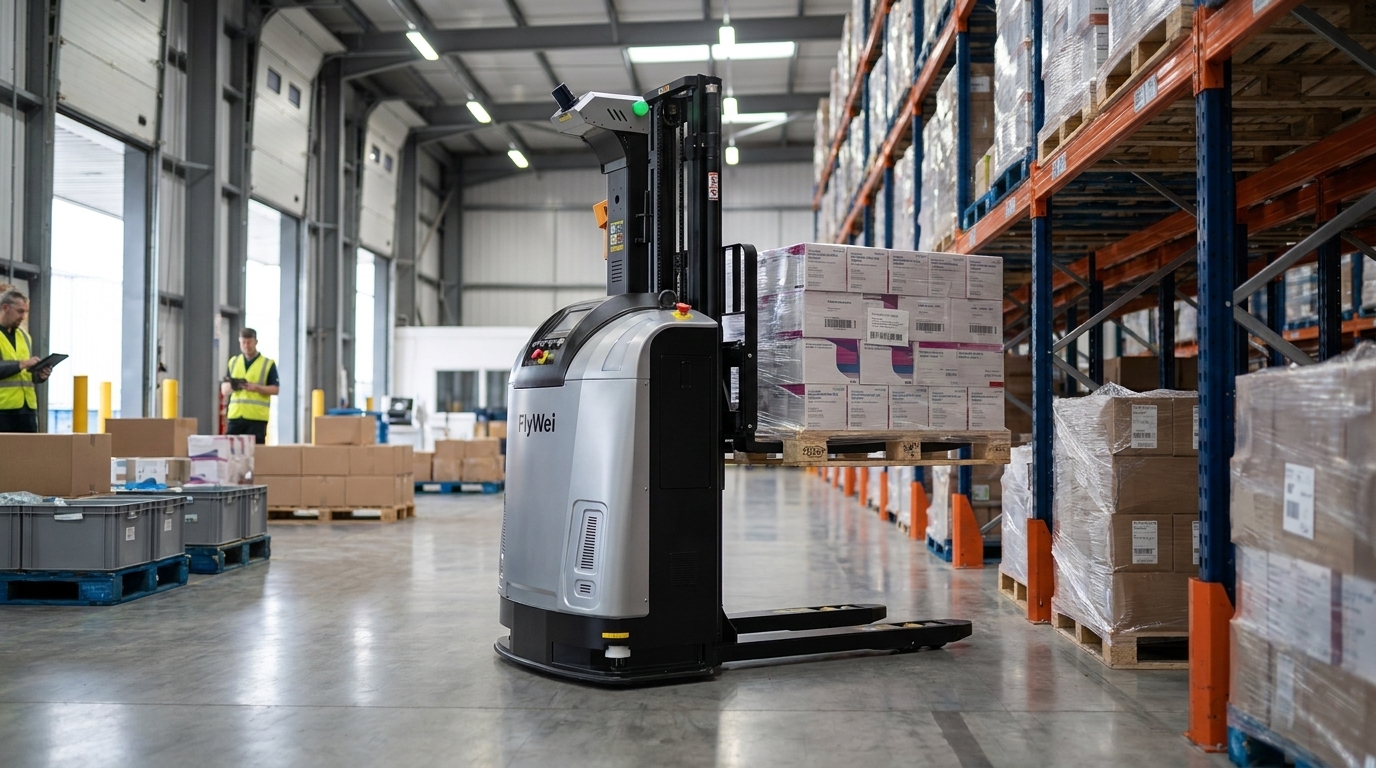
Industrial robot servicing is the planned maintenance, calibration, safety-system testing and spare-part provision that keeps an autonomous forklift or AMR fleet legally operable and productive across its working life. It is not optional: Regulation 5 of the Provision and Use of Work Equipment Regulations 1998 requires every employer to keep work equipment in efficient working order and in good repair, and to keep the maintenance log up to date where one exists — a duty the PUWER 1998 text applies to driverless trucks exactly as it does to manned ones. For a head of procurement building a Q3 capex case for a UK pharmaceutical distribution centre, that duty is the line item nobody costed. The quotation covers trucks, charging and commissioning. It rarely covers seven years of servicing, requalification after a safety-controller firmware change, or the cost of a validated site standing idle waiting for a part.
Why servicing falls out of the capex case
Three things go wrong, in the same order, at almost every UK pharmaceutical site.
First, the tender template asks the wrong question. Most capital request forms have a field for unit price and one for installation, and none for keeping a safety-rated mobile machine compliant for eight years. Procurement compares what the form asks it to compare. The lowest truck price wins the paper exercise and loses the operation three winters later, when scanner recalibration, drive-wheel replacement and firmware support arrive as unbudgeted variations.
Second, autonomous trucks sit across two maintenance disciplines. A manned reach truck is a mechanical asset with a thorough examination regime under the Lifting Operations and Lifting Equipment Regulations 1998. A driverless one is that plus a navigation stack, a safety controller, certified laser scanners and a fleet application. Engineering owns the first half; the automation team owns the second. Neither is asked to cost the other, so the combined scope never appears in full.
Third — and this is the one that hurts in pharma specifically — a maintenance intervention on a validated site is rarely just a maintenance intervention. Change a safety controller and you have changed a machine whose behaviour was qualified against a documented specification. Under Good Distribution Practice expectations administered by the MHRA, that change needs assessing, and depending on scope requalifying before the truck runs against live stock again. That work lands with quality assurance, which was not in the room when the trucks were priced. Guidance from Logistics UK and standards published through BSI is clear that documentation obligations follow equipment through its whole life, not to the end of the warranty.
Regulation 5 of PUWER 1998 requires every UK employer to keep work equipment in efficient working order and in good repair, which makes industrial robot servicing a legal duty for autonomous forklift fleets rather than a discretionary line in the operating budget.
Lever one: buy response time and spares cover, not visit counts
The operational lever is to stop procuring servicing by frequency and start procuring it by outcome. A contract promising four preventive visits a year tells you nothing useful. One committing to an on-site response window, a named spares kit held on site and a defined availability target tells you exactly what you are buying.
Build the scope from your own flow. Identify which movements have no manual fallback — typically moves into and out of a quarantine or cold area where manual handling would breach the storage regime. Those routes need the tightest response commitment and consumables held on site: drive wheels, load wheels, batteries and a spare safety scanner. Everything else sits on a slower tier. Ask for the model in writing, then ask what happens on the days it fails, because a credit note against a monthly charge is not a loan truck arriving next morning. FlyWei publishes its industrial robot servicing scope for that reason: a procurement team cannot compare what it cannot read.
Lever two: make the fleet manager your maintenance evidence engine
The technical lever is condition-based servicing, and it only works if the fleet software produces evidence rather than dashboards. Every autonomous truck already generates the raw material: motor current, brake application counts, battery cycles, scanner fault codes, distance travelled per axle, charge dwell time. The question is whether that data leaves the machine in a form an auditor accepts.
A fleet manager such as FlyWei M4 should hold a per-truck maintenance record that timestamps every intervention, records the engineer, and captures pre- and post-intervention safety-system test results. Dispatch logic in FlyWei RDS should then route work away from a truck approaching a service threshold instead of running it to failure mid-shift. Insist on open interfaces: a fleet operating to the VDA 5050 specification can be evidenced consistently even when it contains machines from more than one manufacturer — which matters on a brownfield site where trucks arrive across several budget years. Ask the direct question at evaluation: can the system export a complete, time-ordered maintenance history per asset without a support ticket? If the answer involves a spreadsheet, you have found a future audit finding.
Lever three: write PUWER, LOLER and ISO 3691-4 into the service scope
The regulatory lever converts a service contract from a commercial document into a compliance instrument. Three references belong in the scope of works by name.
PUWER covers maintenance, inspection and the requirement that equipment stays suitable for its use — the HSE guidance on PUWER sets out how those duties apply. LOLER covers the lifting function and its thorough examination regime, which does not disappear because the driver has. ISO 3691-4, the safety standard for driverless industrial trucks, governs the protective devices, the safety-related control system and the conditions under which the machine may operate around people.
Practically, the contract should state who performs periodic verification of the safety-related functions, at what interval, to what acceptance criteria, and who holds the records. It should also state what happens after a change: which modifications trigger re-verification, and who signs it off. On an MHRA-regulated site, attach the requalification trigger matrix as a schedule so quality assurance and engineering read the same document. Writing this down before signature costs a fortnight. Getting it wrong costs a validated line.
Lever four: fund servicing as operating cost, not a capex afterthought
The commercial lever is structural. A capex committee will scrutinise the asset price and wave through the service schedule, because that schedule looks small and annual. Reverse it: present one whole-life figure with servicing inside.
Full-service leasing does this cleanly. FlyWei offers autonomous forklift leasing over 3, 5 and 7-year terms with servicing, spares and software support inside the monthly charge. The advantages are procedural as much as financial: one predictable number, no annual argument about whether a failure is warranty or wear, and no incentive to defer maintenance to protect a quarterly budget. It also matches how pharmaceutical contracts behave — a 3PL holding a five-year customer contract can align the automation term to that contract rather than to an unrelated depreciation schedule.
| Servicing model | What the capex paper shows | What arrives later | Effect on validated uptime | Best fit |
|---|---|---|---|---|
| Reactive break-fix | Lowest truck price; servicing a small annual estimate | Call-out charges, list-price parts, unbudgeted requalification | Weakest — downtime is discovered, not scheduled | Non-critical, substitutable flows |
| Planned preventive contract | Truck price plus fixed annual service fee | Parts outside the inclusion list; software support often separate | Good, if visit intervals match duty cycle | Stable, predictable throughput |
| Full-service lease | One monthly figure: trucks, servicing, spares, software | Little — variation limited to agreed usage bands | Strongest — supplier carries availability risk | Regulated sites; contract-aligned 3PL |
What FlyWei does here
FlyWei is an independent, vendor-neutral UK systems integrator of autonomous forklifts and AMRs. That independence is the point when servicing is the question: FlyWei selects the right machine class for each flow across multiple manufacturers, then takes single-point responsibility for keeping the mixed fleet running, evidenced and compliant.
In a pharmaceutical distribution centre that usually means a narrow-aisle autonomous reach truck working high-bay pallet locations, an autonomous pallet stacker on goods-in replenishment, and lifting AMRs shuttling tote cages between pick faces and dispatch. FlyWei designs the duty cycle, sizes the fleet against your shift curve, and writes the maintenance and verification regime into the delivery documentation from day one rather than bolting it on at handover. Sites at Magna Park, DIRFT and SEGRO East Midlands Gateway show one pattern: the fleet that stays available is the one whose service regime was designed alongside it.
The software does the evidential work. FlyWei M4 holds the asset register, intervention history and safety-function test records for every truck. FlyWei RDS treats service thresholds as a routing input, so a truck due for attention leaves the critical quarantine flow before it fails in it. FlyWei engineers are UK-based, and the team that commissions the fleet maintains it — which is why the requalification matrix is agreed with your quality function before the first truck is energised. Sector configurations are set out across the FlyWei solutions pages.
Frequently asked questions
What does industrial robot servicing cover on an autonomous forklift?
Mechanical maintenance and the lifting function, wear items such as drive and load wheels, battery health, periodic verification of the safety-related control system and laser scanners, navigation calibration, software support, and the records evidencing it.
Do PUWER and LOLER apply to driverless forklifts?
Yes. Both apply to the work equipment, not to the presence of an operator. Removing the driver adds ISO 3691-4 obligations; it does not remove the existing ones.
How often should an autonomous forklift fleet be serviced?
By duty cycle rather than calendar. A truck running three shifts on chilled goods-in wears far faster than one on daytime dispatch. Use condition-based scheduling with a regulatory backstop interval for safety-function verification.
What triggers requalification on an MHRA-regulated site?
Any change that could affect qualified behaviour: safety-controller changes, navigation software upgrades, protective-field reconfiguration, or a route change through a temperature-controlled area. Agree the trigger matrix with quality assurance and attach it to the contract as a schedule.
Should servicing be capex or opex?
Operating cost, in almost every case. Bundling trucks, servicing, spares and software into a full-service lease over 3, 5 or 7 years gives the committee one predictable figure.
Can one provider service a fleet from several manufacturers?
Yes, and on brownfield sites it is usually the only workable answer. An independent integrator working to open interfaces such as VDA 5050 can evidence a mixed fleet under one maintenance regime.
What should a procurement team ask for before signing?
A written response-time commitment, the on-site spares list, the availability target and its remedy, the safety-verification schedule and acceptance criteria, the requalification trigger matrix, and proof that maintenance history exports without a ticket.
If seven-year servicing exposure on a validated pharmaceutical site is on your Q3 risk register, price the whole life rather than the truck.
Request a fleet-sizing and ROI estimate for your DC and we will model duty cycle, maintenance regime and monthly cost together — or review the term structures on FlyWei autonomous forklift leasing first.
UK-based engineers. No obligation. We reply within one business day.