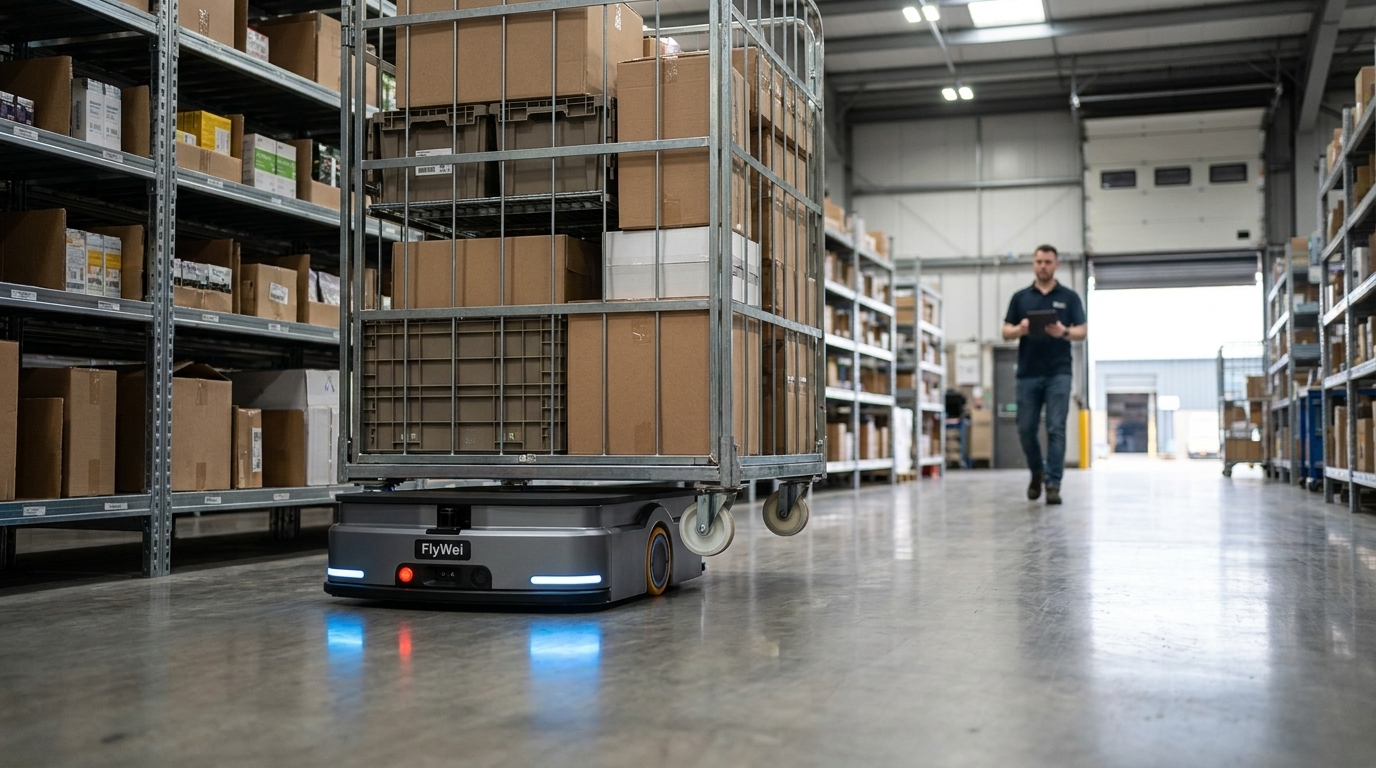
Lifting automated robots are self-driving mobile machines that raise, carry and set down heavy loads — pallets, stillages, engine sub-assemblies and wheeled kit trolleys — without a person taking the weight or steering the truck. Handling, lifting and carrying causes roughly 17% of all non-fatal workplace injuries reported to the Health and Safety Executive each year, and heavy-parts warehouses carry more of that exposure than most. If you run a large engineering or spares store, you already know the shape of it: castings and gearbox cases that are too heavy to pick cleanly, kit trolleys pushed by hand the length of the building, a counterbalance truck tied up for much of a shift on a job it was never sized for, and an agency headcount that turns over faster than you can induct it. The injuries are rarely dramatic. The cost is cumulative.
Why heavy-parts warehouses still move loads by hand
Engineering and heavy-industrial parts warehouses were never designed the way a grocery distribution centre was. A retail DC handles a narrow band of pallet weights and automates around that consistency. A parts store near Burton-on-Trent, or a spares operation off DIRFT, holds a bimodal profile instead: thousands of small, light, fast-moving consumables alongside a few hundred castings, housings, gearbox cases and part-built assemblies far heavier than any person should shift.
Three things follow. First, the heavy items rarely sit on a standard pallet. They sit in stillages, on wheeled kit trolleys or in bespoke cradles — the load type a counterbalance forklift handles worst and a person is most tempted to push by hand.
Second, the heavy moves are individually infrequent. No single flow looked big enough to justify a dedicated truck and driver, so the work was absorbed into everybody's day: a shove here, a two-person lift there, a trolley walked across a live aisle. The Health and Safety Executive's workplace transport guidance is unambiguous that mixing pedestrians, manual handling and moving vehicles in one aisle is where serious events happen — an exact description of a parts store at shift change.
Third, the labour that quietly absorbed all this has become unreliable. Agency turnover means the operative doing a two-person lift today may be on their second shift in the building, and Logistics UK has tracked persistent recruitment pressure across warehousing roles for years. Induction quality falls as churn rises, and manual handling technique degrades first.
None of this is a training failure. It is a design gap: the building was laid out for people and for pallets, and the heavy work fell between the two.
Lifting automated robots are self-driving machines that raise, carry and set down heavy loads without a person taking the weight — addressing the handling, lifting and carrying injuries that account for roughly 17% of non-fatal workplace injuries reported to the Health and Safety Executive.
Lever 1: map the heavy moves before you specify any robot
The operational lever comes first and costs nothing but a week of attention. Agree a weight threshold with your safety lead, then have supervisors log every load above it for five working days: what moved, from where, to where, how many people touched it, and how long the aisle was blocked. Most warehouse managers expect the answer spread thinly across dozens of flows. It almost never is. In a typical UK parts store a handful of routes — goods-in to heavy bulk, bulk to kitting, kitting to despatch marshalling — account for most of the heavy work and nearly all the two-person lifts.
That concentration is the whole business case: you are not automating a warehouse, you are automating three routes. It also tells you the load carrier, traffic pattern and cycle time to specify against — the difference between a machine that fits your building and one that fits a brochure. Do this before inviting anyone to quote.
Lever 2: put a lifting robot under the load, not a person beside it
Once the flows are known, the machine class follows from the load carrier rather than the other way round. Wheeled kit trolleys and mesh cages suit a latent-jacking robot that drives underneath, lifts a few centimetres and tows the whole carrier away — no re-handling, no cage tipping, no one walking backwards. Heavy sub-assemblies, motor blocks and transmission cases on skids suit a heavy-lift robot with a scissor deck. Palletised bulk stays with an autonomous forklift, and mid-height racking work suits a stacker variant.
This lever works because it changes what the person does rather than removing them. The operative stops being the power source and becomes whoever releases the move, checks the load and handles the exception — a different job to induct someone into, and one that holds up far better when agency headcount turns over. It also returns a counterbalance truck to productive work, no longer tied up shunting trolleys it was never sized for. FlyWei specifies lifting automated robots across several manufacturers, so the carrier dictates the machine.
Lever 3: orchestrate the fleet through one dispatch layer
This is the technical lever, and where most first deployments quietly fail. Two robots running standalone will shift loads and look impressive in a trial. Eight will deadlock in a narrow aisle on a Friday afternoon. What prevents that is a fleet manager above the machines, holding traffic rules, charging strategy and the task queue in one place.
FlyWei's M4 fleet manager performs that role and speaks VDA 5050, the open standard for communication between mobile robot fleets and a central controller. That matters twice over. One controller can command machines from different manufacturers, which is what makes vendor-neutral specification possible at all. And the interface to your enterprise WMS, or the operator's existing ERP, is built once against the fleet layer rather than once per robot type. RDS robot dispatch then decides which machine takes which task, so your warehouse system keeps holding stock truth and never has to learn about batteries, routes or traffic.
Lever 4: document the lifting regime under PUWER and LOLER
The regulatory lever decides whether the deployment survives its first audit. An autonomous machine that lifts a load is still work equipment and still lifting equipment. PUWER 1998 requires it to be suitable, maintained and operated by trained people; LOLER 1998 brings thorough examination and records into scope for the lifting function. Autonomy changes neither duty.
Alongside those, ISO 3691-4 sets the safety requirements for driverless industrial trucks — detection fields, speed zones, and what the machine does when a pedestrian steps into its path. It is the standard your integrator should design the safety case against. Settle two practical points early. Concrete flatness and joint condition, assessed against the relevant TR34 guidance, drive navigation reliability more than any sensor specification. And risk assessments need rewriting rather than annotating, because the hazard has moved from the person's back to the interface between people and machines.
| Lever | Typical elapsed time | Capital required | Where it shows on the KPI sheet |
|---|---|---|---|
| Map the heavy moves | One week | None | Nothing yet — but it sizes everything below |
| Lifting robots on one flow | Six to ten weeks to live running | Lease or capital, one flow | Two-person lifts, absence days, truck availability |
| Fleet orchestration layer | Runs in parallel | Software and integration, priced separately | Aisle congestion, task completion, charging downtime |
| PUWER and LOLER regime | Starts at design, never finishes | Engineering time | Audit findings, insurer questions, incident rate |
What FlyWei does here
FlyWei is an independent UK systems integrator of autonomous forklifts and mobile robots. That independence is the point in a heavy-parts environment, because a site like yours rarely needs one machine class. It needs latent-jacking robots under the kit trolleys, a heavy-lift unit for skidded sub-assemblies and an autonomous counterbalance truck on palletised bulk — rarely best served by a single manufacturer. FlyWei specifies across several, so the load carrier decides the machine rather than a catalogue deciding for you.
The engagement starts with the survey rather than the robot. FlyWei engineers walk the heavy routes with your supervisors, check floor condition and aisle geometry, and return a flow-by-flow view of what is automatable now, what needs a layout change first, and what should stay manual. Where the numbers work, FlyWei designs and delivers the installation: machines, charging positions, safety case, M4 holding traffic and tasking, and RDS dispatch taking work from your existing warehouse system so stock truth stays put.
Support afterwards is UK-based, which matters more in engineering than most sectors: a stalled robot in a kitting cell stops a line, not just a pick face. The same fleets are available through leasing over three, five and seven-year terms where capex is closed, and FlyWei works across UK industrial sectors on the same vendor-neutral basis.
Frequently asked questions
What is a lifting automated robot?
A self-navigating mobile machine that raises, transports and lowers a load without a driver. Variants include latent-jacking robots that drive under a wheeled carrier and lift it clear of the floor, scissor-deck robots for heavy sub-assemblies, and autonomous stackers for palletised loads.
How much can a lifting automated robot carry?
Capacity depends on the class: latent-jacking robots handle trolleys and cages, heavy-lift variants tonne-scale sub-assemblies, and autonomous trucks palletised bulk into racking. The useful question is not maximum capacity but your heaviest routine load, which the survey establishes.
Do lifting automated robots need LOLER thorough examination?
Where the machine lifts a load, LOLER 1998 duties on thorough examination and records apply as to any lifting equipment, and PUWER 1998 duties on suitability, maintenance and training apply in parallel. Autonomy removes neither, and the inspection regime belongs in the handover pack.
Can lifting automated robots work alongside manual forklifts and people?
Yes, and in a working parts store they have to. Mixed operation is governed by ISO 3691-4: detection fields, reduced-speed zones and defined behaviour when a pedestrian enters the path. Shared aisles need traffic rules set centrally in the fleet manager, not machine by machine.
Do we need to replace our WMS to run lifting automated robots?
Usually not. An orchestration layer sits above your existing warehouse system and takes work from it, so that system stays the source of truth for stock and orders. Replacement is only worth considering where it cannot expose work at all.
How long does a first deployment take in a UK engineering warehouse?
For one well-chosen flow, weeks rather than quarters is a realistic planning assumption. The long pole is rarely the machines; it is agreeing how work reaches the fleet, how exceptions are handled, and signing off the safety case.
Is our floor good enough for autonomous lifting robots?
It usually is, but check rather than assume. Concrete flatness and joint condition affect navigation repeatability and load stability at height far more than sensor choice does. A survey assesses the running surface against the relevant TR34 guidance and flags remedial joints before specification.
If manual handling of heavy parts is sitting on your Q3 risk register, the fastest way to size the opportunity is to look at one flow rather than the whole building.
Book a free 30-minute site survey and a FlyWei engineer will walk your heavy routes with you. To start with the machine classes instead, the lifting automated robots range covers latent-jacking, heavy-lift and rotary-lift variants for UK engineering operations.
UK-based engineers. No obligation. We reply within one business day.