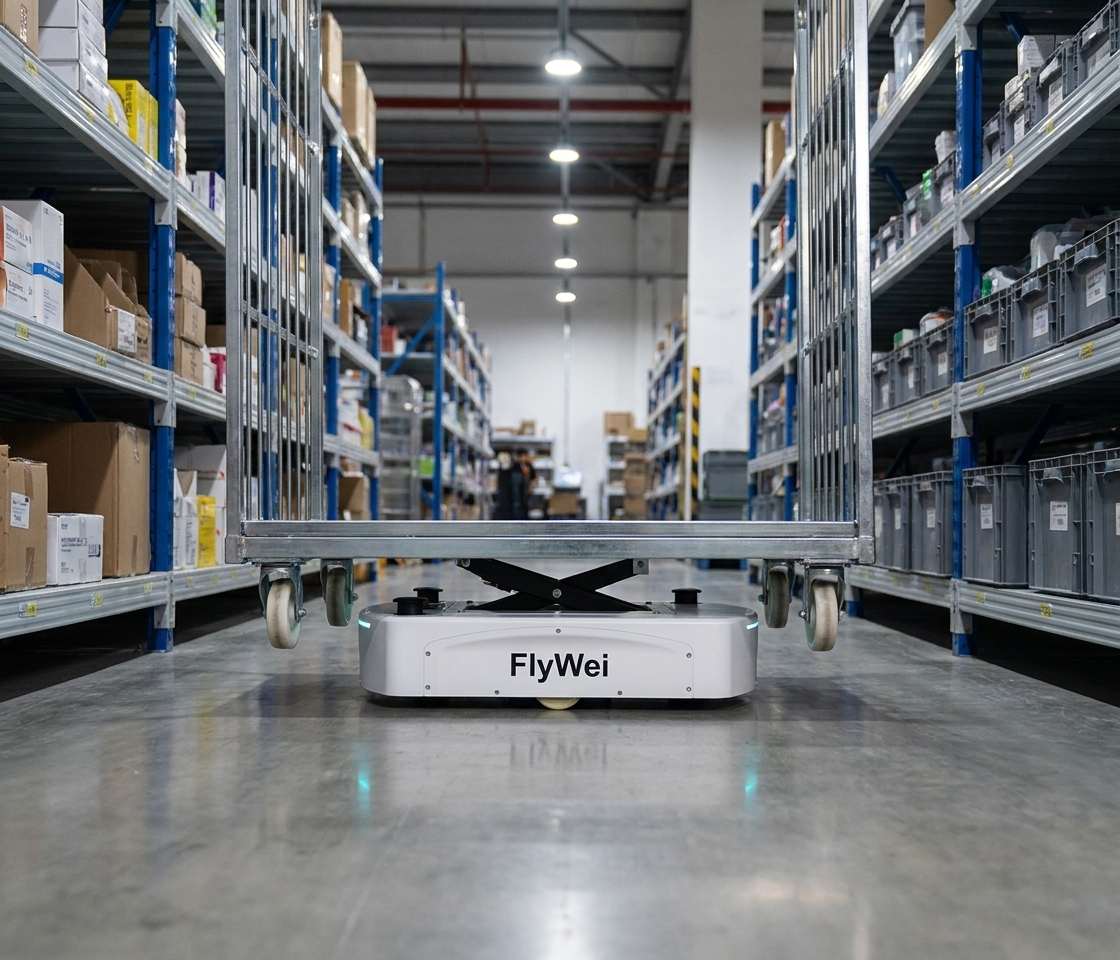
Lifting automated robots are autonomous mobile robots that jack, carry and set down palletised or cart-based pharmaceutical loads while writing a tamper-evident, timestamped chain-of-custody event for every move inside GDP-regulated fulfilment centres. The scale of the problem is now regulatory as well as operational: the UK Health and Safety Executive records around 5,000 workplace transport incidents in Great Britain each year, and pharmaceutical distribution centres sit at the sharp end because every cart or pallet also carries GDP lot integrity. Wave-pick volumes at UK MHRA-regulated fulfilment centres continue to climb as clinical trials, home-delivery and hospital-direct channels stack on top of retail replenishment. Supply Chain Directors now have to close two gaps at once: the safety gap that widens with every extra manual pallet-truck move per shift, and the audit gap that opens the moment a lot slips off a scanner's line of sight and is later reassembled by hand from paper timestamps to satisfy an MHRA inspector's spot check.
Lifting automated robots are autonomous mobile robots that jack, carry and set down palletised or cart-based pharmaceutical loads while writing a tamper-evident, timestamped chain-of-custody event for every move inside GDP-regulated fulfilment centres.
Why chain-of-custody gaps open in UK pharma fulfilment
UK pharma fulfilment inherited its material-handling toolkit from grocery and general 3PL, with a much sharper audit requirement bolted on top. Every manual pallet-truck movement between goods-in, quarantine, staging, wave pick and dispatch is a hand-off that either creates a WMS event, if a scanner is used at the right moment, or produces nothing at all when the operator is under time pressure and defers the scan to end-of-shift. The delta between the physical move and the scanner event is exactly where MHRA GDP inspectors find their exceptions.
Labour is the second driver. UK pharma DCs at Magna Park, DIRFT and Burton-on-Trent compete with e-commerce and 3PL for the same forklift-licensed operators, and turnover has forced heavier reliance on agency labour that does not know the site-specific FEFO discipline or the controlled-drug SOPs. A paper log becomes fiction long before an inspector sees it.
SKU proliferation is the third. A modern MHRA-regulated site handles ambient, 2 to 8 °C refrigerated, controlled drugs (Schedule 2 to 5) and clinical-trial kits: each with its own chain-of-custody rule. A manual pallet-truck can move any of them; the audit trail that proves the correct one moved to the right zone at the right time cannot be produced without a data spine underneath.
Fourth, the standards themselves have moved on. ISO 3691-4 now specifies safety for driverless industrial trucks and their systems, and PUWER 1998 makes it plain that provided equipment must be suitable, maintained and used only by trained people. When an inspector asks who moved a pallet at 02:14, a manual log cannot answer; a properly configured lifting-AMR audit trail can.
The four levers that close the gap
Lever 1: Redesign the wave-pick loop around a lifting-AMR shuttle (operational)
The biggest operational lever is to stop moving cages and pallets manually between the pick face and the dispatch dock. A latent-jacking lifting automated robot slides under a mesh cart or euro-pallet, jacks 12 to 20 cm, and shuttles it to the next zone under continuous scanner and LiDAR coverage. Every arrival and departure event is written to the fleet-management database and streamed into the WMS. Where a manual operator might batch three pallets, park them at the door and forget which arrived first, the AMR shuttle enforces one-load-per-move with a hard timestamp. The wave-pick loop shortens because pickers stop moving totes themselves and stay at the pick face while the robots do the metres. Peak throughput lifts because the AMR fleet runs the same cycle across eight, sixteen or twenty-four hours without breaks or fatigue-driven scan omissions.
Lever 2: Wire the fleet into M4 with VDA 5050 into your existing WMS (technical)
The technical lever is orchestration. A single AMR is a novelty; a fleet of fifteen without a coherent controller is chaos. FlyWei's M4 fleet manager speaks VDA 5050 to the AMRs and standard REST or message-queue interfaces to the operator's existing enterprise WMS. That means the WMS still owns the task master (order release, wave planning, FEFO logic) and M4 owns the execution layer: which robot picks up which cart, on which path, at what time, and what event is written when it arrives. Because the interface is VDA 5050 rather than a proprietary bus, the operator can add a second AMR fleet later, or blend a floor-based lifting-AMR fleet with a narrow-aisle reach-truck fleet, without ripping out the WMS. FlyWei's fleet dispatch software then routes each task against real-time floor state (traffic, blocked lanes, battery windows) so the WMS never has to deal with the physics of the floor. The audit trail is complete because M4 becomes the single source of movement truth and the WMS remains the single source of order truth.
Lever 3: Map every AMR journey onto PUWER and ISO 3691-4 conformance (regulatory)
The regulatory lever turns the AMR fleet's own logs into ready-made compliance evidence. PUWER requires that work equipment be suitable, maintained, inspected, and used only by trained people; ISO 3691-4 lays out the safety expectations for driverless industrial trucks and their systems. A lifting-AMR fleet running under M4 already produces the exact evidence set an HSE inspector or an MHRA GDP auditor asks for: safety-scanner conformance status, laser-scanner firmware versions, per-shift usage log, per-operator authentication events, PPM completion dates, and a full incident log of any protective stop, whether triggered by a pedestrian, a pallet overhang or a floor-marking scuff. Inspection preparation becomes an export from M4, not a two-week paper-chase.
Lever 4: Segregate cold-chain, controlled-drug and clinical-trial flows into robot-scheduled zones (operational)
Once the audit backbone is in place, workflow segregation locks the gains. A schedule inside M4 gates each AMR to the zones its cargo class permits: 2 to 8 °C moves stay inside the temperature-mapped route, Schedule 2 to 5 controlled drugs move only between authorised locations, and clinical-trial kits keep their own witness step. Because the fleet enforces the route at the robot level, an operator cannot short-cut through a non-conforming zone under end-of-shift pressure. For a Supply Chain Director this converts a policy question into a physical control: the strongest form of GDP evidence.
| Flow model | Audit event completeness | Safety conformance path | Cost per pallet-move (indicative) | Typical payback |
|---|---|---|---|---|
| All-manual pallet trucks | Partial: scanner events rely on operator discipline; gaps common at shift-end | PUWER via operator training only | Baseline | n/a |
| Mixed manual and supervised lifting-AMR pilot | Improved on the AMR routes only | PUWER plus partial ISO 3691-4 on the pilot cell | Slightly above baseline in year one | 18 to 30 months on the pilot cell |
| Full lifting-AMR shuttle backbone orchestrated by M4 | Complete: every move writes a WMS-linked event with load ID, zones and signature | PUWER plus full ISO 3691-4 evidence set from M4 logs | Lower than baseline past 60 percent fleet utilisation | Two to four years depending on shift pattern |
What FlyWei does here
FlyWei integrates and supports lifting-AMR fleets purpose-built for UK MHRA-regulated fulfilment. The FlyWei lifting robot range covers the three load classes most pharma sites need: the AMB-300 base AMR for lighter cart-based tote moves, the AMB-300JZ latent-jacking variant for wheeled cages and euro pallets, and the AMB-JS heavy-lift AMR for one-tonne pallet moves between goods-in and staging. All are orchestrated by M4 and dispatched by fleet dispatch software, with the same VDA 5050 interface into the operator's existing enterprise WMS. FlyWei's UK engineers deploy each fleet with an MHRA-familiar validation pack: IQ, OQ, PQ, PUWER conformance evidence, and a mapped PPM schedule that becomes part of the site's quality management system on day one. For Supply Chain Directors evaluating capex against a leased alternative, the FlyWei 3, 5 and 7-year lease converts the upfront ticket into a per-move operating cost against the throughput the fleet is contracted to deliver: the argument stops being about robots and becomes about pallet-moves per pound per audit-clean shift.
Frequently asked questions
What exactly is a lifting automated robot in a UK pharma DC?
A lifting automated robot is an autonomous mobile robot fitted with a lifting mechanism (latent jack, scissor lift or rotary jack) that slides under a cart, cage or pallet, raises it 12 to 200 mm and shuttles it to the next zone under continuous LiDAR and safety-scanner coverage. Every move is logged to the fleet-management database and streamed to the WMS.
Does an AMR fleet satisfy PUWER on its own?
The equipment itself is PUWER-suitable when it is CE- or UKCA-marked, deployed and maintained to the manufacturer's plan, and used by trained supervisors. The compliance case is completed by the site's PPM schedule, training records for the humans who share the floor, and the M4 log of every protective stop and manual override.
How does ISO 3691-4 differ from ISO 3691-1?
ISO 3691-1 covers manned industrial trucks. ISO 3691-4 sets the safety requirements for driverless industrial trucks and their systems including path safety, hazard detection, obstacle detection, and the safety of the fleet-manager interface.
Can lifting AMRs work alongside our existing manual pallet trucks during the transition?
Yes. The most common UK pharma deployment starts with the lifting AMRs on the highest-volume repeatable loop while manual pallet trucks handle exceptions and low-frequency zones. M4 segregates AMR corridors from mixed-traffic aisles so both operate safely.
What audit evidence will an MHRA GDP inspector ask for?
Chain-of-custody records for lot movements, temperature integrity records for cold-chain SKUs, training records, PPM records for handling equipment, and CCTV or scanner corroboration for controlled drugs. A lifting-AMR fleet under M4 produces the movement and equipment records natively.
How long does a lifting-AMR deployment take in a live UK pharma DC?
A pilot cell (one loop, three to five robots, M4 configured for the site) is typically live within 8 to 12 weeks, including site survey, floor marking, WMS interfacing and operator training. A full site backbone rolls out in three to four cells across six to twelve months without interrupting live operations.
Do we still need our existing WMS?
Yes. M4 orchestrates the physical fleet; the WMS remains the master for order release, FEFO logic and inventory truth. VDA 5050 is the bridge, so both sides keep their strengths and the audit trail is a single reconciled record.
If GDP chain-of-custody audit gaps and wave-pick growth are both on your Q3 pharmaceutical risk register, the shortest path to closing them is a single evidence-grade lifting-AMR loop that you can extend across the site once it proves out.
Get a 48-hour feasibility read on your highest-volume flow from FlyWei's UK pharma engineering team, or explore the FlyWei lifting robot range to see which base, latent-jack or heavy-lift variant fits your load profile.
UK-based engineers · no obligation · reply within one business day.