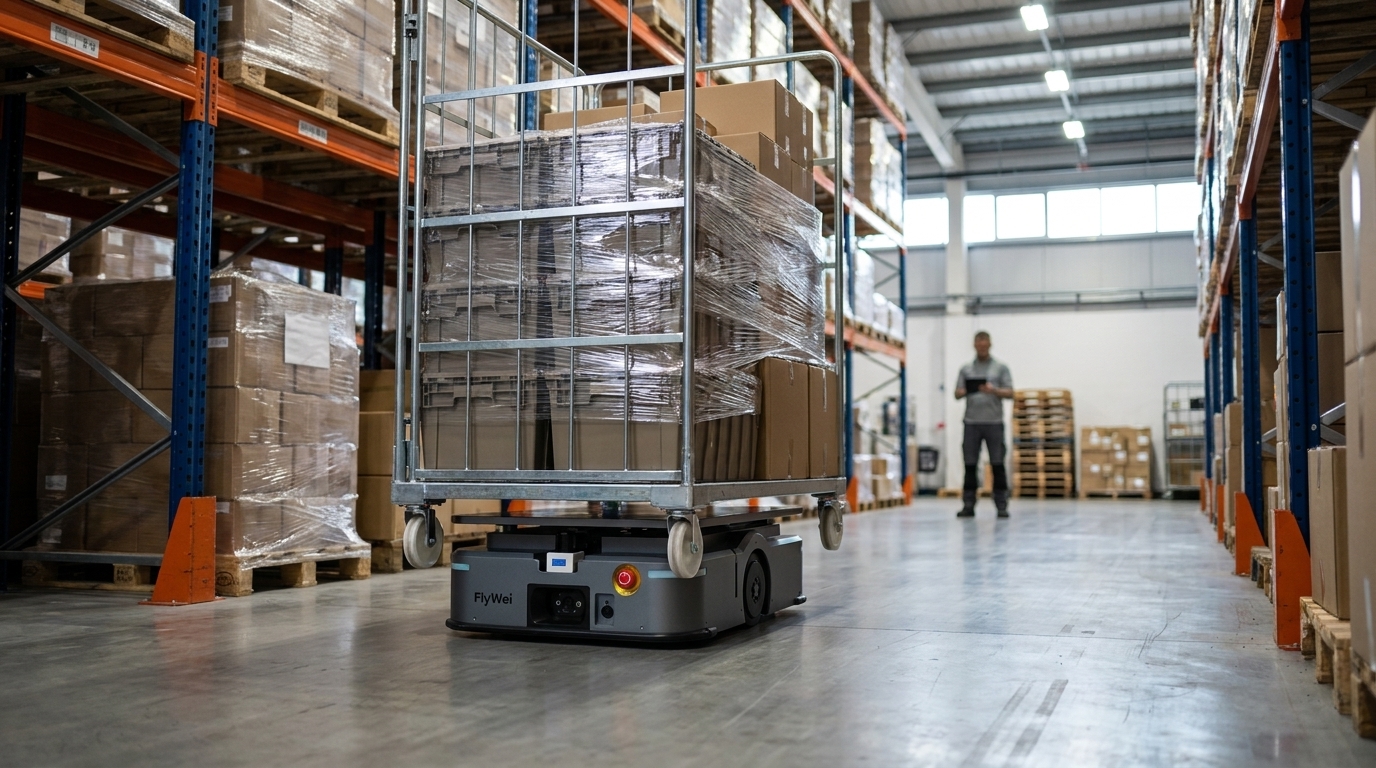
A lifting robot is a driverless warehouse vehicle that raises, carries and sets down a palletised load without an onboard operator. In Great Britain, 511,000 workers reported a work-related musculoskeletal disorder in 2024/25, and 40.1 million working days were lost to work-related ill health and injury across the same period, according to HSE's headline statistics. If you run a chilled or frozen site, those two numbers describe your leaving interviews. Freezer-rated labour is the hardest cover on the rota: a −22°C chamber limits exposure time, forces rotation breaks and turns every absence into agency spend. Through Q4 the problem compounds, because seasonal volume lands on the pallet moves that are heaviest, lowest and most repetitive: depalletising at the blast-freezer door, feeding the pick face and clearing the dock before the next trailer backs on. A lifting robot removes the operator from under the load, which is why UK cold-store automation cases are now argued on injury and retention records rather than on pallet throughput alone.
Why cold-store handling injuries happen, and why they persist
Cold stores concentrate every manual-handling risk factor that the Manual Handling Operations Regulations 1992 ask employers to assess, then add two more. The load factors are unforgiving: cases of frozen product are dense, pallets are built to the full height the chamber allows, and the lowest tier of a chilled pick face sits at ankle height. The task is repetitive by design, because replenishment is paced by the pick wave rather than by the person.
The two additions are temperature and clothing. Cold reduces grip strength and dexterity, so loads are held closer and recovered later. Insulated freezer suits and gauntlets restrict movement and make a controlled lift harder than the same lift in ambient conditions. A task assessed as acceptable on the ambient dock becomes marginal inside the chamber, and the assessment is rarely repeated there.
Persistence is operational rather than cultural. Exposure limits mean freezer work is shared across more people than an ambient equivalent, which spreads the risk rather than removing it and makes the injury data look diffuse. Cover is thin: Logistics UK has tracked recruitment difficulty across warehousing for years, and freezer-rated roles sit at the hard end of it. The chamber is also the one place you cannot simply add light, space or a longer run-up, because every cubic metre is refrigerated capital. When someone is off, the shift still has to clear the dock, so the remaining team absorbs the same moves in fewer hours.
Lever one: take the operator out of the chamber, not out of the job
The operational lever is to redraw the flow so the human half of the task happens in ambient conditions and the cold half happens unattended. In practice that means staging: a lifting robot collects a built load from an ambient marshalling bay, enters through the airlock, delivers to a defined drop at the pick face or the blast-freezer door, and returns with the empty. Operators build, check and label in ambient conditions, and supervise the chamber from a screen.
Design the airlock cycle first, because that is where these projects stall. A robot waiting for a door opened by someone else has not removed the person. Door interlocks, call-off sensors and a traffic rule preventing a robot and a manual truck meeting in the doorway belong in the layout drawing, not the snag list. Then set drop points so no one reaches into a loaded carrier: a robot presenting its load at a fixed height to a gravity lane beats one that parks a cage for a person to unpack kneeling on a frozen floor.
Lever two: one orchestration layer for a mixed fleet
The technical lever is orchestration. A cold-chain site rarely needs one robot type. Jacking-style lifting automated robots suit cages, trolleys and mobile racking; a counterbalanced or reach-type autonomous forklift suits full pallets and high-bay locations. If each speaks only to its own controller, you have parallel systems that cannot arbitrate a doorway.
The fix is a fleet manager that takes work from the system you already run and issues it to every vehicle over a documented interface. FlyWei's M4 fleet manager orchestrates mixed-manufacturer fleets using the open VDA 5050 standard, so a lifting robot and an autonomous forklift draw from the same queue under central traffic rules; FlyWei RDS robot dispatch handles the exception paths cold stores generate constantly — a frosted reflector, a blocked drop, a cage that failed to seat. Two details matter more than headline speed: how the fleet behaves when the link to your warehouse system drops, and how it schedules charging, since duty cycle changes below freezing.
Lever three: write the regulatory evidence into the acceptance test
The regulatory lever is to treat compliance as a deliverable with a date on it. Under the Provision and Use of Work Equipment Regulations 1998, mobile work equipment must be suitable for its conditions of use, and in a cold store those conditions include ice, condensation on sensor housings and poor floor friction near the airlock. HSE's PUWER guidance and its workplace transport material are what your auditor will use, so use them first.
Ask for four documents before handover and make payment depend on them. A safety validation covering the protective stop performance actually achieved on your floor finish at your temperature, referenced to ISO 3691-4 for driverless industrial trucks. A thorough-examination schedule for the lifting function, to the discipline BSI-aligned practice applies to lifting equipment. A revised manual-handling assessment showing which operations the robot removed, which it changed and which a person still performs. And a traffic-management drawing covering mixed robot and pedestrian movement at the doorway, signed by your own safety lead.
Lever four: instrument the flow before you buy anything
The commercial lever is measurement. Cold-store automation cases fail on arithmetic far more often than on technology, because the saving sits in three places that are not on the capital request: agency cover, injury cost and refrigeration energy wasted on doors held open for manual traffic. Spend four weeks logging the dock-to-chamber flow before specifying a fleet: moves per hour, dwell at the airlock, replenishment lateness, and how many moves sit at or below knee height.
That log does two things. It sizes the fleet honestly, which stops the familiar outcome of buying for peak and idling for ten months. And it gives the board a baseline in your own numbers rather than a vendor's reference site. If the capital route is the obstacle rather than the case, structure matters: FlyWei robot leasing over 3, 5 and 7-year terms moves the fleet, software licence, maintenance and support into one monthly operating cost, which is usually the version a cold-chain capex committee can approve inside one quarter.
| Decision area | Manual freezer handling | Lifting-robot flow | Evidence for the board pack |
|---|---|---|---|
| Human exposure | Chamber time capped per person | Ambient build; chamber runs unattended | Chamber hours per head per week, before and after |
| Handling risk | Knee-height lifts in restrictive clothing | Lift performed by the robot at a fixed height | Reportable handling incidents and your assessment |
| Shift resilience | Absence absorbed by the remaining freezer-rated team | Cold moves continue; cover for ambient roles only | Agency hours and freezer-shift absence from HR records |
| Throughput | Paced by available people | Paced by the task queue, continuous | Replenishment lateness, logged for four weeks |
| Doors and energy | Doors held open during manual moves | Interlocked call-off; minimum door-open time | Door-open duration per move |
| Compliance | Assessment written for the dock, not the chamber | Validation, examination schedule and traffic plan | Four named documents as acceptance conditions |
A lifting robot removes the operator from under the load, which is why UK cold-store automation cases are now argued on injury and retention records rather than on pallet throughput alone.
What FlyWei does here
FlyWei is an independent, vendor-neutral UK systems integrator of autonomous forklifts and AMRs. In a chilled or frozen operation that independence is the practical point: no single manufacturer builds the best machine for every move in a cold store, so FlyWei designs the flow first, then selects across manufacturers. A jacking-type lifting robot from the FlyWei lifting robots range may handle cages and mobile racking at the pick face, while a FlyWei autonomous forklift takes full pallets between the airlock and high-bay locations.
FlyWei engineers survey the site cold, because a layout that works in an ambient aisle behaves differently once floor friction and door cycles are real. The deliverable is a flow design with airlock sequencing and traffic rules, a fleet sized from your measured move profile rather than a brochure, integration so the fleet takes work from your existing warehouse system, and the four acceptance documents. M4 orchestrates the mixed fleet; RDS carries the exception handling. Support comes from UK-based engineers, and the sector work is set out under FlyWei industry solutions. For an Operations Director the measure that matters is simple: how many knee-height lifts in the chamber still need a person at the end of it.
Frequently asked questions
What is a lifting robot?
A lifting robot is a driverless mobile robot that raises a load clear of the floor, transports it and sets it down with no operator on board. Jacking types slide under a cage, trolley or mobile rack and lift it a short distance. Navigation is typically laser SLAM, so no magnets or rails are required.
Can a lifting robot work in a freezer at −22°C?
Freezer-rated operation is a specification, not an assumption. The variables are battery duty cycle at temperature, sealing and heating of sensor housings against frost, lubricant selection, and wheel compound for grip. Ask for figures measured at your chamber temperature.
How is a lifting robot different from an autonomous forklift?
A lifting robot raises a load a short distance to move a cage, trolley or shelf, and suits goods-to-person and replenishment work near floor level. An autonomous forklift uses forks and a mast to stack pallets into racking at height. Most cold stores need both.
Do we have to replace our warehouse system to use lifting robots?
Usually not. An orchestration layer sits above your existing system and takes work from it, so that system stays the record of stock and orders, with completions written back. Without a live interface, a scheduled export of open work and an import of confirmations is enough to begin.
What regulations apply to lifting robots in a UK warehouse?
PUWER 1998 governs suitability, inspection and maintenance, and applies specifically to mobile work equipment. The Manual Handling Operations Regulations 1992 still require assessment of the operations that remain. ISO 3691-4 is the reference standard for driverless industrial trucks, and traffic management follows HSE guidance.
How do we build the business case for cold-chain automation?
Use three of your own datasets rather than a vendor model: reportable handling incidents and their cost, freezer-shift absence and agency cover, and replenishment lateness. Four weeks of measurement sizes the fleet and gives the board its own baseline.
If freezer-shift cover and manual-handling exposure sit on your Q4 risk register, the next step is measurement, not procurement.
Book a free 30-minute site survey and a FlyWei engineer will walk your dock-to-chamber flow cold, log the moves that still need a person at knee height, and say which a lifting robot should take first. Review the machine classes first on the FlyWei lifting robots page.
UK-based engineers, no obligation, and a reply within one business day.