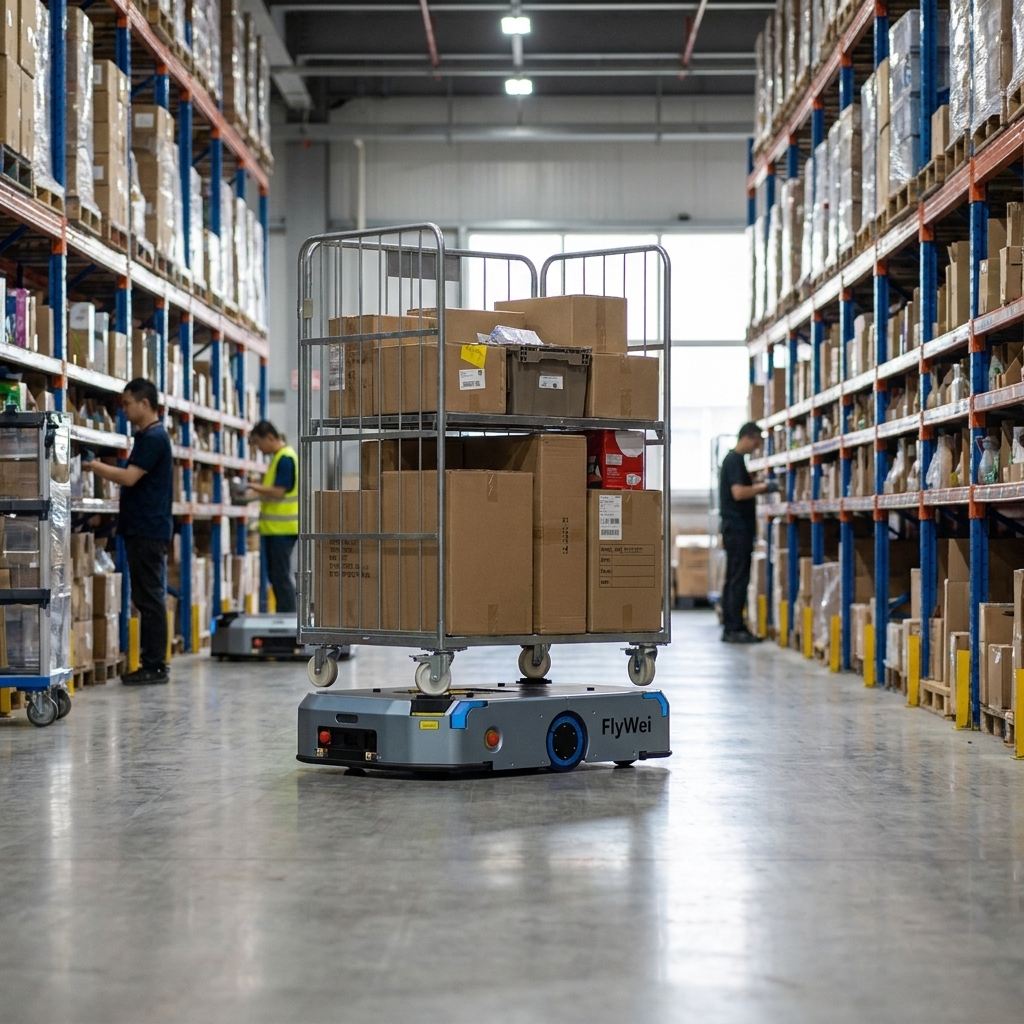
A lifting robot is an autonomous mobile robot that raises a load and carries it between fixed points with no driver on board. Under the Lifting Operations and Lifting Equipment Regulations 1998, lifting equipment that carries goods must have a thorough examination at least every 12 months, and every 6 months where it lifts people. For a Logistics Director in engineering and heavy industrial parts, that duty multiplies quietly. Castings, gearbox housings and machined sub-assemblies move between machining cells, the paint line and the parts warehouse on a mixed estate of counterbalance trucks, overhead hoists, pallet trucks and hand-pushed stillage trolleys. Every one of those assets carries an inspection record, an operator competence file and a damage history. Meanwhile the flow itself is unbalanced: goods-in queues behind a single truck at 07:00, machining cells idle waiting on a feed nobody scheduled, and the same short, heavy moves absorb hours that your planners never see in a KPI pack.
Why heavy-parts plants lose hours on short moves
Engineering and heavy industrial sites have a handling profile that behaves nothing like palletised consumer goods. A machined casting is dense, awkwardly balanced and often part-finished, which means it cannot simply be dropped, restacked or shrink-wrapped out of trouble. It usually travels in a steel stillage or on a bespoke fixture, and each one of those carriers has its own lifting points, its own tolerances and its own way of failing. That combination pushes plants towards the most flexible asset on site — a counterbalance truck with a skilled operator — for moves that do not actually need either flexibility or skill.
The second factor is structural and specific to the UK. Much of Britain’s heavy engineering capacity sits in brownfield buildings extended in stages, so aisles narrow without warning, floor slabs change level at every expansion joint, and goods-in was designed for a lower throughput than the plant now runs. Skilled operators are also a scarce and mobile pool, concentrated around the Midlands corridors — Burton-on-Trent, Daventry, Magna Park, DIRFT and SEGRO East Midlands Gateway — where distribution employers compete for the same people. When a machining cell waits on a feed because the one qualified driver is at goods-in, the cost lands on machine utilisation.
The third factor is regulatory exposure that grows with congestion. Health and Safety Executive guidance on workplace transport is unambiguous that mixing vehicles and pedestrians in shared space is a principal source of serious injury, and heavy-parts sites mix them constantly: fitters crossing traffic routes, deliveries reversing onto a live aisle, agency staff walking desire lines nobody drew. Every additional truck movement is another interaction to control and another item on the inspection register.
Under LOLER 1998, lifting equipment used to carry goods must undergo a thorough examination at least every 12 months, and at least every 6 months where it lifts people.
Lever one: map the flow before you choose the machine
The operational lever comes first because it decides everything downstream. Spend a fortnight recording actual movements rather than intended ones: origin, destination, load type, carrier type, time of day and who performed the move. Most heavy-parts plants find that a small number of origin-destination pairs — typically the machining cell to the wash or deburr bay, and the finished-parts bench to the parts warehouse — absorb a disproportionate share of truck hours at a fairly steady rate across all shifts. That profile is exactly what a lifting robot is designed for: fixed points, known load, no judgement required. Exception work and anything needing a slinger stays with people. Choosing the machine before you have this map is how sites end up with a robot too large for the aisle and too small for the load.
Lever two: orchestrate the fleet rather than scheduling it by hand
The technical lever is the layer above the vehicles. A single robot running a fixed route can be commissioned in days; the difficulty arrives with the fourth machine, when traffic conflicts, charging windows and task priority all start competing. That work belongs in a fleet manager, not a spreadsheet or a supervisor’s radio. FlyWei’s M4 fleet manager holds the map, the traffic rules and the charging strategy centrally, while RDS robot dispatch takes work from the systems you already run and translates it into missions, writing completions and load confirmations back so your existing enterprise WMS or ERP stays the record of stock. Where vehicles support the VDA 5050 open standard, one fleet manager can command machines from different manufacturers using the same message format — the practical reason a vendor-neutral estate is now realistic. Ask any supplier how long that layer keeps running if the link to your business system drops.
Lever three: treat the robot as work equipment from day one
The regulatory lever is the one most often deferred, and the most expensive to retrofit. A lifting robot is work equipment under the Provision and Use of Work Equipment Regulations 1998: it must be suitable, maintained, inspected, and used only by instructed people — including the supervisors and fitters who share the aisle with it, not only whoever launches a mission. Because it raises and carries a load, LOLER duties apply to the lifting function and to any fixture or stillage used as a lifting accessory, at the examination intervals set out above. Autonomous behaviour itself sits under BS EN ISO 3691-4, the standard for driverless industrial trucks, which governs protective devices, speed and stopping in shared space. Build the inspection regime, the competence records and the traffic-management drawing into the project plan, not into the handover pack.
Lever four: fix load presentation and the floor before you scale
The fourth lever is the one that quietly decides whether the pilot generalises. Autonomous machines are less tolerant than people of the things a plant stops noticing: a stillage that sits two centimetres proud because its foot is bent, a pick-up point marked in tape that has been re-laid twice, a slab joint that a driver instinctively slows for. Standardise the carriers first — a small number of stillage types, consistent lifting points, consistent presentation height — because every exception you keep becomes a permanent cost in cycle time. Then survey the floor to TR34 flatness along the routes you intend to automate, before you commit to a vehicle class, since tolerance tightens as lift height increases. Remediating a few dozen metres of joint is a bounded job when scoped early; discovered late, it stalls a deployment already announced to the board.
| Lever | What changes on the floor | Effort to stand up | Measure in the first fortnight | Where the benefit lands |
|---|---|---|---|---|
| Flow mapping | Heaviest repeat runs separated from exception work | Low — observation only | Moves per hour by route | Truck hours released |
| Fleet orchestration | Traffic, charging and priority managed centrally, not by radio | Medium — depends on data access | Completions written back unaided | Machine utilisation |
| Compliance build-in | Inspection, competence and traffic management live before go-live | Medium — paperwork, not hardware | Open actions at first audit | Audit and insurance position |
| Load and floor readiness | Standard stillages, consistent pick-up heights, remediated joints | High if found late, low if scoped early | Exception stops per 100 missions | Ability to scale beyond one flow |
What FlyWei does here
FlyWei is an independent, vendor-neutral UK systems integrator of lifting robots and autonomous forklifts. Because FlyWei is not tied to one manufacturer, the specification starts with your flow rather than with a catalogue: a heavy-lift AMR with a scissor-lift platform for machined castings and sub-assemblies, a latent-jacking AMR that runs beneath existing stillage trolleys where the carrier is already fit for purpose, and a tugger where several trolleys should travel together. Where a load must go to height rather than along the floor, FlyWei integrates autonomous forklifts from the same fleet layer.
In practice, a FlyWei engagement on an engineering site starts with a survey of the routes, the carriers and the floor, then a single automated flow chosen for volume rather than visibility. The fleet runs under M4, with RDS taking work from your existing systems so nothing is re-keyed and no system of record is replaced. Compliance evidence — PUWER suitability, LOLER examination scheduling, the ISO 3691-4 assessment and the updated traffic-management drawing — is produced as part of the deployment, not reconstructed for an audit six months later. Commissioning and support come from UK-based engineers, and leasing over three, five or seven years is available where capital does not suit the business case.
Frequently asked questions
What is a lifting robot?
A lifting robot is an autonomous mobile robot that raises a load and carries it between fixed points with no driver on board. Lifting automated robots, jacking AMRs and heavy-lift AMRs all describe machines in this class.
How is a lifting robot different from an autonomous forklift?
A lifting robot raises a load a short distance — enough to take a stillage, cart or platform off the floor — and moves it horizontally. An autonomous forklift places loads to height on racking. Most engineering sites end up running both.
What payload do heavy engineering parts actually need?
Far less than people assume once the carrier is included in the calculation. Machined sub-assemblies frequently travel in stillages well within the range of a scissor-lift AMR. Weigh a representative sample of loaded carriers before specifying, rather than sizing from the heaviest part in the plant.
Do we need to replace our WMS or ERP to run lifting robots?
Usually not. An orchestration layer sits above your existing system, takes work from it and writes confirmations back, so that system remains the record of stock. Replacement is only worth considering where the system cannot expose work through an interface or a scheduled export.
What are the UK regulatory duties for a lifting robot?
It is work equipment under PUWER 1998, so it must be suitable, maintained, inspected and used by instructed people. LOLER 1998 applies to the lifting function and to lifting accessories. BS EN ISO 3691-4 covers the autonomous behaviour of driverless industrial trucks.
Does our floor need work before a lifting robot fleet can run?
Often, and it is much cheaper to know early. Autonomous machines tolerate joint defects and level changes less well than a driver who instinctively slows down. Survey the intended routes to TR34 flatness before you choose a vehicle class.
Can we run robots from more than one manufacturer in the same building?
Yes, where they support a common interface. VDA 5050 allows one fleet manager to issue orders to vehicles from different suppliers in the same message format. Traffic rules still need to be set centrally, but a separate integration per manufacturer is not required.
Where should a first deployment go on an engineering site?
On the highest-volume repeatable flow, not the most visible one. The cell-to-parts-store run and the finished-parts-to-warehouse run are usually the strongest candidates because they are frequent, predictable and currently absorbing a skilled operator who is needed elsewhere.
If machine utilisation and the cost of skilled handling cover are on your Q3 risk register, the quickest test is to have your heaviest repeat run read by someone who deploys these machines.
Get a 48-hour feasibility read on your highest-volume flow from FlyWei, or see the machine classes and payloads on our lifting robot page.
UK-based engineers. No obligation. We reply within one business day.