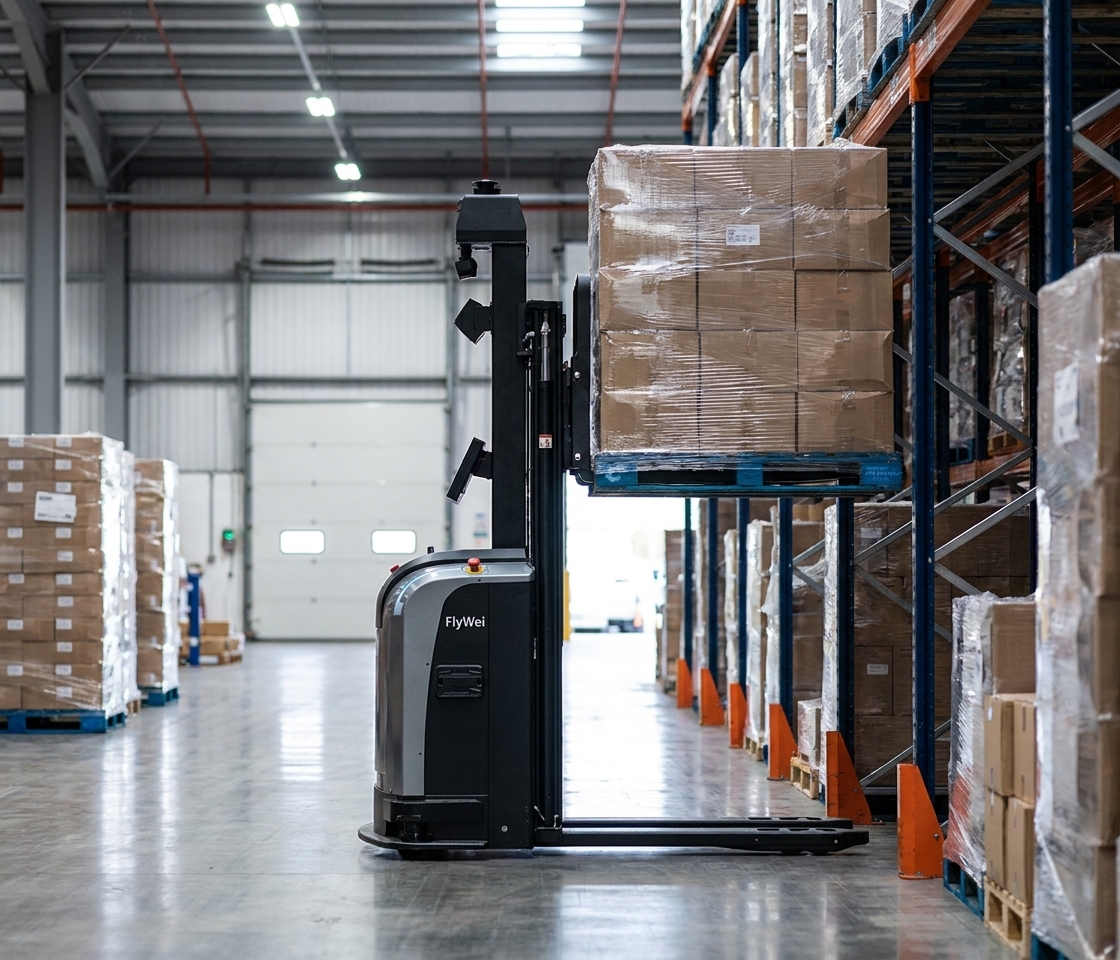
Warehouse robot leasing is a funding structure that converts an autonomous forklift fleet from a single capital purchase into a fixed monthly operating cost, over a three, five or seven-year term, with maintenance, fleet software and support bundled into the same payment. The safety obligations do not change with the funding route: the Provision and Use of Work Equipment Regulations 1998 apply in full to a leased driverless truck, and ISO 3691-4 sets the safety requirements for driverless industrial trucks. For a Head of Procurement in engineering and heavy industrial parts, that distinction is this quarter's problem. Your capex committee is already weighting a press refurbishment, a new CNC cell and a roof against each other. A robot fleet asked to compete in that same envelope loses, not on merit, but on timing — the payback is real but it arrives after the committee's horizon, and the plant carries a further year of agency drivers, unmanned night shifts and pallets stacked on the marshalling floor.
Can you lease warehouse robots instead of buying them?
Yes. Autonomous forklifts and AMRs are available on 3, 5 and 7-year leases as well as short-term rental, so the equipment is financed and serviced without a large upfront purchase. Leasing suits buyers who want predictable monthly costs and the option to refresh the fleet as needs change. FlyWei publishes current warehouse robot leasing terms.
Why engineering capex committees stall robot business cases
Heavy industrial parts sites have a capital rhythm that predates automation. Machine tools, presses and handling plant are bought outright, depreciated over a long life and replaced when they fail. That works because a press in 2026 does roughly what a press did in 2016. Mobile robotics does not behave that way, and the mismatch is what kills the paper.
Two things then go wrong in the committee room. The fleet is presented as a single line — one number, one approval, one year — while the benefit is a stream spread across shifts and sites. Committees discount streams and fixate on the line. And the sponsor is usually an operations lead with no mandate over funding structure, so the only lever available is to shrink the fleet until the number fits, destroying the throughput the case rested on.
More damaging still, the risk register is wrong. The committee prices technology risk — will the machines work — when the real exposures are integration effort, master-data quality and compliance, and those are identical whether you buy or lease. Meanwhile the cost of doing nothing accrues: driver recruitment across the East Midlands corridor around Magna Park, DIRFT and Daventry stays tight, agency cover on nights is the most expensive labour on site, and workplace transport remains one of the most heavily regulated activities you run, as the Health and Safety Executive sets out. A structure that lets the fleet arrive this year rather than in three budget cycles is not a finance trick — it is the difference between a control that exists and a control that is still a slide.
Lever 1 — Fund the fleet on the term that matches its duty cycle
Start from how hard the machines will actually work, then pick the term. A single-shift finishing area with predictable pallet flows is a long-term asset: a seven-year term spreads the cost thinnest and the machines will still be fit at the end. A near-continuous three-shift goods-in operation consumes its duty cycle faster, and a shorter term putting a refresh point in front of you is worth the higher monthly figure. The common error is to inherit the depreciation schedule finance applies to fixed plant and use it for something mobile. Ask two questions before committing: how many hours a year will each truck run, and what changes about this flow in year four? If the honest answer to the second is "we do not know", a shorter term is how you buy that uncertainty down. Full-service structures matter too, because a term outliving its maintenance cover transfers unbudgeted risk back to your plant engineers.
Lever 2 — Size the fleet from your worst week, not your annual average
Average throughput is a comfortable number that produces an uncomfortable fleet. Engineering sites are lumpy: a casting run, a shutdown recovery, a customer pulling forward a build slot. Size on the average and the fleet sits at capacity precisely when the plant is under most scrutiny — which is when your business case gets its verdict. Take twelve months of movement data, find the busiest week, and size to hold service level through it with one machine spare. Then check the constraint is really the trucks — often it is dock doors, floor flatness against BSI-referenced expectations, or one congested aisle. Leasing helps specifically here: with no lump of capital per machine, the marginal truck that covers peak is a monthly-cost conversation rather than a fresh capex submission. That makes fleet sizing an operational adjustment rather than an annual battle.
Lever 3 — Make the fleet layer open before you sign
What determines whether a seven-year term ages well is not the truck. It is the layer above it. A fleet manager speaking an open standard such as VDA 5050 can command vehicles from more than one manufacturer, so the machine you add in year four is chosen on merit rather than on whoever supplied year one. A closed stack quietly converts a funding term into a procurement lock. Insist on three things in writing before signature: that the fleet layer exposes a documented interface to your existing ERP and WMS; that it accepts a vehicle from another manufacturer without a bespoke integration per unit; and that maps, missions and traffic rules remain exportable and yours. FlyWei's M4 fleet manager and RDS robot dispatch are built to that principle. Ask any supplier to demonstrate a mixed-manufacturer fleet in live production, not on a slide.
Lever 4 — Put PUWER and ISO 3691-4 duties in the lease schedule
A leased truck is work equipment. PUWER 1998 places duties on the employer who controls its use, and those do not transfer to the lessor because an invoice arrives monthly. Where a machine lifts a load, LOLER 1998 sits alongside. ISO 3691-4 governs driverless industrial trucks, and UKCA marking, the safety case and the layout risk assessment each need an owner named in the contract. Make the schedule explicit: who performs thorough examination and at what interval; who holds the maintenance record your inspector will ask for; how a safety-relevant firmware change is tested and signed off; and what happens to the safety case when you move a route mid-term. Guidance from Logistics UK and the HSE is the reference point. Settle this at negotiation, because retro-fitting it after go-live is where projects lose months.
| Funding route | Monthly cash | Upfront capital | Refresh point | Typically suits |
|---|---|---|---|---|
| 3-year lease | Highest | None | Year 3 | Three-shift sites, uncertain year-four flows |
| 5-year lease | Middle | None | Year 5 | Stable two-shift sites |
| 7-year lease | Lowest | None | Year 7 | Single-shift, predictable flows |
| Hire purchase | Middle to high | Deposit | Ownership at term end | Buyers wanting eventual ownership |
| Outright purchase | None | Full fleet cost | When it fails | Cash-rich sites, settled flows |
Warehouse robot leasing converts an autonomous forklift fleet from a single capital purchase into a fixed monthly operating cost over a three, five or seven-year term, with maintenance, fleet software and support bundled into the same payment.
What FlyWei does here
FlyWei is an independent, vendor-neutral UK systems integrator of autonomous forklifts and AMRs. That matters to a procurement lead because the machine specified for your casting bay is chosen for that duty cycle, not because it is the only line available. FlyWei integrates equipment from multiple manufacturers, so a heavy-lift AMR moving engine sub-assemblies and a narrow-aisle autonomous forklift serving high-bay racking run under one fleet layer.
In practice FlyWei surveys the flows that hurt — dock to machine, machine to inspection, finished goods to marshalling — and sizes from your peak week rather than your average. M4 takes work from the ERP and WMS you already run and turns it into missions, so the plant does not inherit a second system of truth. RDS handles dispatch, traffic and charging across the estate, and where a lifting duty dominates, FlyWei lifting robots cover the sub-assembly moves a forklift handles badly.
Commercially, FlyWei supplies that same fleet on 3, 5 and 7-year leasing terms with maintenance and software included, and UK-based engineers hold the maintenance record and compliance schedule. What a committee can act on is a fixed monthly figure, a named owner for every regulatory duty, and no manufacturer lock on what you add next.
Frequently asked questions
Is warehouse robot leasing cheaper than buying autonomous forklifts outright?
Outright purchase usually shows the lowest total cost over a full term, but it demands capital now and carries the obsolescence and maintenance risk. Leasing costs more in aggregate and buys predictability, bundled service and a refresh point. Which is cheaper depends on your cost of capital.
What is included in a warehouse robot lease?
A full-service lease normally bundles the machines, planned and reactive maintenance, the fleet software licence and support into one monthly payment. Confirm in writing what is excluded: typically consumables, damage outside fair wear, battery replacement and integration work, which is nearly always costed separately.
Does leasing change our PUWER responsibilities?
No. PUWER 1998 places duties on the employer who controls the use of work equipment, so they stay with you regardless of who owns the truck. What the lease should do is name who performs thorough examination, who holds the maintenance records, and how safety-relevant changes are signed off.
How long does a warehouse robot deployment take once funding is agreed?
Commissioning the vehicles is rarely the long pole. Mapping order and stock fields between your existing systems and the fleet layer, agreeing exception handling and testing against live data set the timeline. Sites whose current system already exposes a documented interface move fastest.
Can we add machines to the fleet part-way through a lease term?
Yes, and it is one of the practical advantages of leasing over a single capital purchase. Adding a truck to cover a peak becomes a monthly-cost adjustment rather than a fresh capital submission. Check before signing that additions are priced on a published schedule.
What happens at the end of a 3, 5 or 7-year lease?
Typical options are to return the machines, extend at a reduced rate, or refresh onto current equipment. Refresh matters most: it stops a long term becoming a fleet of ageing trucks. Agree end-of-term options at the outset, not in the final year.
Will leasing lock us into one robot manufacturer?
Only if the fleet software does. The funding agreement covers the machines; the lock, where it exists, lives in a closed fleet layer that cannot command another manufacturer's vehicle. Require an open standard such as VDA 5050 and confirm maps and missions stay exportable.
If funding an autonomous fleet without a capex submission is on your Q3 risk register, the fastest test is to size the fleet against your own movement data.
Request a fleet-sizing and ROI estimate for your DC, or read the 3, 5 and 7-year terms on FlyWei warehouse robot leasing.
UK-based engineers, no obligation, and we reply within one business day.