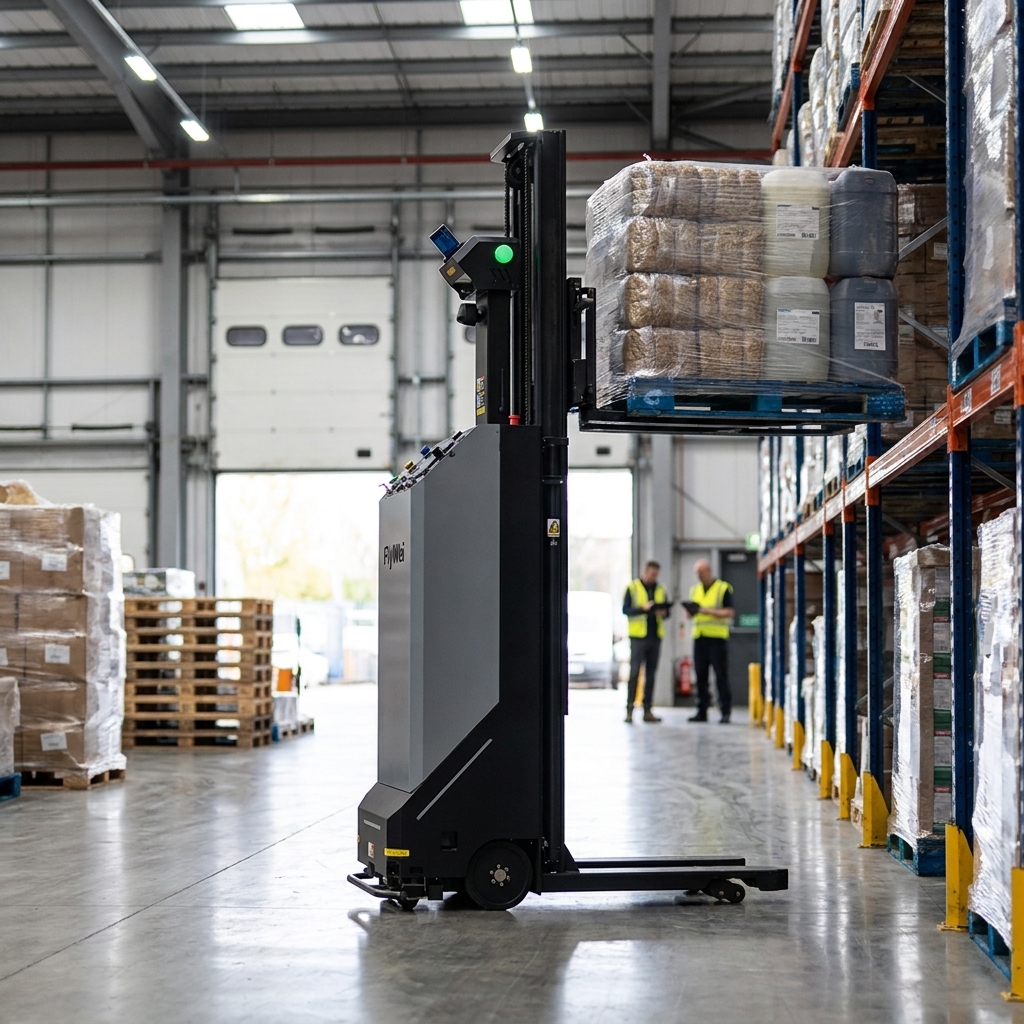
Inside a modern UK materials recovery facility, the choreography looks orderly from the mezzanine — but on the floor, wheeled fleets run near-continuously between baler outfeeds, tipping bays, contamination lines and dispatch. Peak weeks compress that dance further. This illustrative scenario shows how a vendor-neutral autonomous forklift and AMR programme typically supports a UK recycling and waste operator, and what a phased deployment usually looks like.
Illustrative scenario — this case study describes a representative UK recycling and waste operation and does not reference any specific FlyWei customer. All capability figures are given as typical engineering ranges from the underlying autonomous forklift and lifting-robot classes, not results from a specific project.
Operation profile
- Operator type: a regional UK recycling and waste operator running a materials recovery facility (MRF) alongside a bulking and transfer yard
- Footprint band: typically in the region of 10,000–25,000 m² of covered process floor, plus an outdoor bulking apron
- Shift pattern: two staffed shifts, six days a week, moving toward a lights-out third shift for bale movement and dispatch marshalling
- Throughput band: a few hundred to a few thousand tonnes of mixed dry recyclables and residual waste per week, with sharp peak weeks around post-holiday and seasonal recovery cycles
- Existing fleet: a mixed manual fleet of counterbalance forklifts and telehandlers, plus tugs for bale-cart shuttling
At-a-glance application snapshot
The class of autonomous truck typically deployed on this kind of site sits in the following capability envelope. These are indicative engineering ranges from the underlying products, not project results:
- Autonomous counterbalance forklifts in the 1.4–3 tonne payload band, typically stacking to around 3–6 m
- Autonomous pallet trucks (driverless forklift class) in the 1.5–2 tonne band for baled-material shuttling between baler outfeed and dispatch marshalling
- Autonomous stackers reaching up to around 6 m for narrower storage lanes where bales are block-stacked
- Travel speeds typically in the region of 1.5–2 m/s when clear, moderated by dynamic safety fields near people and doorways
- Runtimes generally 8–10 hours on lithium-iron-phosphate packs, with opportunity charging during handover and break windows
- Aisle widths from around 3.2 m for counterbalance duty; narrower for the stacker classes
- Safety architecture built around dual-scanning LiDAR safety fields, contour navigation and SIL-2 controllers on higher-duty chassis
The challenge
Recycling and waste sites present a distinctive intralogistics profile. Bale weights and shapes vary as feedstock changes. Wheeled traffic runs alongside people at sortation lines, tipping bays and roll-on-roll-off exchanges. Weather, dust and condensation move indoors under covered process bays. And the workforce challenge is real — manual forklift driving is one of the harder shifts to recruit and retain for, and near-miss incidents on wheeled equipment carry both a safety cost and a downtime cost that compounds through the shift.
Layered on top: waste stream composition keeps changing. Extended producer responsibility, deposit return and the ongoing rebalancing of dry mixed recyclables mean that today''s bale mix and tomorrow''s rarely look identical, and a fixed conveyor-only automation strategy struggles to keep up. Operators typically need a fleet that flexes with the material rather than one welded into the building.
The solution — a vendor-neutral fleet, chosen per task
FlyWei is an independent UK integrator of autonomous forklifts and mobile robots. That vendor-neutral stance matters here, because no single chassis family covers a recycling site well from bay to dispatch. In a typical design, the fleet is composed as follows:
- Baler outfeed to buffer: autonomous pallet trucks (driverless forklift class) shuttle finished bales from the baler outfeed conveyor into a short-dwell buffer lane, freeing operators from the most repetitive move on the site
- Buffer to block stack: autonomous counterbalance forklifts (AGV forklifts / automated guided forklifts) stack bales into block or racked storage, typically two or three high depending on bale integrity and floor loading
- Block stack to dispatch: the same counterbalance fleet — or narrow-aisle autonomous stackers where floor space is tight — marshals loads into staged dispatch lanes ahead of trailer loading
- Support moves: lifting-robot class AMRs handle roll-cage and tote movement for reject sorting, contamination re-handles and consumables replenishment across the sortation floor
Because the integration is vendor-neutral, the chassis choice for each task is driven by the task, not by a single manufacturer''s catalogue. Controllers, LiDAR and safety scanners are specified against the site''s floor conditions, aisle geometry and traffic density. Integration typically bridges the MRF''s SCADA and the operator''s WMS or ERP, so the robots see baler state, dispatch schedules and trailer bookings as first-class signals rather than after-the-fact events.
How a deployment typically runs
- Free site survey: our engineers walk the floor, map wheeled-traffic flows, capture aisle geometry and identify the two or three moves that account for the majority of manual forklift hours
- Simulation and business case: a digital twin of the flows is used to test candidate fleet mixes, dwell buffers and charging patterns against realistic bale schedules and peak-week loads
- Phased rollout: a single high-value flow — usually baler outfeed to buffer — goes live first, so operators, safety officers and shift managers can adapt without disrupting the whole floor
- Live ops: once the first flow stabilises, adjacent flows are switched on in sequence, with safety cases and standard operating procedures updated between each phase
- Scale: as the fleet grows, the same orchestration layer coordinates trucks from different manufacturers, and the same site becomes a template for sister sites within the operator''s network
Typical results
Because this is an illustrative scenario, we describe outcomes qualitatively rather than as fabricated single-point figures. A well-scoped recycling and waste deployment of this shape typically produces:
- Night-shift bale movement and dispatch marshalling that becomes feasible without a full staffed shift on wheeled equipment
- A fall in wheeled-fleet near-miss incidents on the automated lanes, as dynamic safety fields and speed moderation replace human judgement calls in the busiest crossings
- Operators redeployed from repetitive shuttling into sortation quality, contamination management and dispatch coordination — roles that carry more value and are easier to recruit for
- Bale-to-dispatch cycle time that becomes noticeably more predictable across the week, particularly during peak recovery weeks when manual fleets historically bottleneck
- Lower reliance on agency drivers to backfill absence, because the automated flows keep running while staffed roles rebalance
What to consider for your site
- Which two or three flows account for the majority of your manual forklift hours today?
- What does your bale mix look like now versus twelve months ago — and how might EPR and DRS reshape it again in the next twenty-four?
- Where do wheeled traffic and people cross most often, and what would it take to separate them?
- What state does your baler and MRF SCADA already expose, and to which system?
- Is there a single site in your network that could carry a first phase without disrupting the wider operation?
FlyWei is an independent, vendor-neutral UK integrator. We design across multiple autonomous forklift and AMR manufacturers, and specify the chassis, safety and controls that fit your recycling or waste site — not a fixed catalogue. To scope your first phase, book a free site survey with one of our engineers, or explore our autonomous forklift range, lifting-robot range, controllers, sector solutions and leasing options.