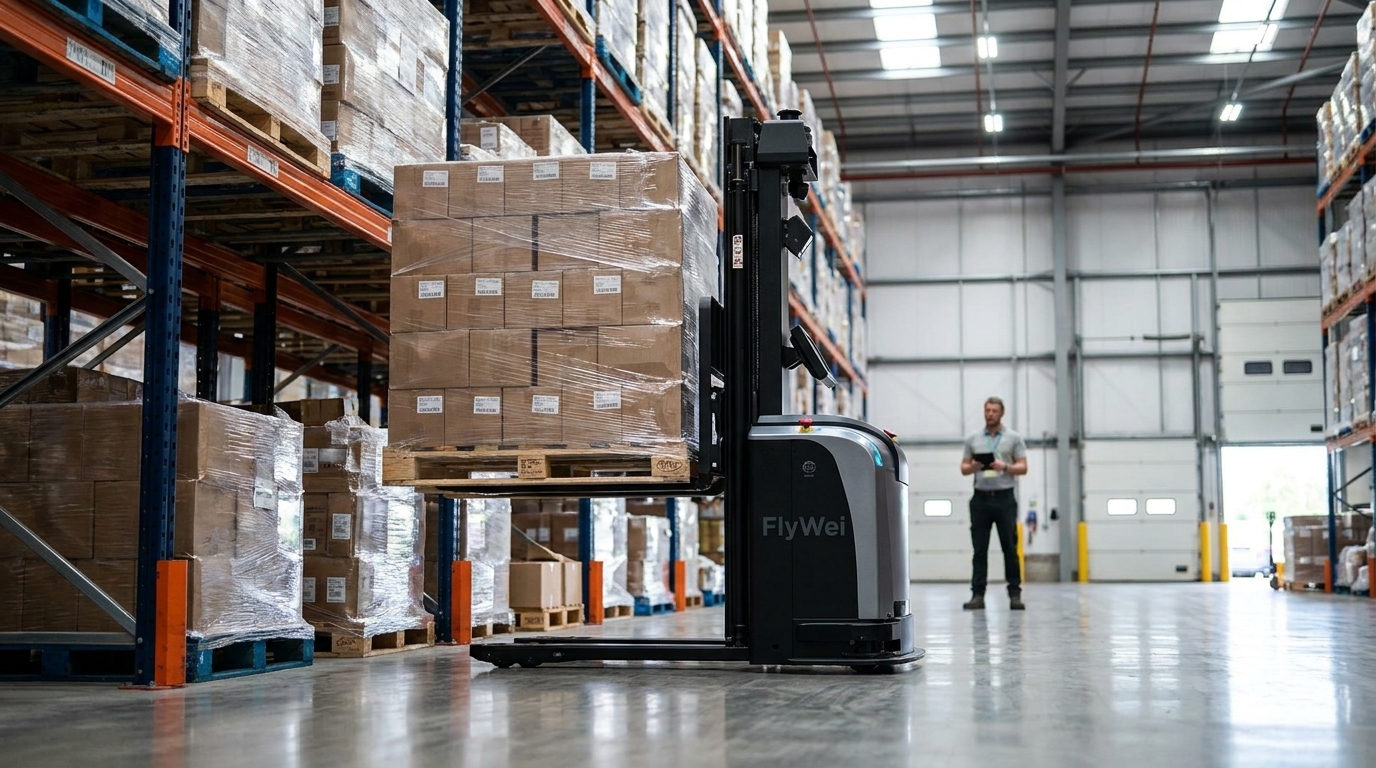
Illustrative scenario — this case study describes a representative UK textiles mill and finished-goods warehouse and does not reference any specific FlyWei customer. All capability figures are given as typical engineering ranges.
British textiles is a sector that never stops moving heavy, awkward loads. Fabric rolls, yarn cone pallets, bales of raw fibre, roll cages of finished garments and totes of e-commerce returns all travel between goods-in, storage racking, cutting or finishing lines, and dispatch, often across mill floors that were laid out decades before pallet automation existed. Labour is scarce, forklift-driver churn is high, and safety expectations under PUWER and LOLER keep tightening. Autonomous forklifts and autonomous mobile robots (AMRs) — driverless forklifts orchestrated as one fleet alongside existing manual trucks — are increasingly the way UK textile operators reclaim floor productivity without demolishing the building around them.
This case study walks through how a vendor-neutral integrator such as FlyWei typically approaches a textiles automation project, what the intralogistics UK landscape usually looks like inside these sites, and what a representative deployment tends to deliver.
Operation profile (illustrative)
- Business: A UK textiles operation combining weaving or knitting production with a finished-goods warehouse and e-commerce fulfilment for own-brand apparel.
- Site: A brownfield multi-bay mill in the order of 15,000-30,000 m², with legacy aisle widths and part-mezzanine storage.
- Shift pattern: Typically two shifts on production, one on dispatch, with lights-out potential overnight.
- Throughput band: Broadly a few hundred to over a thousand pallet moves per day, plus roll cage and tote flow to the pick-face.
- Fleet today: Mixed manual counterbalance and reach trucks, hand pallet trucks and a small number of powered pallet trucks — no autonomous units yet.
At-a-glance application snapshot
Indicative capability bands a UK textiles operator can typically expect from modern autonomous units integrated by a vendor-neutral partner:
- Payload: autonomous pallet trucks typically 1.5-3.0 t; autonomous counterbalance forklifts typically 1.4-3.0 t; latent jacking AMRs typically in the region of 300-1,000 kg for roll cages and totes.
- Lift height: reach-truck-class autonomous units typically 6-10 m; counterbalance units typically 3-4.5 m.
- Travel speed: generally around 1.2-2.0 m/s laden, tuned to aisle safety zones.
- Runtime: commonly 8-12 hours per shift on lithium-ion, with opportunity charging supporting continuous running.
- Aisle width: narrow-aisle-capable units generally operate from about 1.6-2.3 m depending on load class.
- Safety: CE-marked, SIL 2 safety controllers, redundant LiDAR, and PUWER-conformant handover procedures.
The challenge
Textiles operations tend to bring several problems together at once. The load mix is genuinely difficult: fabric rolls are long and roll if not correctly cradled; yarn cone pallets are top-heavy; garment cages have a high centre of gravity; finished pallets are dense; e-commerce totes are small and fast-moving. Manual forklift traffic between goods-in, racking, cutting or finishing lines, and dispatch generates a lot of empty travel and near-miss reports. Recruiting and retaining licensed forklift operators is an ongoing pressure, and nightshift or lights-out running is difficult to sustain safely with a manual fleet. On top of that, dust and lint in the air demand IP-rated sensors and careful thermal management.
Most sites we speak to describe the same underlying issues:
- Empty forklift travel between the mill floor and dispatch is difficult to squeeze out with rostering alone.
- Peak seasonal demand — fashion drops, back-to-school, festive — stretches the manual fleet past its comfortable limit.
- Legacy mill layouts make wholesale re-racking impossible; automation has to fit the building rather than the other way round.
- Health and safety incident reporting keeps flagging pedestrian-forklift interactions on shared routes.
- WMS and ERP integrations vary — sometimes tier-1 platforms, sometimes home-grown — and the automation has to talk to whatever is already in place.
The solution: a vendor-neutral, mixed autonomous fleet
Because FlyWei is an independent UK systems integrator rather than an OEM, the design starts from the load and the layout, not from a preferred brand. In a textiles operation the shortlist typically blends several classes of driverless forklift and AMR:
- Autonomous counterbalance forklifts for full-pallet moves between goods-in and bulk floor storage, including yarn pallets from the raw-fibre bay to the machines.
- Autonomous reach trucks for high-bay storage of finished-goods pallets where floor space is tight and racking runs up 6-10 m.
- Autonomous pallet trucks — the workhorse for horizontal moves between production, dispatch staging and cross-dock lanes.
- Latent jacking AMRs for goods-to-person picking of e-commerce apparel returns and small totes, bringing roll cages and shelves to a fixed pick-face.
- Under-conveyor or low-profile AMRs where cutting or finishing lines need feeding under existing infrastructure without civil works.
All units are orchestrated as one fleet by a manufacturer-agnostic control layer that talks to the site WMS or ERP over standard interfaces, so a mixed fleet — including manual trucks — is scheduled, routed and safety-managed as a single system. Charging is handled by opportunity-charge docks positioned to match travel patterns, keeping utilisation high without dedicated charging shifts.
How a deployment typically runs
- Free site survey: FlyWei engineers walk the mill and the DC, capture aisle widths, floor conditions, dust levels, load samples and existing traffic patterns, and review the WMS or ERP.
- Simulation and business case: observed flows are modelled to size the fleet and pick the right vendor mix. The output is a phased plan with realistic ranges rather than spot promises.
- Phase 1 pilot: a single flow — commonly dispatch pallet transport or a goods-to-person returns pick loop — is automated first, integrated with the WMS and run alongside the manual fleet for several weeks.
- Phase 2 rollout: additional classes of autonomous unit are added, safety zones are extended, and further flows (raw-fibre replenishment, high-bay putaway) are cut over.
- Live operations: the fleet runs on shift as one system, with 24/7 remote monitoring, spares held in the UK and preventive maintenance planned around production windows.
- Scale: once the operating model is proven, additional units, additional shifts (including nightshift or weekend running) and additional sites are added on the same architecture.
Typical results
Results always depend on the individual site, but the qualitative pattern is consistent across textiles automation projects:
- Operators are typically redeployed from repetitive pallet-moving duties into higher-value machine-minding, quality and packing roles.
- Empty-travel time generally falls once flows are orchestrated centrally rather than assigned by shift lead.
- Nightshift and weekend running become feasible without extending manual driver hours.
- Pedestrian-forklift interactions on shared routes tend to fall, as autonomous units follow deterministic paths and hold at safety zones.
- Peak-season throughput becomes easier to absorb because the fleet can be flexed with additional units rather than agency drivers.
- WMS-driven inventory accuracy tends to improve simply because every move is scanned and logged automatically.
None of these outcomes are quoted here as a single-point figure — they are the pattern we see across textiles projects, and they are exactly what a site survey and simulation size against your own baseline.
What to consider for your site
- What proportion of your forklift moves are between fixed points on a repeatable route? Those are the natural first candidates.
- Where is empty travel highest today? Cross-dock and dispatch flows usually pay back fastest.
- Is there a goods-to-person opportunity in returns, pick-and-pack or kitting?
- How is your fleet financed today, and would leasing suit a phased rollout better than capex?
- What does your WMS or ERP already expose? Modern autonomous fleets integrate with most tier-1 and mid-market platforms.
- What is your PUWER, LOLER and DSEAR position today, and how are pedestrian routes managed?
Related pages
- Autonomous forklifts — full driverless forklift range across counterbalance, reach and pallet-truck classes.
- Lifting robots and AMRs — latent jacking and goods-to-person units for cages, totes and shelves.
- Robot and AMR controllers — the safety and navigation stack behind a mixed fleet.
- Solutions — vertical playbooks including textiles, apparel and fashion e-commerce.
- Leasing and rental — three-, five- and seven-year full-service options for phased rollouts.
FlyWei is an independent, vendor-neutral UK systems integrator of autonomous forklifts and AMRs. If you would like to see how this pattern maps onto your own mill or finished-goods warehouse, our engineers will visit the site and produce a free, no-obligation survey with a realistic phased plan.
Book a free site survey to talk to an independent integrator about your textiles automation options.