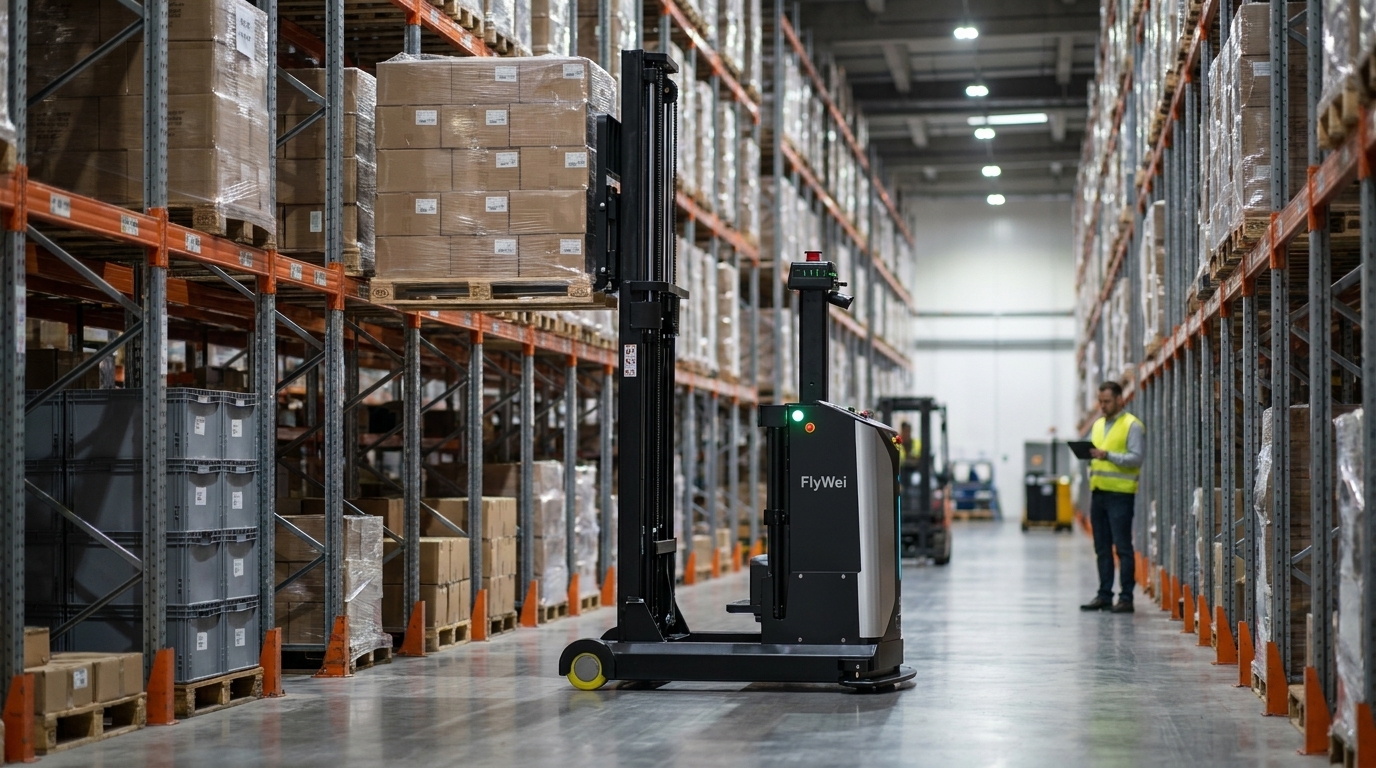
Furniture and home goods warehouses are among the more demanding environments in UK intralogistics: bulky, high-value cartons with fragile finishes, long seasonal peaks around key retail windows, an awkward mix of pallet and loose-carton flows, and a forklift driver pool that is thinning year by year. Autonomous forklift automation — deployed in the right classes and sequenced across the right aisles — is now a realistic answer for mid-sized UK operators.
Operation profile
- Type: UK independent furniture and home goods distributor supplying regional retail estates and direct-to-consumer channels.
- Footprint: in the region of 20,000–40,000 m² across one or two buildings.
- Product mix: flat-pack cartons on Euro and CHEP pallets, sofas and bed sets in oversized cartons, plus smaller cases of textiles, cushions, lighting and homeware.
- Shift pattern: typically a day shift for inbound and put-away and an afternoon-into-evening shift for retail dispatch and home-delivery consolidation.
- Throughput band: hundreds of pallets in and out per day, plus several thousand loose-carton picks.
At-a-glance application snapshot (typical, indicative)
- Autonomous counterbalance and reach truck payloads in the 1.4–3 tonne range.
- Lift heights typically 4–10 m, depending on the rack profile in place.
- Travel speeds in the region of 1.5–2 m/s in shared aisles, higher on segregated corridors.
- Runtime of a full shift on lithium-ion packs, with opportunity charging between waves.
- Aisle widths from very-narrow-aisle (VNA) at around 1.8 m up to wide reserve aisles sized for oversized cartons.
- WMS integration via standard interfaces; safety per ISO 3691-4 and BS EN 1525.
The challenge
Furniture and home goods operations face a distinctive stack of pressures:
- Bulky, damage-sensitive loads. A single scuffed sofa carton is lost margin and a customer complaint. Manual handling of oversized cartons is slow because it has to be careful.
- An awkward mix of pallets and cartons. Flat-pack furniture arrives on standard pallets, but retail dispatch and home delivery pull loose cartons for mixed loads.
- Sharp seasonal peaks. The Christmas retail build, Boxing Day sales, spring garden furniture and back-to-university create demand spikes that quickly outstrip a stable driver roster.
- Driver licences and turnover. Counterbalance and reach truck licences are increasingly hard to fill, particularly in the Midlands and South-East UK distribution clusters.
- Aisle safety. Home goods sites often mix picking, packing and dispatch traffic in the same aisles; the more human-driven trucks in an aisle, the higher the recorded near-miss count.
- Space cost. High-bay VNA extension is expensive; most operators would rather squeeze more density and more shift-hours out of the existing envelope first.
The solution: a vendor-neutral autonomous forklift system
As an independent, vendor-neutral integrator we start from the aisle up rather than the badge in. A furniture and home goods site typically ends up with a mixed autonomous fleet drawn from more than one manufacturer, because no single OEM excels at every truck class. A representative design might combine:
- Autonomous counterbalance forklifts (2–3 t) for inbound container unloading and pallet put-away at ground level and low racking.
- Autonomous reach trucks (around 1.4 t, lifts to roughly 10 m) for high-bay storage and retrieval of flat-pack pallets.
- Autonomous pallet stackers for medium-bay put-away and picking-face replenishment.
- Autonomous pallet trucks for horizontal moves between goods-in, staging and dispatch lanes.
- Lifting AMRs in a goods-to-person format for loose-carton picking of homeware, cushions and lighting.
The integration layer is where the vendor-neutral edge shows. FlyWei’s safety-rated controllers and fleet manager unify trucks from different OEMs onto a single traffic model, one WMS interface (SAP-based, Oracle-based, Manhattan Associates, Blue Yonder or Microsoft Dynamics 365 F&SCM estates all integrate through the same layer) and one dashboard for the warehouse team — so the operator never has to run three separate vendor consoles or three separate safety cases.
How a deployment typically runs
- Free site survey. Our engineers walk the site with the operations team, capture aisle geometry, load types and shift rhythms, and identify the two or three highest-value automation lanes.
- Simulation. We model the mixed fleet against real order profiles to confirm throughput, cycle times and charging patterns before any capital is committed.
- Phased pilot. Usually a single lane or truck class first — most commonly inbound put-away or dispatch consolidation — running alongside the manual fleet for a few weeks.
- Live operations. The pilot is measured against the manual baseline and tuned; the WMS integration is hardened and shift procedures are updated.
- Scale. Additional trucks and additional aisles are added in waves, with each wave paid for by the previous one where the business case supports it.
Typical results (ranged and qualitative)
Because outcomes vary widely by rack profile, order mix and shift design, we describe typical patterns rather than a headline percentage:
- Operators are typically redeployed from repetitive pallet moves to higher-value tasks: quality-checking oversized cartons, home-delivery loading, exception handling and inventory accuracy work.
- Travel time on horizontal moves generally falls once the fleet manager batches routes and eliminates deadhead legs.
- Night-shift running becomes feasible on the automated aisles, taking pressure off the driver rota through peak retail weeks.
- Recorded near-miss events in automated aisles tend to fall, because autonomous trucks slow deterministically at defined zones and do not take shortcuts under time pressure.
- Damage rates on bulky and high-gloss cartons tend to improve where trucks are set to gentler acceleration profiles than a human under a peak-week clock.
Our engineers usually start a furniture and home goods project by mapping the two aisles where a driver spends most of the shift and the fewest human decisions are being made. Automating those first delivers the clearest return, and it earns the credibility to automate the harder lanes next.
What to consider for your site
- Which two aisles absorb the most driver hours today?
- What is the split between pallet flows and loose-carton flows through your dispatch lanes?
- Are your rack heights and aisle widths ready for autonomous trucks, or is a re-profile part of the case?
- Which WMS is in place, and which interface pattern does the automation need to speak to it?
- Would a full-service lease (trucks, chargers, safety controllers, service and spares) suit your finance team better than an outright capex purchase?
- Do you need a driverless forklift class that a single OEM cannot deliver — and would a mixed, vendor-neutral fleet unlock the case?
Where to go next
We publish sector applications like this one to make it easier for UK intralogistics teams to picture what autonomous forklift automation could look like on their own site. If you would like a specific view of your building, our engineers will walk it with you, map the flows and put a mixed-manufacturer proposal in front of you at no cost and with no obligation.
- Explore our autonomous forklift range across counterbalance, reach truck, stacker and pallet-truck classes.
- See how our lifting robots handle goods-to-person picking for loose-carton homeware.
- Read about the safety-rated controllers that let a mixed-OEM fleet run as one system.
- Browse the full-warehouse solutions we integrate for UK operators.
- Compare capex against full-service leasing to match the case to your finance model.
Book a free site survey to see how a vendor-neutral autonomous forklift and AMR system could work for your furniture and home goods operation — an independent view, one integrator, one accountable partner across every truck class on your floor.