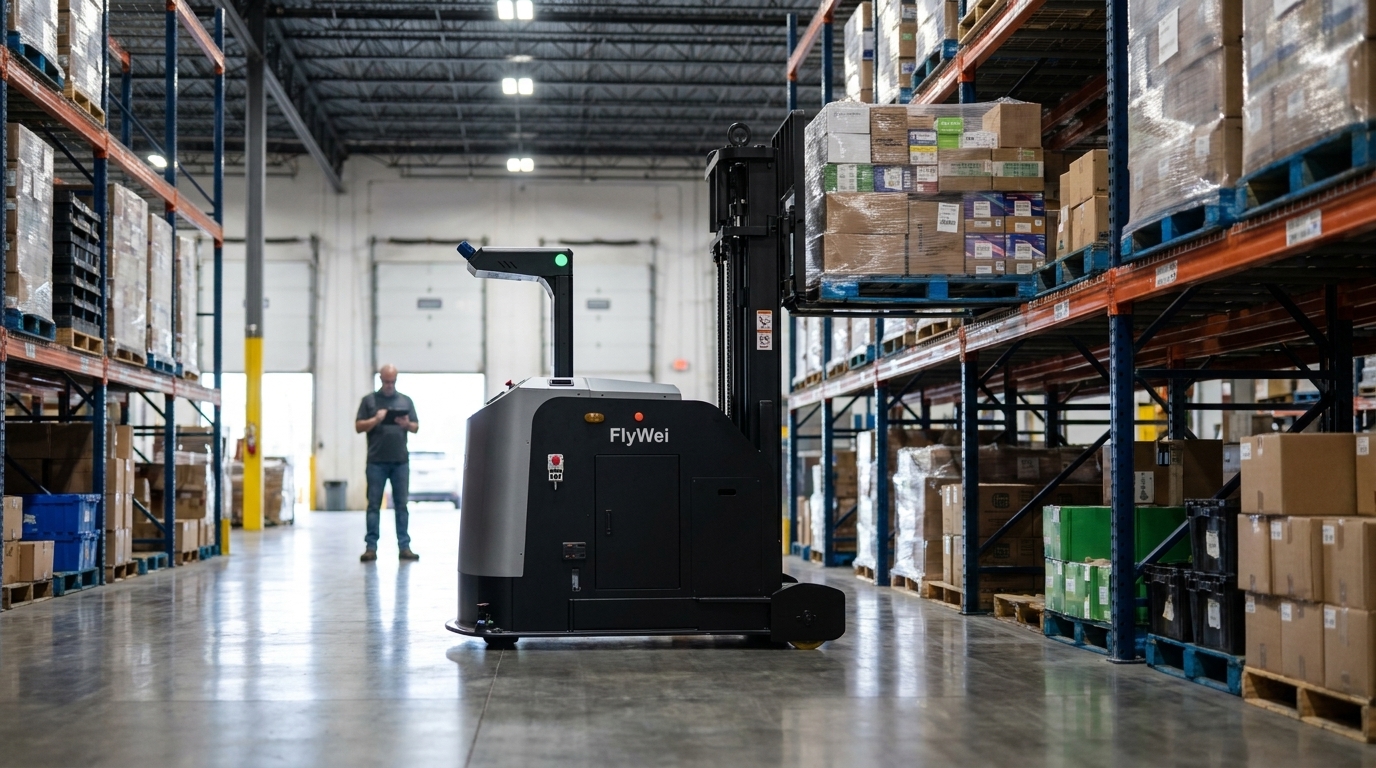
Illustrative scenario. This case study describes how autonomous forklift and AMR automation typically works for a UK tools, hardware and fasteners distribution operation. FlyWei is an independent, vendor-neutral UK systems integrator and does not publish confidential client names; the operator profile and figures below are representative capability ranges, not a specific project.
British trade counters and merchant supply chains are judged on next-morning fulfilment. A regional tools, hardware and fasteners distribution centre has to ship everything from bulk pallets of steel fixings to single hand tools, top up its trade counter through the day, and hold service through DIY peaks — all against a labour market that has quietly reshaped what "reliable" looks like. Autonomous forklifts and AMRs, deployed vendor-neutrally by an independent integrator, are increasingly the answer.
Below is an illustrative view of how a FlyWei intralogistics UK deployment typically works for a tools, hardware and fasteners distributor — the operation profile, the shape of the automation, and what the results usually look like once a mixed fleet of autonomous pallet stackers, driverless forklifts and lifting AMRs is live.
Operation profile
At-a-glance application snapshot
Typical engineering envelopes for the classes of autonomous vehicle that usually fit this environment. These are indicative capability ranges across the market, not a project result — a real site's numbers are set by rack height, floor flatness, aisle width and duty cycle, and are always confirmed on a site survey.
- Autonomous counterbalance forklifts: payloads in the region of 2–3 tonnes, lift heights up to roughly 5 m for standard racking, aisle widths of about 3.5–4 m.
- Autonomous pallet stackers: 1.4–2 tonne payloads, lifts up to roughly 6 m, typically used for floor-to-second-beam replenishment and letdown.
- Very narrow aisle (VNA) autonomous trucks: up to around 10 m lift with about a 1.4 t payload, aisles typically 1.6–1.8 m wide — the density play for a high-SKU hardware DC.
- Latent jacking and roll-cage lifting AMRs: in the 300–1,000 kg range, moving totes and cages between goods-to-person stations, packing benches and dispatch lanes.
- Runtimes: typically an 8+ hour shift on a full charge for lithium-based platforms, with opportunity charging integrated at natural dwell points.
The challenge
A tools, hardware and fasteners DC has an awkward intralogistics shape:
- An enormous SKU tail — tens of thousands of small, look-alike parts where a picking error is expensive to unwind.
- Bimodal handling: heavy incoming pallets of fixings, tile adhesive and power tools alongside eaches and inner packs going out to trade counter, click-and-collect and contractor drops.
- Trade-counter pull that spikes unpredictably against a book of scheduled routes.
- Persistent recruitment and retention pressure, especially for licensed reach and VNA drivers.
- A safety envelope with mixed traffic — pedestrians at the counter, contractor collections, replenishment trucks and cages sharing the same footprint.
The obvious response — hire more drivers, add more racking — has diminishing returns. What actually changes the shape of the operation is decoupling repeatable, long-travel and after-hours work from human drivers, so that experienced staff spend their time on exceptions and on customer-facing trade-counter work.
The solution: a vendor-neutral, mixed-fleet design
FlyWei is an independent UK systems integrator of autonomous forklifts and AMRs — not an OEM, reseller or single-brand distributor. That matters here, because a tools and fasteners DC almost never has one right robot for the whole building. A typical mixed-fleet design combines:
- Autonomous counterbalance forklifts to receive inbound pallets from the yard and put them away into bulk locations.
- Autonomous pallet stackers to run the letdown loop from reserve to pick face, particularly overnight.
- VNA autonomous trucks in dense fastener and fixings racking, where high-bay storage matters more than one-off pick speed.
- Latent jacking and lifting AMRs to shuttle totes and roll cages between the small-item pick module, packing benches and dispatch lanes.
The fleet is orchestrated as a single system that talks to the customer's WMS and, where relevant, ERP and any existing conveyor or PLC layer. FlyWei's engineering team designs to open standards — including VDA 5050 where fleets need to mix vehicle brands or coexist with existing automation — so the site does not become locked into any one manufacturer's roadmap. Safety-rated laser scanners, controllers and charging infrastructure are specified per vehicle class and per aisle, not bundled as a fixed kit.
How a deployment typically runs
- Free site survey. Our engineers walk the DC, capturing floor flatness, aisle geometry, rack heights, dock layout, WMS/WCS interfaces and current cycle times. No obligation, no vendor lock.
- Simulation. Traffic, throughput and charging behaviour are modelled against the site's real order profile, so the recommended fleet mix is defensible before a single vehicle is ordered.
- Vendor-neutral vehicle selection. Autonomous forklift and AMR platforms are chosen on fit — payload, lift, aisle, uptime, safety, total cost of ownership — not because they came from a single line card.
- Phased rollout. Deployments usually start with the highest-repeatability flow (often overnight letdown or inbound put-away), then extend to trade-counter replenishment and small-item movement.
- Live operations. Fleet management, remote diagnostics and preventive maintenance run alongside the customer's own team; SLAs are structured around uptime rather than vehicle count.
- Scale-out. Once the first flows are proven, additional vehicles are added against measured demand, not a speculative capex plan.
Typical results
Qualitative and ranged only — magnitudes depend on baseline shift design, WMS quality and site condition.
- Labour redeployed, not eliminated. Licensed drivers typically move onto exception handling, trade-counter service and inbound quality checks — the work that most rewards experience.
- Longer productive day. Overnight and shoulder-hour running becomes feasible without additional headcount, smoothing morning goods-out.
- Steadier throughput under peak. Autonomous vehicles hold their pace where human fatigue would otherwise dip — most visible during DIY spring peaks and promotional weeks.
- Fewer rack, product and pedestrian incidents. Safety-rated laser scanners and geo-fenced travel paths generally reduce contact events in shared aisles.
- Better inventory hygiene. Because every autonomous move is logged against the WMS, cycle-count and location-accuracy drift usually shrinks.
What to consider for your site
- Where is your true intralogistics bottleneck — inbound put-away, letdown, pick face replenishment, dispatch marshalling, or trade-counter cross-dock?
- What is the mix of pallet, tote and cage moves per shift, and how bimodal is your SKU profile between heavy fixings and small-item eaches?
- Are your aisles standard, wide or VNA — and is floor flatness in the range autonomous vehicles need?
- How open is your WMS and any existing conveyor or sorter layer to a VDA 5050 fleet controller?
- Is your commercial preference outright purchase, or a lease / robotics-as-a-service arrangement aligned to contract length with your customers?
FlyWei's engineers usually start a tools, hardware and fasteners project with a site survey and a short simulation before recommending any vehicle at all — the point is to shape the fleet around your operation, not to sell you a specific truck.
Related pages
- Autonomous forklifts — the counterbalance, reach, VNA and stacker range
- Lifting robots and AMRs — goods-to-person, latent jacking and roll-cage automation
- Controllers — safety-rated AMR and autonomous forklift controllers
- Solutions — intralogistics UK by sector
- Leasing and financing — 3, 5 and 7-year term options for autonomous fleets
Talk to an independent integrator. A free site survey is the fastest way to see what an autonomous forklift or AMR fleet could realistically do for your tools, hardware and fasteners DC — with a vendor-neutral recommendation, not a single-brand pitch. Book a free site survey.