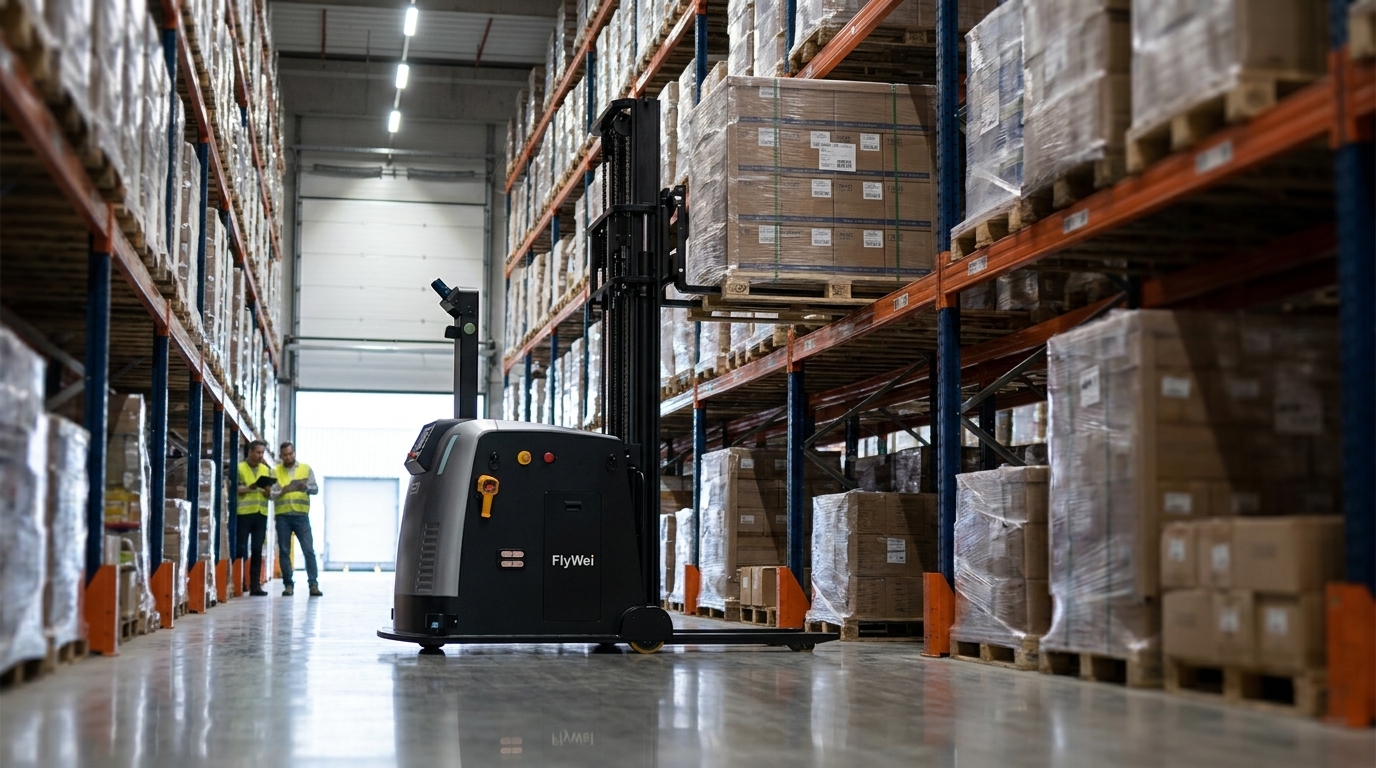
Solar modules, heat pumps and packaged HVAC units are among the heaviest and most awkward pallets moving through UK distribution today — and the fastest-growing. A vendor-neutral autonomous forklift and AMR fleet, sized by an independent integrator, is now a realistic way for a UK renewable energy and HVAC distribution operation to keep pace with demand without adding shifts or shuffling drivers between sites.
Illustrative scenario. This case study describes a representative UK renewable energy and HVAC distribution operation, not a named FlyWei client. All figures are indicative engineering ranges typical of the class of equipment described, not project-specific results.
Operation profile
- Sector: Renewable energy and HVAC distribution — solar PV modules, mounting systems, inverters, air-source and ground-source heat pumps, and packaged HVAC units serving UK installers and commercial contractors.
- Site type: A regional UK distribution centre supplying installers nationwide, with a trade counter for same-day collections.
- Approximate scale band: 8,000–15,000 m² of high-bay racking, typically 8–11 m clear internal height.
- Shift pattern: Two productive shifts with a lightly-crewed twilight shift for inbound container clearance.
- Throughput band: Several hundred pallet moves per day at peak, dominated by inbound container stripping and outbound line-side loading to trucks.
At-a-glance application snapshot
Realistic capability ranges for the class of autonomous equipment used on a scheme like this — indicative rather than a promise for any single site.
- Payload: typically 1.4–3.0 tonnes per pallet for solar and HVAC pallets; heavier bases available for palletised inverters and battery cabinets.
- Lift height: in the region of 3–6 m for narrow-aisle stackers; up to roughly 10 m with automated reach trucks for high-bay solar module bays.
- Aisle width: from about 1.6 m for very narrow aisle equipment, up to standard 2.7–3.2 m aisles for autonomous counterbalance trucks.
- Travel speed: typically 1.2–2.0 m/s under load, with safe-slowdown around people and shared-floor zones.
- Runtime: opportunity charging usually keeps a mixed fleet running through a full 16-hour productive day, with dwell at charge stations built into the schedule.
The challenge
Renewable energy and HVAC distribution has been growing steadily as the UK heat-pump rollout accelerates and rooftop solar volumes climb. That growth exposes a specific set of intralogistics UK problems that are hard to solve with extra drivers alone:
- Long, heavy solar pallets. Framed module pallets can be around 2 m long and close to a tonne each; damage on the corner of a stack is expensive and slows the outbound trailer.
- Boxed HVAC units are top-heavy. Air-source heat pump outdoor units and packaged rooftop units concentrate mass high on the pallet and reject rough handling.
- Seasonal peaks are sharp. Solar installs cluster in the warmer months; heat-pump volumes lift in autumn. A fleet sized for either peak sits idle in the other window.
- Inbound containers arrive in waves. Container stripping is a persistent labour bottleneck that ripples straight into outbound if not cleared inside a shift.
- Trained forklift drivers are hard to retain in regional distribution parks that compete with e-commerce and 3PL sites next door.
- Site safety is under scrutiny. Boxed HVAC units and installers picking up their own goods mean pedestrians and forklifts share more floor than in a pure pallet-out site.
The solution: a vendor-neutral autonomous fleet
FlyWei is an independent, UK-based systems integrator of autonomous forklifts and AMRs. Because we are not tied to a single manufacturer, we can select the specific driverless forklift or lifting robot best suited to each task and blend them into one orchestrated fleet. For a renewable energy and HVAC operation, a typical mixed fleet includes:
- Autonomous counterbalance forklifts (roughly 2–3 tonne class) for container stripping and outbound truck loading of solar module pallets and packaged HVAC units.
- Automated reach trucks (up to about 10 m lift) for high-bay putaway of module pallets, keeping the tall bays dense without a dedicated night-shift crew.
- Autonomous pallet stackers and pallet trucks for goods-in staging, line-side replenishment of picking faces, and moving mixed pallets to consolidation lanes.
- Lifting AMRs and mobile bases for smaller totes and boxed accessories — brackets, cabling, controls, filters — that support each solar or HVAC order.
All of the above are coordinated by a vendor-neutral fleet controller that integrates with the site''s WMS or ERP, respects picking waves and truck slots, and enforces safe interactions with pedestrians and any manual forklifts still on the floor.
How a deployment runs
- Free site survey. Our engineers usually start a renewable energy and HVAC project with a physical walk-round, a WMS review and a shift-pattern conversation. No cost, no commitment.
- Simulation. We model the site''s flows against the proposed fleet mix and validate that peak days close on time before any hardware ships.
- Phased rollout. A typical first phase covers one flow — often container stripping and staging — with one or two autonomous forklifts and a small AMR complement, running alongside existing drivers.
- Live operations and iteration. Once the first flow is settled, we extend to putaway, replenishment and outbound loading, tuning the fleet mix as real operating data comes in.
- Scale. Additional trucks and AMRs are added to match the sector''s growth curve, without swapping vendors or re-integrating the control layer.
Typical results
These are qualitative outcomes representative of the class of deployment, not project-specific numbers:
- Container stripping typically clears inside the same shift it arrives in, easing the knock-on into outbound.
- Night-shift running for putaway becomes feasible with light supervision rather than a full drive crew.
- Damage to solar module pallets generally falls when the same automated reach truck handles every putaway to the tall bays.
- Trained drivers can typically be redeployed to higher-value tasks — installer counter service, quality checks, inbound QC — rather than repetitive shuttle runs.
- Seasonal peaks flex on fleet hours rather than on hiring, which historically has been the hardest lever to move.
- Safety incident rates in shared-pedestrian zones tend to fall as autonomous trucks apply consistent slowdown and give-way behaviour.
What to consider for your site
- Are your solar module and heat-pump pallets on a consistent footprint, or does inbound arrive on non-standard pallets that need re-palletising?
- What is the split between putaway to tall bays and outbound line-side loading? That drives the reach-vs-counterbalance mix.
- How much of your floor is genuinely shared with installers picking up goods? Shared floors need higher-spec safety scanners and a stricter route plan.
- Do you have WMS-level pallet identity, or are you still working from paper for goods-in? Automation is easier when the pallet is known at the door.
- Is your seasonal peak dominated by solar (spring and summer) or heat pumps (autumn and winter)? That shapes the leasing profile and the maintenance schedule.
Relevant FlyWei pages
- Autonomous forklifts — the driverless forklift, reach truck, stacker and pallet-truck range.
- Lifting robots and AMRs — mobile bases and jacking robots for cases, totes and roll cages.
- Robot controllers — the safety and navigation controllers behind vendor-neutral fleets.
- Sector solutions — how autonomous intralogistics fits your operation.
- Leasing — full-service leasing options for scaling a fleet without capex spikes.
Talk to an independent integrator
If you run a UK renewable energy or HVAC distribution operation and you are weighing autonomous forklifts against another season of contract labour, book a free FlyWei site survey. Because we are vendor-neutral and independent, our recommendation is honest about what a driverless forklift or lifting robot will and will not solve on your specific floor — and what the honest engineering ranges look like before any commercial conversation begins.