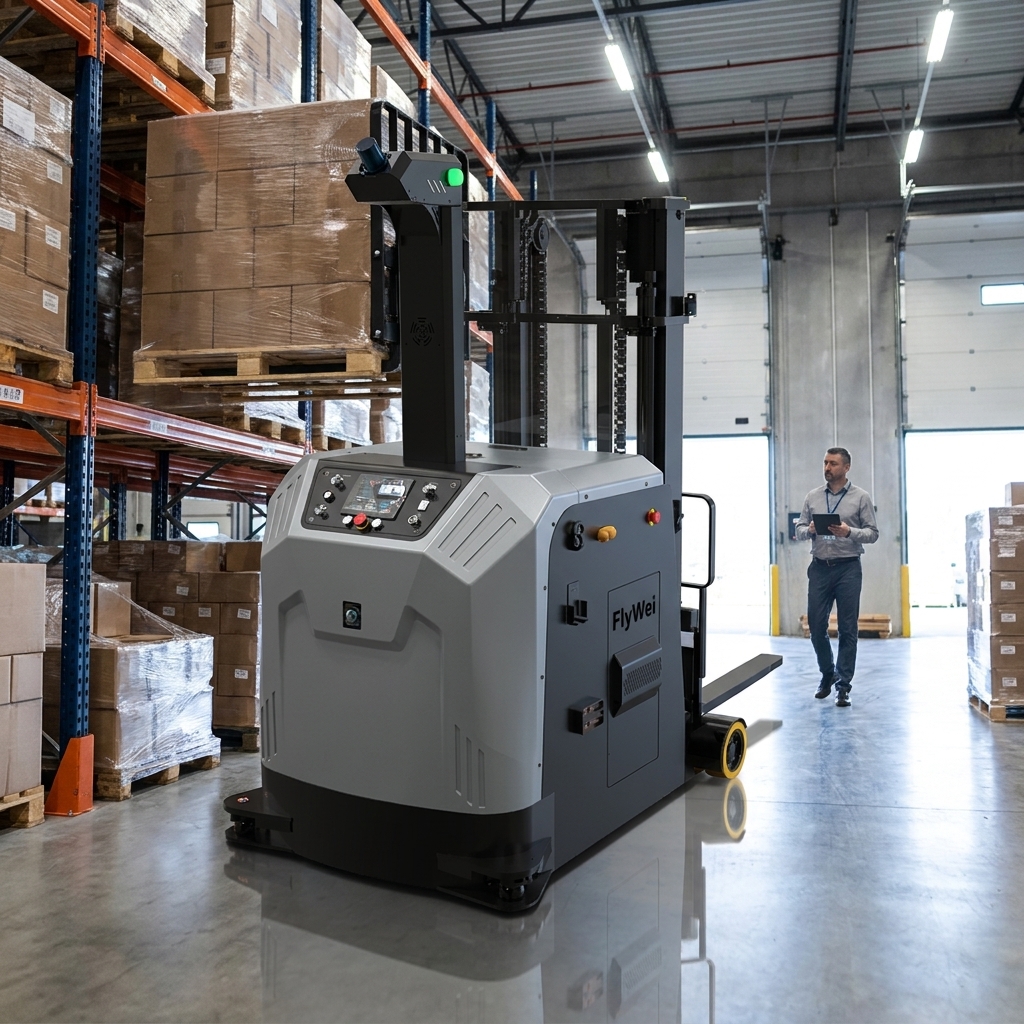
Illustrative scenario — this case study describes a representative UK glass, ceramic and porcelain-tile distribution operation and does not reference any specific FlyWei customer. All capability figures are given as typical engineering ranges, not project-specific results.
Glass, ceramic and porcelain-tile distribution is one of the most physically punishing corners of UK intralogistics. Pallets weigh a tonne or more, product is fragile at the edges and unforgiving on the floor when it drops, and demand from the DIY multiples, independent tilers and specification builders arrives in tight, weather-sensitive waves. It is a sector that runs on skilled counterbalance and reach-truck drivers — and one that has felt the shortage of them harder than most.
This illustrative case study describes how a UK glass, ceramic and tile distribution operation might approach autonomous forklift and AMR integration with FlyWei, an independent, vendor-neutral British systems integrator. FlyWei does not sell a single brand of robot; it integrates the best autonomous pallet trucks, stackers, counterbalance forklifts and reach trucks across multiple manufacturers, orchestrated by a common controller layer that speaks to your WMS or ERP.
Operation profile
- Sector: Glass, ceramic and porcelain-tile distribution serving trade counters, tilers and retail DIY chains
- Footprint: Single-roof regional distribution centre, in the range of 12,000–20,000 m²
- Storage: Block stack for fast-moving lines plus adjustable pallet racking to around 7–9 m; a very narrow aisle (VNA) block for slow-moving SKUs
- Throughput band: Roughly 8,000–14,000 pallets in and out per month, with a 30–40% swing across the spring build season
- Shift pattern: Two weekday shifts with an inbound Saturday morning; the goal is to add lights-out inbound put-away without adding headcount
At-a-glance application snapshot
Typical / indicative figures for the classes of autonomous truck normally used in this kind of operation:
- Payload: in the region of 1.4–3.0 tonnes per truck, matched to the heaviest tile pallet the site actually moves
- Lift height: typically 4–6 m for stackers, and up to around 10 m where a reach-truck class robot is used for high-bay slow-mover picking
- Travel speed: in the region of 1.0–2.0 m/s laden, tuned down in mixed-traffic and pedestrian zones
- Runtime: typically 6–10 hours per charge with opportunity charging integrated at natural dwell points
- Aisle width: from around 1.6 m for the narrowest VNA-class robots up to standard 2.8–3.0 m aisles for counterbalance work
- Safety: functional-safety controllers with dual 2D safety scanners, typically to Performance Level d
The challenge
Glass, ceramic and tile distributors typically share a familiar set of pains:
- Heavy, fragile, unforgiving pallets. A tonne of 60×60 porcelain floor tiles that shifts on a fork is an insurance claim; a dropped glass unit is a shift-stopping clean-up. Repeatable, gentle handling matters more here than in almost any other sector.
- Long, monotonous cross-DC travel legs. Bulk stock is often block-stacked at one end of the roof and picked at the other. Those horizontal legs are exactly the work that erodes driver retention.
- Peak seasonality. Spring builds and refurbishment cycles push throughput 30–40% above baseline, and the UK labour market cannot always flex to match.
- Safety and PUWER duties. High-mass loads, pedestrians at trade counters and mixed-traffic yards make the site's HSE case for lift-truck automation unusually strong.
- Space discipline. Racking sits close to product because floor rent is not cheap; manned counterbalance drivers eventually widen aisles to feel safe. Autonomous trucks hold aisle dimensions more tightly and more consistently.
The solution — a vendor-neutral system design
Because FlyWei is an independent integrator rather than a robot OEM, the starting point is the task, not the brand. In a glass, ceramic and tile operation, a typical mixed fleet would combine:
- Autonomous counterbalance forklifts for inbound put-away of the heaviest full-pallet stock in the block-stack area, sized to the 2–3 tonne band.
- Autonomous pallet stackers for medium-height replenishment from ground pick-face to lower rack beams, typically in the 1.4–2 tonne class.
- Autonomous reach trucks or VNA-class robots for high-bay slow movers, where aisle width and lift height demand a purpose-built truck.
- Autonomous pallet trucks for the long horizontal legs between goods-in, dispatch and the trade counter.
All of the above are orchestrated by a single fleet controller that speaks VDA 5050 to the trucks and integrates with the site's WMS (or, where the customer runs a lighter software stack, direct ERP hooks). This is the wedge of vendor-neutral integration: a task and its truck can be swapped without re-plumbing the software.
Integration surface
Typical integration points in a glass, ceramic and tile DC include: inbound ASN feed for pre-allocated put-away; slotting rules that respect fragility and pallet-weight-on-pallet limits; a marshalling handshake at dispatch bays; and PLC integration where an infeed conveyor drops onto a robot's forks. FlyWei's engineers do this integration in-house rather than sub-contracting it, which shortens the change-request loop after go-live.
How a deployment runs
- Free site survey. An engineer walks the DC, maps aisles, measures floor flatness and identifies which tasks are automation-ready today.
- Simulation. The candidate fleet and task list are simulated against real inbound and outbound volume so the site sees a defensible throughput envelope before it commits.
- Phased rollout. Automation typically starts on one repetitive lane — very often the block-stack put-away or the trunking leg between goods-in and racking — so operations learn the system on a low-risk task.
- Live operations and handover. Site engineers are trained to the controller layer, not to the individual robots, so future fleet expansion does not depend on FlyWei for day-to-day running.
- Scale. Additional trucks, tasks or shifts are added under the same controller with minimal disruption.
Typical results
Because this is an illustrative case study we do not attach single-point figures to a specific project. However, glass, ceramic and tile operators can typically expect:
- Manual lift-truck hours on the automated tasks fall materially, and operators are usually redeployed to trade-counter service, quality inspection and put-away exception handling — roles that people actually want to do.
- Damage rates on the automated flows generally trend down because a robot picks and places the same way every time.
- Night-shift and lights-out inbound put-away becomes feasible without adding headcount, which unlocks the spring peak.
- Aisle discipline improves — robots do not widen aisles for personal comfort — releasing floor for additional pallet positions.
- HSE incidents involving lift trucks trend downwards, supporting the site's PUWER and insurer case.
What to consider for your site
- Do you know the true weight distribution of your heaviest 20% of pallets? Autonomous trucks are sized to the real load, not the average.
- Is your floor flat enough for AGV/AMR travel, or is a targeted flatness survey needed?
- Does your WMS expose the put-away and replenishment tasks cleanly, or will a controller-side abstraction layer be needed?
- Which single lane — inbound put-away, trunking, or dispatch marshalling — would you automate first if you could pick only one?
- Are you evaluating leasing versus outright purchase? A phased lease often better matches the risk profile of a first automation project.
You can read more about FlyWei's autonomous forklift range, its lifting robot and AMR portfolio, the controllers that orchestrate the fleet, sector-specific solutions, and options for long-term leasing and full-service rental.
Book a free site survey. As an independent, vendor-neutral UK integrator, FlyWei will walk your glass, ceramic or tile distribution site, propose a mixed-manufacturer fleet designed for your tasks, and simulate the throughput envelope before you commit a penny. Talk to an independent integrator — not a single-brand reseller — before you specify your first autonomous forklift.