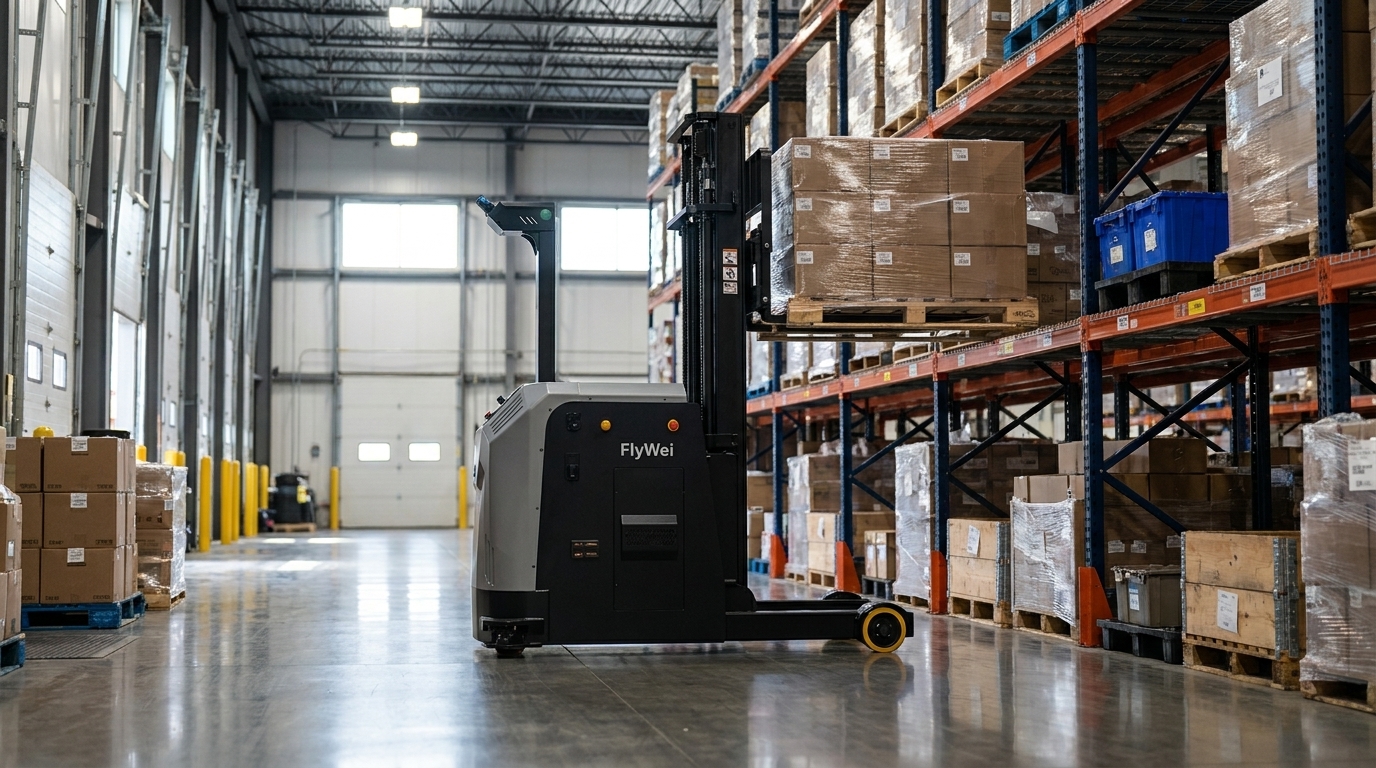
Illustrative scenario, not a named client. FlyWei does not publish confidential client identities. Figures below are typical engineering capability ranges, not project-specific results.
Paint and coatings warehousing sits at the awkward intersection of heavy pallets, hazardous storage and stubbornly manual handling. A single-shift UK site can move several hundred pallets of solvent-based product, decorative emulsion, industrial coatings and empty cans in a day — much of it inside COSHH- and DSEAR-controlled zones where every extra forklift movement is another risk assessment. This is a representative case study of how a vendor-neutral autonomous forklift and AMR deployment typically unfolds for a UK paint and coatings operation, drawing on FlyWei's independent integration work across multiple manufacturers.
Operation profile
- Operator: a mid-sized UK paint and coatings manufacturer-distributor with a single Midlands DC serving trade merchants and retail DIY.
- Site footprint: roughly 12,000–20,000 m², combining ambient racking, a temperature-regulated flammable-liquid store, and a mixed-case pick module.
- Throughput band: in the region of 300–600 pallet moves per shift across inbound, put-away, replenishment and dispatch.
- Shift pattern: two-shift weekday operation with a lightly-staffed Saturday backfill during decorating season (roughly March to September peak).
At-a-glance application snapshot (typical, indicative)
- Autonomous forklift class: counterbalance and reach-truck AMRs in the 1.4–3.0 tonne band, lift heights typically 6–10 m.
- Travel speeds: in the region of 1.5–2.0 m/s laden on main aisles, throttled inside DSEAR zones.
- Aisle widths: compatible with existing very-narrow-aisle racking from around 1.7 m; wider aisles preferred at solvent-store interfaces.
- Runtime: typically 8–10 hours between opportunity charges on modern LiFePO4 packs; charging docks are compact enough to sit at aisle ends.
- Safety: multi-layer scanning LiDAR, PLd / SIL 2 rated controllers, and geofenced speed and dwell zones around flammable-store approaches.
The challenge
Paint and coatings operators tend to face a familiar cluster of pain points:
- Manual handling in hazardous zones. Every human-driven pallet move inside a flammable store carries a mandated risk assessment, PPE overhead and a real injury exposure from spillage or load instability.
- Seasonal peak volatility. Decorating season and trade promotions can lift dispatch volumes by a large multiple over quiet weeks, and manual fleets do not scale linearly.
- Mixed load profiles. Full pallets of 10 L tubs, shrink-wrapped cases of aerosols, drums of resin and returns of half-empty tins all move through the same doors — hard to optimise with a single manned-truck mix.
- Driver recruitment. Certified counterbalance operators willing to work inside coating stores are increasingly hard to hire and retain in the UK, and turnover costs stack up quickly.
- Traceability. COSHH-controlled batches need reliable location and movement history; manual scan-and-move workflows leak data.
The solution: a vendor-neutral autonomous fleet
Because no single manufacturer builds the ideal truck for every task in a paint plant, FlyWei's approach as an independent UK integrator is to specify the right robot for each flow — chosen from the manufacturers we integrate — and unify them under one orchestration layer:
- Autonomous counterbalance trucks in the 2–3 tonne band handle inbound from trailer, cross-dock, and put-away into bulk racking.
- Autonomous reach trucks in the 1.4–1.5 tonne band service high-bay pick locations, including inside temperature-regulated flammable stores where geofenced speed and dwell rules apply.
- Lifting AMRs in the 300–1000 kg base-jacking class move totes, shrink-wrapped kits and returned goods between pick faces and outbound consolidation.
- Autonomous pallet stackers handle low-level replen and end-of-line pallet drops from the fill line into floor buffer.
The whole fleet — regardless of manufacturer — talks to the customer's WMS and to the mill/fill PLC layer through a single orchestration platform using open interfaces such as VDA 5050, so the buyer is never locked to a single OEM's software. That vendor-neutral, multi-manufacturer stance is the difference between an integration decision you can revisit in five years and one you cannot.
How a deployment typically runs
- Free site survey. FlyWei engineers walk the site to map aisle widths, floor flatness, ATEX and DSEAR zones, WMS integration points, and current shift-by-shift throughput.
- Simulation and specification. Flows are modelled against realistic peak volumes; the truck mix is chosen for the actual load profile, not a sales-driven default.
- Phased rollout. A first pilot flow — often inbound put-away, because it is the highest-volume single loop — proves the integration before scaling.
- Live operations. The fleet runs alongside a smaller manned complement during the transition; operators are typically redeployed to higher-value tasks such as goods-in checks, mixing-room support and outbound loading.
- Scale. Additional units, additional flows, and — in many sites — an unattended or lightly-staffed night shift are added once the day-shift baseline is stable.
Typical results (ranged and qualitative)
- Reduced human exposure inside flammable stores — the majority of routine pallet moves inside DSEAR zones can typically be automated, cutting the number of manned entries per shift.
- More consistent throughput — autonomous trucks generally deliver steady cycle times through shift-end and break periods, which flattens the peak curve.
- Unattended night-shift running becomes feasible where it previously wasn't cost-effective, giving the site headroom for peak-season promotions.
- Improved traceability — every move is timestamped and tied to a WMS location, tightening COSHH audit trails.
- Redeployment, not redundancy — operators tend to move onto quality, replenishment planning, or driving during genuine mixed-load exceptions, roles that are typically easier to recruit for than pure counterbalance duty in a coating store.
What to consider for your site
- What proportion of pallet moves happen inside DSEAR or COSHH-controlled areas today?
- How volatile is your seasonal peak, and how much of that is currently absorbed by overtime or agency drivers?
- What is the age and condition of your floor, aisle widths and rack uprights? These drive truck selection more than any datasheet.
- Does your WMS already talk to mobile robotics, or will an orchestration layer be needed?
- Do you prefer to buy outright, lease, or run on a full-service leasing model that spreads the capex across 3, 5 or 7 years?
An honest, vendor-neutral integrator will start with the site survey rather than the shortlist. Explore FlyWei's autonomous forklifts, lifting robots and robot controllers, or read how the solutions layer ties an existing WMS into a mixed-manufacturer fleet. If cost modelling is your first question, our leasing options outline how the same technology can be procured across a 3, 5 or 7 year term.
Book a free UK site survey with FlyWei's independent integration team and see what a vendor-neutral autonomous forklift and AMR fleet could do for your paint and coatings operation.