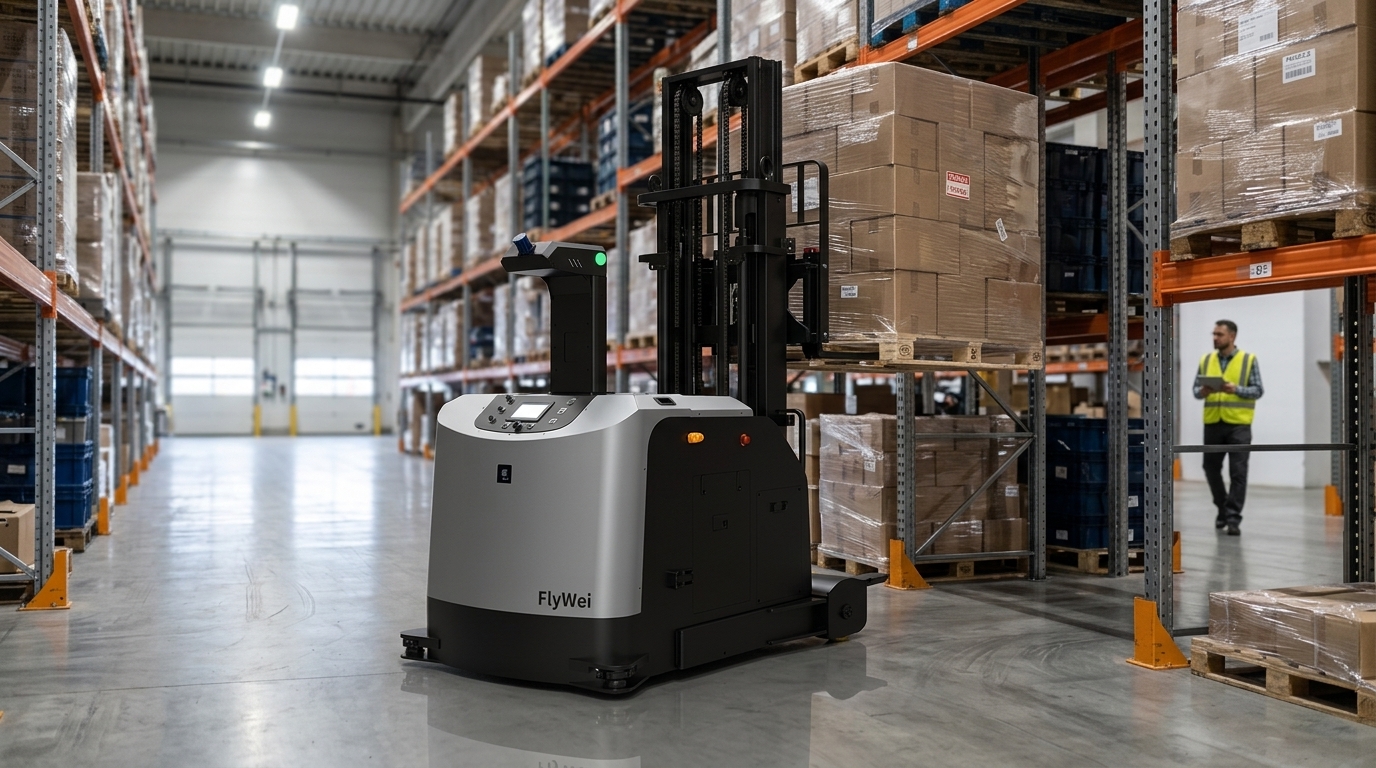
The UK tyre and wheel distribution sector runs on peak-and-trough rhythms — the twice-yearly summer and winter tyre swaps, spikes tied to weather events, and a steady baseload of aftermarket and OEM orders. Between those peaks, a busy regional depot might handle tens of thousands of tyre units a week, moving pallets of new tyres inbound from ports and manufacturing plants, then breaking them down into mixed loads bound for fast-fit chains, independent garages, dealerships and consumers. It is heavy, repetitive, and unusually seasonal work — a strong fit for autonomous forklift and AMR automation delivered by an independent, vendor-neutral integrator.
A note on this scenario. The operator described below is an illustrative composite drawn from typical UK tyre and wheel distribution warehouses. All numbers are indicative engineering ranges, not results attributed to a single client. FlyWei does not publish confidential customer names.
Operation profile (illustrative)
- Type: Regional UK tyre and wheel distribution centre serving fast-fit chains, independent garages and mobile fitters.
- Footprint: roughly 8,000–15,000 m² of warehouse space, with a mix of block stacking and drive-in racking.
- Racking: typically 5–9 m clear lift for pallet locations, with some very narrow aisle (VNA) sections for slow-moving SKUs.
- Throughput band: in the region of 30,000–120,000 tyre units per week, depending on season.
- Shift pattern: two shifts most of the year, extending to three-shift cover in the pre-winter and pre-summer swap windows.
- Product mix: palletised inbound (car, van, 4x4, LCV, some agricultural), plus loose case-picked outbound; some wheel and rim SKUs on stillages.
At-a-glance application snapshot (typical / indicative)
- Autonomous fleet size: typically 4–12 units, mixed across pallet trucks, counterbalance and reach trucks.
- Payload class: in the region of 1.4–3 tonnes per unit.
- Lift height: typically 5–10 m, matched to the site''s tallest racking.
- Travel speed: typically 1.5–2 m/s in open aisles, reduced automatically in shared zones.
- VNA aisle width: in the region of 1.6–1.8 m for very narrow aisle SKUs.
- Runtime: multi-shift with opportunity charging at natural handover points.
- Integration: VDA 5050-compatible fleet layer sitting above the site''s WMS/WCS.
The challenge
Tyre and wheel operations tend to sit at the harder end of intralogistics work. A few of the recurring pains an independent integrator hears at the initial site survey stage:
- Heavy, repetitive lifting. Full pallets of van and 4x4 tyres push the upper end of standard forklift payload, and the movements are relentless. Manual handling drives injury exposure, insurance load, and driver fatigue.
- Extreme seasonality. Twin peaks — pre-winter and pre-summer swaps, plus weather spikes — mean the operator must staff for a peak that lasts weeks and idles the rest of the year. Agency labour is expensive and increasingly hard to source at short notice.
- Mixed formats. Inbound is neat palletised stock. Outbound is a more chaotic mixture: full pallets to fast-fit chains, mixed cases to independents, loose singles to mobile fitters and retail.
- Space discipline. Rubber is bulky and low value per cubic metre; every centimetre of racking is fought over. VNA layouts and tall block stacks are common.
- Compliance and PUWER. Every lift truck is regulated equipment, and every operator needs current training. As fleets grow, so does the compliance overhead.
The solution — a vendor-neutral, mixed-manufacturer fleet
Because FlyWei is an independent UK systems integrator rather than a manufacturer, the starting question is never which of our robots do you want? — it is what does your operation actually need? For a typical tyre and wheel site, that usually means a mixed fleet:
- Autonomous counterbalance and pallet trucks for inbound receipting, dock-to-stack moves and put-away of full tyre pallets, typically in the 1.5–3 tonne payload band.
- Autonomous reach trucks for tall racking, taking pallet locations up to the site''s clear-lift limit — often 8–10 m — with the accuracy to work close to structure.
- Very narrow aisle (VNA) AGVs where the operator has invested in dense racking and can trade width for cube.
- Autonomous lifting AMRs and jacking robots for stillages of alloy wheels or for goods-to-person picking of loose tyres and small parts.
All of this is orchestrated by an open, VDA 5050-compatible controller layer that talks to the site''s existing WMS or WCS. That is the core of the vendor-neutral advantage — the operator is not locked into any one manufacturer''s roadmap, and can add a different robot next year without rebuilding the software stack.
How a deployment typically runs
An honest deployment for a UK tyre and wheel site usually follows five phases, and it is deliberately incremental:
- Free site survey. Our engineers walk the racking, watch a full shift, and capture aisle widths, lift heights, floor condition, and current throughput.
- Simulation and design. Realistic flows are modelled against candidate fleet mixes. The output is a phased plan, not a big-bang change.
- Phase 1 pilot. Two to four robots on the highest-volume flow — often dock-to-stack — with clear KPIs and a defined success gate.
- Live operations and tuning. Fleet size and routes are optimised against measured performance. Manual and autonomous trucks coexist; PUWER compliance is preserved throughout.
- Scale and diversify. Once the flow is stable, additional robot classes (reach, VNA, AMR) are added to cover more of the operation.
Typical results (ranged and qualitative)
We describe outcomes in ranges rather than headline numbers because every site is different, and honest engineering resists precision that isn''t there.
- Labour redeployment: operators typically shift from repetitive lift work to higher-value tasks — inbound QC, pick planning, exception handling.
- Peak resilience: the operator can generally run additional autonomous hours in the pre-swap peak without adding as many agency drivers, softening the annual labour spike.
- Night-shift running: unattended or lightly attended overnight put-away often becomes feasible, freeing daytime aisle space for outbound.
- Damage and safety: repeatable, sensor-guided movement tends to reduce racking strikes and near-miss reports over time.
- Compliance overhead: a smaller manual driver pool means less PUWER training turnover.
What to consider for your site
Before requesting a survey, a tyre and wheel operations manager can usefully sketch out:
- Weekly unit throughput at trough versus peak
- Racking heights, aisle widths and floor levelness
- WMS/WCS in use, and available integration points
- Split of full-pallet vs case vs loose-tyre outbound
- Shift pattern and headcount by shift
- Preferred commercial model — capex, lease or full-service
The more of that is answered up front, the sharper the phased plan we can propose.
Getting started
Because FlyWei is manufacturer-independent, we can honestly recommend the mix of autonomous forklifts and AMRs that suits a UK tyre and wheel operation — not the mix that suits a single OEM''s catalogue. If you want to explore what a phased deployment could look like at your site, our engineers offer a free UK site survey. Talk to an independent integrator before you commit to any one robot brand.
Explore: autonomous forklifts, lifting robots, AMR and AGV controllers, sector solutions, flexible leasing options.