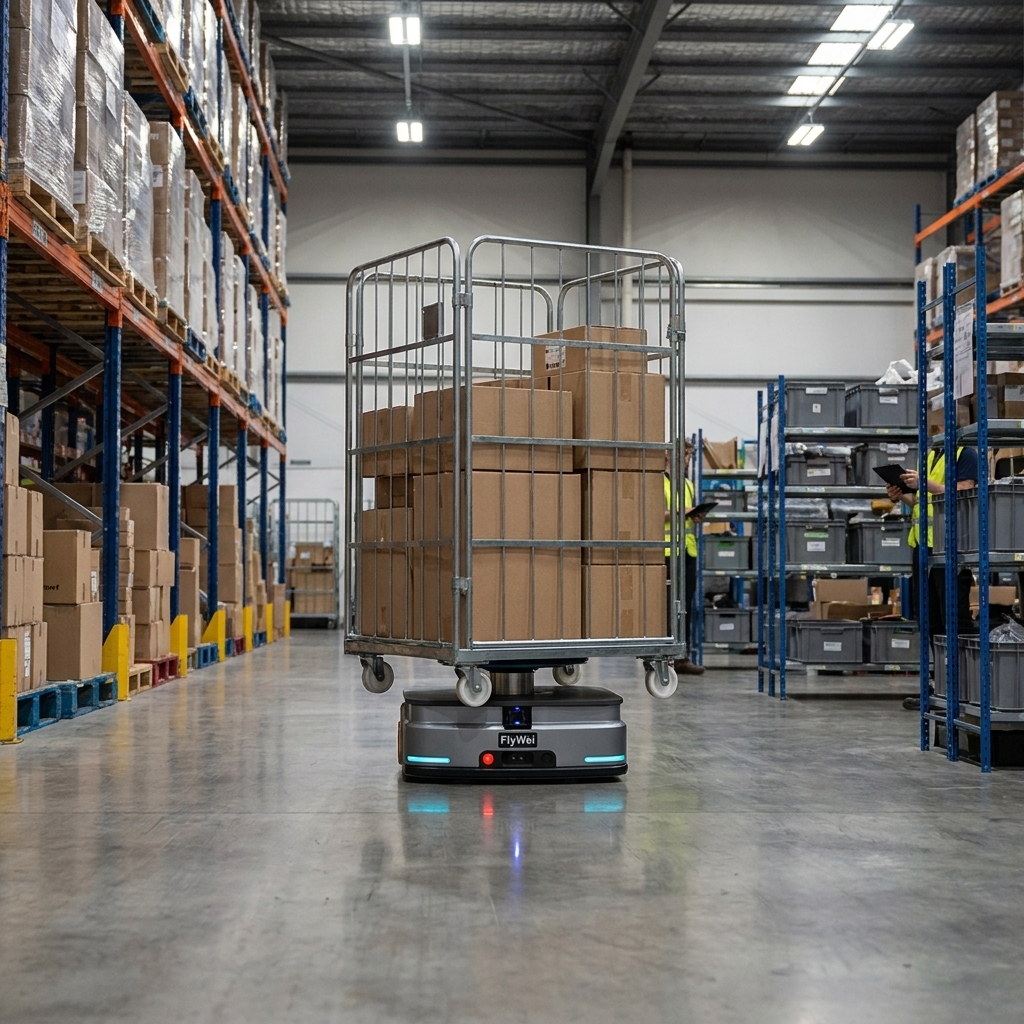
Illustrative scenario. This shows how autonomous forklift and AMR automation typically works for a UK reverse logistics and returns operation. It is a representative engineering example, not a named client reference: the operator is generic, and every figure is an indicative capability range, not a measured project result.
Returns are the awkward half of the supply chain. Outbound flows are planned, palletised and predictable; inbound returns arrive as whatever the customer sent back — a boxed kettle, a pallet of unsold seasonal stock, a roll cage of mixed apparel from a store sweep. The work is labour-hungry and stubbornly manual, and the returns hall tends to be the last part of a UK warehouse to see any automation. That is exactly why it repays a look: it is where the most walking, the most double-handling and the most idle stock sit.
Operation profile
An illustrative UK reverse logistics operator — a returns and refurbishment centre handling online and store returns for retail clients. Sector-typical, not drawn from any single site.
- Sector: reverse logistics and returns processing (third-party operated)
- Scale band: a single site in the region of 8,000–20,000 m², with a dedicated grading and refurbishment hall
- Shift pattern: typically two shifts across five to six days, with heavy peaks after Christmas and major promotions
- Throughput band: tens of thousands of returned units per week at steady state, commonly doubling in a post-peak surge
- Load types: mixed — parcels, totes, roll cages, part-pallets and consolidated pallets
At-a-glance application snapshot
Indicative capability ranges for the machine classes that suit this work — engineering envelopes across the manufacturers FlyWei integrates, not a quotation for a specific site.
- Autonomous pallet trucks: payloads typically 1.0–3.0 tonnes, for trunking consolidated pallets between goods-in, grading and putaway
- Autonomous stackers and reach trucks: lift heights typically from around 3 m to roughly 10 m by class, for putaway of graded stock into racking
- Latent jacking and lifting AMRs: payloads typically 150–1,000 kg, for roll cages, tote stacks and mobile grading trolleys
- Travel speed: generally in the region of 1–2 m/s laden, tuned down in pedestrian zones
- Runtime: typically a full shift per charge with opportunity charging at idle points, allowing near-continuous running
- Aisle requirements: narrow-aisle classes typically work in aisles from around 1.6–2.0 m; counterbalance work generally wants 2.7–3.5 m
- Navigation and safety: natural-feature SLAM in most cases — no buried wire, magnets or reflector grid — with functional-safety controllers and certified laser scanners for shared-space working
The challenge
Reverse logistics fails differently from outbound. The pain is rarely raw lifting capacity — it is variability, in a hall that stays busy with people, so anything automated has to work alongside pedestrians and manual trucks rather than behind a fence.
Every load is a different shape
A returns hall cannot assume a standard pallet. Within an hour one operator may move a shrink-wrapped mixed pallet, a half-empty roll cage and a tower of totes — swapping handling equipment each time, and spending a surprising share of the shift finding the right truck rather than processing returns.
Demand is spiky by design
Returns volume is a lagging shadow of retail peaks. January and the weeks after a promotion bring a step change in inbound units, which traditionally means agency labour hired exactly when the labour market is tightest — and returns roles are among the hardest to fill and retain.
Skilled people spend their day walking
Grading is a judgement task: resaleable, refurbish or scrap? That judgement is valuable. Fetching and carrying between bench and putaway aisle is not, yet it consumes a large slice of the day — and a returned unit earns nothing until it is graded and back on sale.
The solution
FlyWei is an independent, vendor-neutral integrator, so the design question is never “which of our machines can we sell into this?” It is “which class of robot, from whichever manufacturer builds it best, fits this flow?” A returns operation almost always needs more than one class — which is where a multi-manufacturer approach earns its keep.
Split the flow before choosing the robot
Returns work decomposes into three movements, each suiting a different machine:
- The trunk move — bulk pallets from goods-in to the grading hall, and consolidated pallets out to putaway or disposal. Classic autonomous forklift territory: an autonomous pallet truck or autonomous pallet stacker running a repeatable long lane, often the easiest win on site.
- The bench loop — roll cages, tote stacks and trolleys shuttling between grading benches, refurbishment cells and buffer. Latent jacking lifting robots suit this well: they slide under a wheeled cage, lift, move and drop, keeping the warehouse existing furniture in play rather than demanding new load carriers.
- The putaway — graded stock returned to racking, where lift height decides the class. Stackers cover mid-height racking; reach-truck automation handles taller pick faces.
Brownfield first
Most returns halls were never designed for robots, so the practical approach is to automate the existing building rather than rebuild it. SLAM navigation avoids cutting the floor, and truck automation can often be applied to a familiar chassis, keeping the service and parts ecosystem the site already knows. Vendor-neutrality matters here: the right answer for a 4 m grading buffer and for a 9 m bulk aisle rarely come from the same catalogue.
Integration is the real project
The robots are the visible part; the integration is the work. A returns deployment typically ties into the WMS or returns-management system so a grading decision becomes a move request automatically, into ERP for stock status, and into doors, lifts and conveyor handshakes via PLC. Sequencing matters more than speed — a robot arriving at the right bench at the right moment beats a faster one arriving at the wrong bench.
How a deployment runs
Our engineers usually start a returns project with a site survey rather than a specification, because the constraint is almost always the building and the flow, not the robot.
- Site survey — floor condition, aisle widths, door and level-change constraints, pedestrian routes, congestion points and the real shape of the peak. Free of charge, and it often reveals that one lane carries most of the value.
- Simulation and flow modelling — model the moves before buying anything, to size the fleet honestly and test peak absorption.
- Phased rollout — commission one flow first, usually the trunk move: most repetitive, easiest to prove, least disruptive to tune.
- Live operations — run alongside manual trucks and people, tune traffic rules and charging windows, and train the team who will own the fleet.
- Scale — extend to the bench loop and putaway once the first flow is stable, adding units to the same traffic management rather than starting again.
Typical results
Deliberately qualitative. Anyone quoting an exact figure for a site they have not surveyed is guessing.
- Travel and fetch-and-carry time generally falls, because the robot does the walking between bench and aisle.
- Graded stock typically returns to saleable status sooner, since cages move on completion rather than when someone is free.
- Operators are usually redeployed onto grading, refurbishment and quality judgement — the tasks that need a person.
- Night-shift running becomes feasible for the trunk move without a full second crew, and peak absorption improves: the fleet runs the same way in January as in June, reducing dependence on hard-to-source seasonal labour.
- Handling damage and near-misses tend to reduce on automated lanes.
What to consider for your site
- Which single flow is the most repetitive? That is your phase one, not the most visible one.
- Are your load carriers standardised enough to be lifted, or does the cage fleet need tidying first?
- What is the true peak-to-trough ratio, and are you sizing for peak or for average?
- How narrow is the narrowest aisle, and is the floor flat enough throughout?
- Can your WMS or returns system emit a move request, or does that interface need building?
- Does leasing or purchase suit your capital position better? Cost is driven mainly by fleet size, integration depth and site readiness, and lease structures can align payment with the seasonality of returns work.
Every returns operation is different, and the honest answer to “will this work here?” comes from walking the floor, not from a brochure. FlyWei is an independent UK integrator, tied to no single manufacturer: you get the machine class that fits your flow — or the advice that automation is not yet the right call. See our solutions, or book a free site survey.