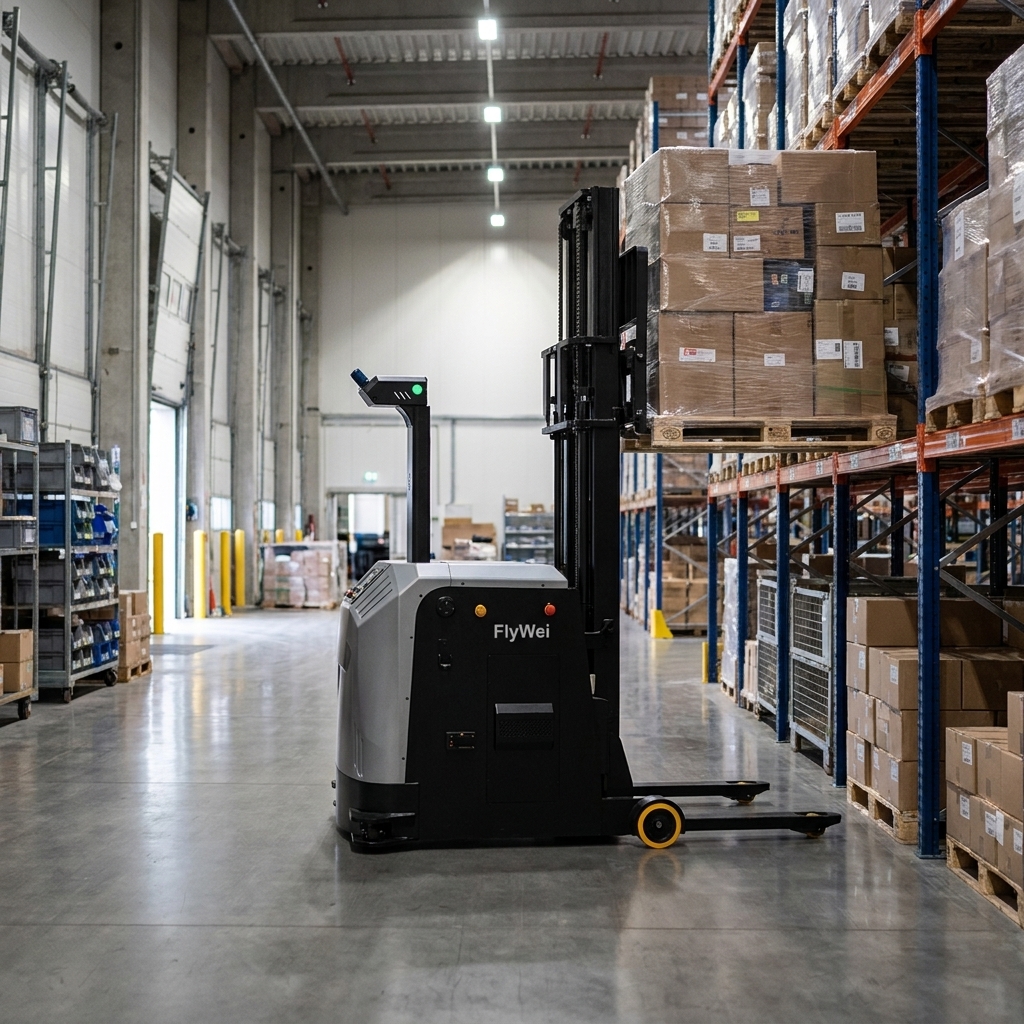
Illustrative scenario. This shows how autonomous forklift and AMR automation typically works for a UK port, freight and cross-dock operation. It is a representative engineering example, not a named client reference: the operator is generic, and every figure is an indicative capability range rather than a measured project result.
A cross-dock is the one building judged on how little it holds. Freight comes off a container or trunk trailer and should be back on an outbound vehicle within hours, sorted by lane, region or consignee. Around UK ports and inland freight hubs, that promise meets a hard fact: the site does not choose its arrival pattern. A vessel discharge, a ferry sailing or a rail service drops a wave of work into a compressed window, and every pallet in it wants the same three things at once — a truck, a driver and a clear stretch of floor. The queue that forms is not a picking problem. It is a horizontal transport problem.
Operation profile
An illustrative UK port-adjacent freight and cross-dock operator — devanning containers, rebuilding freight for onward delivery and marshalling trailers across a busy dock face. Sector-typical, not drawn from any single site.
- Sector: port, freight forwarding and cross-dock handling — container destuffing, deconsolidation and trailer marshalling
- Scale band: a transit shed or cross-dock in the region of 5,000–25,000 m², typically with far more dock doors than racking
- Shift pattern: commonly two or three shifts across five to seven days, driven by vessel, ferry and rail arrival windows rather than an even daily curve
- Throughput band: several hundred to a few thousand pallets, cages and loose units a day, with peaks at a multiple of the quiet-hour rate
- Load types: genuinely mixed — export pallets of variable quality, slip-sheeted and floor-loaded cartons, big bags, crates, cages and drums
At-a-glance application snapshot
Indicative capability ranges across the manufacturers FlyWei integrates — typical engineering envelopes, not a quotation for any specific site.
- Autonomous counterbalance forklifts: payloads typically 2–3 tonnes, for container-mouth, trailer-side and yard-edge pallet work
- Autonomous pallet trucks: payloads typically 1.0–3.0 tonnes, for the long horizontal runs between dock doors, marshalling lanes and staging
- Autonomous stackers and reach trucks: lift heights typically from around 3 m to roughly 10 m by class, for the buffer racking that holds short-shipped or detained freight
- Latent jacking and lifting AMRs: payloads typically 150–1,000 kg, for cages, roll containers and totes in deconsolidation lanes
- Travel speed: typically in the region of 1.0–2.0 m/s in open transit areas, automatically reduced near dock faces, junctions and pedestrian crossings
- Aisle and lane width: narrow-aisle classes typically operate from around 1.6–2.0 m, with wider envelopes on the dock apron where manned traffic mixes in
- Runtime and charging: generally multi-hour runtime with opportunity charging between waves, enabling near-continuous running
- Navigation: laser and natural-feature SLAM, typically without floor magnets or wire, so a live transit shed does not have to be dug up to be automated
The challenge
These sites share the same recurring pains, and a peak compounds them.
- Arrivals are lumpy, labour is not. Staffing for the peak wastes money in the quiet hours; staffing for the average means freight sits. Agency cover, counterbalance licences and night-shift premiums all sharpen it.
- The work is mostly travel. On a large dock face, much of the truck time is simply distance between a container mouth and an outbound lane — repetitive, but on the critical path.
- The dock apron is the highest-risk floor in the building. Reversing vehicles, pedestrians, dock levellers, trailer creep and mixed manned traffic, all in one congested band.
- Loads are not uniform. Freight arrives as it was built abroad: broken pallets, unwrapped stacks, floor-loaded cartons and awkward one-offs that need a person.
- Freight is time-sensitive and transient. Free time, detention and slot bookings turn an hour of congestion into a billable consequence, and the record of a consignment often lives in a transport system rather than a stock file.
The solution
The design principle here is simple: automate the repeatable trunk moves, and leave human judgement where the freight is irregular. People stay at the container mouth breaking down non-standard loads; the long, predictable runs to staging and outbound lanes go to autonomous vehicles that will do them at 03:00 as reliably as at 13:00.
Because FlyWei is an independent, vendor-neutral integrator rather than a manufacturer, the vehicle is chosen per move class rather than pushed from a single catalogue:
Match the vehicle to the move
- Container mouth to staging: autonomous counterbalance or pallet trucks, sized for the heaviest realistic export pallet, not the average one
- Staging to outbound lane: autonomous pallet trucks on the long, flat legs where travel time dominates — the highest-value automation in most cross-docks
- Buffer putaway and retrieval: autonomous stackers or reach truck classes, including retrofits of trucks already on site
- Cages, totes and roll containers: lifting and latent jacking AMRs where the unit of work is smaller than a pallet
Integration is what makes it a system rather than a set of robots. A fleet management layer sits between the site's warehouse, transport or ERP system and the vehicles, taking work over a documented interface and returning completions and load confirmations, so the existing system stays the record of truth. Dock door status, traffic lights, barriers and levellers are typically interlocked through PLC signals, so a vehicle cannot present at a door that is not safe. Where a fleet spans manufacturers, the open VDA 5050 standard lets one fleet manager command vehicles from different suppliers without a bespoke interface for each — which is how a site avoids being locked into whichever brand it bought first. On the apron itself, on-vehicle safety controllers and scanners do the work.
How a deployment runs
- Free site survey. Engineers measure apron and aisle widths, floor condition, door heights and gradients — and observe a real arrival wave, not an average day.
- Move-class analysis and simulation. The site's own movement data settles which legs are automatable and how many vehicles a peak actually needs, before anything is ordered.
- Phased rollout. Typically one or two vehicles on a single well-understood move class, running alongside manned trucks, with the system interface proven on live data.
- Live operations. Traffic rules, charging and exception handling are tuned in production — what happens when a door is blocked, a pallet is out of tolerance, or the link drops.
- Scale. Further move classes and vehicles are added against measured demand, with mixed manufacturers under one fleet manager where that is the better answer.
Typical results
Honest expectations for a cross-dock of this shape, as tendencies not invented figures:
- Travel time on the automated legs generally falls, and peak waves flatten: the same volume is absorbed over a longer running window rather than by adding people for two hours.
- Night and shoulder-hour running becomes feasible, which is often where the real capacity gain sits in a port-adjacent operation.
- Operators are typically redeployed to judgement work — devanning irregular loads, checking condition, resolving discrepancies — rather than driving the same leg all day.
- Interactions between manned trucks and pedestrians tend to reduce as repetitive legs move onto governed routes with enforced speed zones.
- Confirmations arriving as each move completes generally improve the accuracy of where a consignment is, which protects against detention and mis-loads.
What to consider for your site
- Which legs are genuinely repetitive, and what share of your truck hours do they consume?
- Could a longer running window absorb your arrival peak instead of more people?
- Can your warehouse or transport system expose open work and accept completions over an interface, or would a scheduled export be the start?
- What proportion of inbound loads are non-standard, and are they concentrated at one point in the flow?
- Floor condition, gradients and apron congestion — the factors that most often reshape a design.
- Is your equipment strategy capable of mixing manufacturers later, or does the first purchase decide the next decade?
- How would capacity be funded — outright, or through leasing and long-term rental matched to seasonal freight volume?
If that sounds like your dock face, the sensible next step is a survey rather than a quotation. FlyWei is an independent UK integrator: we specify across multiple robot manufacturers and recommend the class that fits your moves, including retrofitting equipment you already own. Explore our autonomous forklifts, our lifting robots and the wider solutions we deliver — then book a free site survey with engineers who are not selling you a single brand.