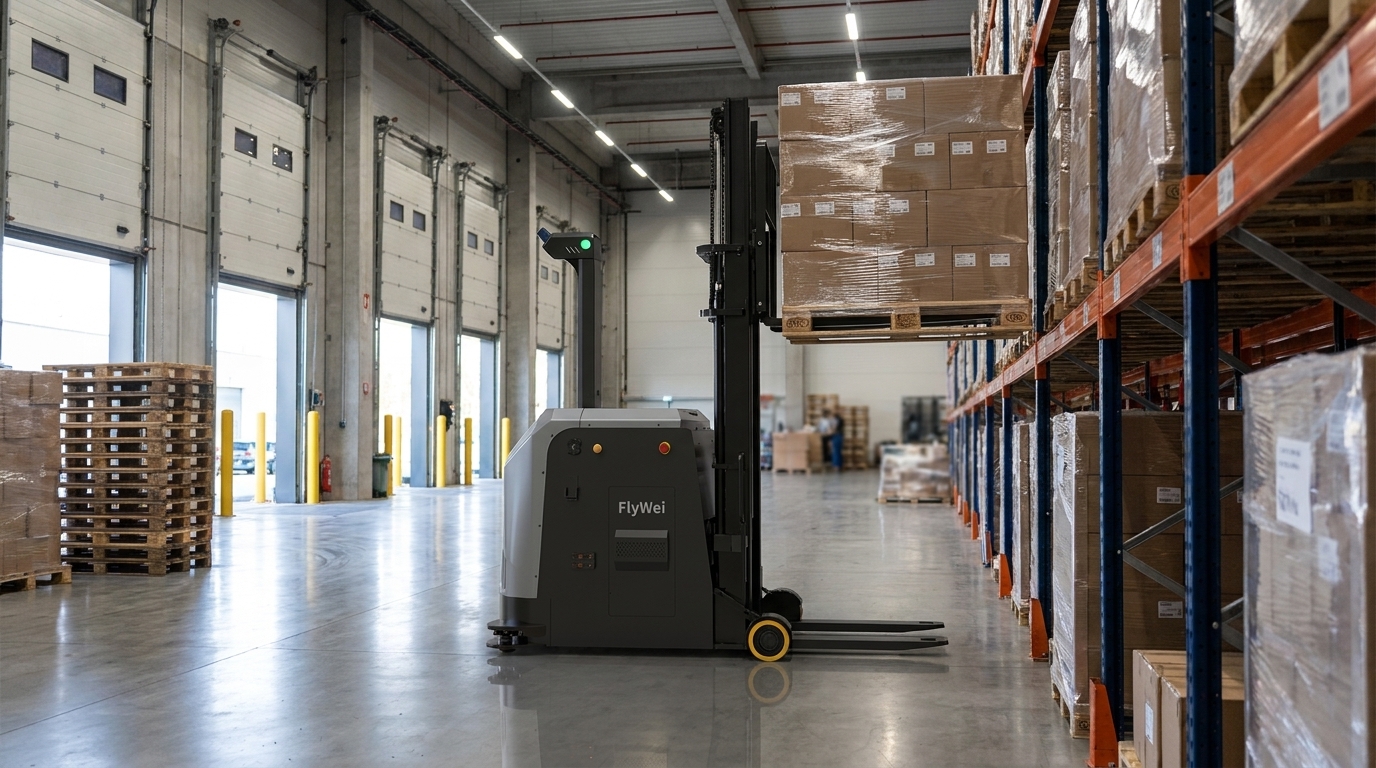
Illustrative case study — this is a representative sector scenario, not a real named client. FlyWei does not publish confidential customer names or invented project figures. Every capability range below reflects typical FlyWei-integrated performance across multiple robot manufacturers.
Fast-moving consumer goods distribution runs on a promise that is simple to state and punishing to keep: whatever the shelf pulls today, the depot replaces tomorrow. Ambient groceries, household lines, personal care, confectionery and pet food churn through a UK distribution centre faster than almost any category, against a demand curve that lurches with every promotion, bank holiday and warm weekend. This illustrative case study walks through how a vendor-neutral autonomous forklift and AMR deployment typically works for a UK FMCG distribution operation — from inbound trailer to marshalling lane — and what an FMCG robot programme realistically changes.
Operation profile
- Sector: FMCG distribution — ambient grocery, household, personal care, confectionery and pet-care lines moving from supplier intake to retail and wholesale despatch.
- Persona: A UK regional FMCG distributor serving supermarket, convenience and wholesale accounts (illustrative — not a specific customer).
- Scale band: One or two UK depots, each roughly 20,000–60,000 m², predominantly ambient with a small chilled annexe.
- Range band: Several thousand active SKUs, with a long tail rotated several times a year.
- Shift pattern: Two picking shifts plus a twilight despatch window; the ambition is unattended running of repetitive internal moves overnight.
- Throughput band: High hundreds to low thousands of pallet movements per day, rising sharply in promotional weeks.
At-a-glance application snapshot
Indicative capability ranges for the classes typically specified on a project of this shape — equipment capabilities, not results claimed for any site.
- Autonomous pallet trucks: typically 1–3 tonne payloads for intake, internal trunking and despatch staging.
- Autonomous stackers: commonly in the region of 4–6 m lift for lower-level pick-face replenishment.
- Autonomous reach trucks: typically up to around 10 m for high-bay bulk storage.
- Autonomous counterbalance forklifts: up to approximately 3 tonne for yard-side and heavy mixed-load work.
- Latent and jacking AMRs: typically 150–1,000 kg for roll cages, dollies and tote movement to pack benches.
- Travel speed: generally in the region of 1.0–2.0 m/s laden, tuned down in pedestrian-shared zones.
- Docking repeatability: typically in the region of ±10 mm at racking and conveyor interfaces.
- Runtime: 48 V lithium-iron-phosphate packs with opportunity charging at docked stations, supporting effectively continuous running.
- Safety: certified safety laser scanners and functional-safety rated controllers, specified to the site risk assessment.
The challenge
Volume that refuses to sit still
FMCG demand is not a flat line with a Christmas bump. A three-for-two on a household brand, a heatwave or a televised sporting weekend can lift the movement profile of a handful of SKUs dramatically for a fortnight, then drop it again. Depots therefore staff and equip for a peak that only exists some of the time — expensive when it is quiet, and inadequate when the promotion lands.
An operator pool that is hard to hold
Counterbalance and reach-truck tickets are portable, and FMCG depots compete for the same drivers as parcel, grocery and third-party logistics sites nearby. The roles that leak hardest are also the least rewarding: long, repetitive shuttles between goods-in, bulk store and the marshalling lanes.
Mixed pallet formats
FMCG is unusually varied at the unit-load level. A single inbound trailer can carry standard full pallets, half pallets, quarter-pallet promotional display units, shrink-wrapped layer pallets and returnable plastic crates on dollies. Any automation that handles only one of those formats solves a fraction of the problem.
Buildings designed for a different decade
Many UK FMCG depots are conversions with inherited column spacing, mixed aisle widths, ramps and shared pedestrian routes. Retrofitting automation into that is a very different exercise from designing a greenfield site around it — and liquids, glass and aerosols are unforgiving of a clipped pallet.
The solution: a vendor-neutral system design
Match the truck class to the move, not the badge to the site
FlyWei is an independent UK systems integrator, not a manufacturer or a reseller for one — which matters in a sector where no single machine class covers the workload. A typical FMCG design mixes them deliberately: autonomous forklifts and pallet trucks in the 1–3 tonne band for high-repetition trunking between goods-in, bulk and despatch; autonomous stackers for pick-face replenishment; reach trucks for the high-bay; and lifting robots and latent AMRs for roll cages, dollies and tote flow into pack and value-added-services areas. Because we specify across manufacturers, each move gets the machine that suits it — including the awkward half-pallet and display-unit handling that often decides a business case.
One orchestration layer over a mixed fleet
A mixed fleet is only an advantage if it behaves as one system. The fleet manager and robot controllers arbitrate traffic, charging and task priority across every machine on site regardless of who built it, so a promotional surge can be absorbed by re-weighting tasks rather than by re-planning the depot. Vendor-neutral orchestration is where the industry is heading; it is how we have designed from the start.
Integration with the systems you already run
Nothing here replaces the WMS. Tasks are typically taken from the existing WMS or ERP over a standard interface, with PLC handshakes at conveyors, pallet wrappers and dock doors, and interlocks to fire and access systems. The aim is that a shift supervisor sees the same task list they saw before, with some lines now executed by a driverless forklift.
How a deployment runs
- Free site survey. Our engineers usually start an FMCG project on the floor: aisle widths, floor flatness, ramp gradients, dock geometry, pedestrian routes, racking condition and the real movement profile — including a promotional week, not just a quiet one.
- Simulation and fleet sizing. The observed move profile is modelled to size the fleet against peak, so the answer is engineered rather than estimated. Sometimes the recommendation is to change a layout before buying a robot.
- Phased rollout. Almost always one route first, typically the longest and dullest shuttle. It proves navigation, safety zoning and the WMS interface on a contained scope.
- Live operations and handover. Operator and supervisor training, escalation routines, and support arrangements agreed before the fleet carries production volume.
- Scale. Additional routes, additional truck classes and, where relevant, additional depots — reusing the integration work rather than starting again.
Typical results
Deliberately expressed as tendencies and ranges. Any integrator quoting a precise percentage before surveying your site is quoting someone else's site.
- Repetitive long-haul internal moves generally shift to unattended running first, so travel time falls where it was least productive.
- Operators are typically redeployed to higher-value work — pick quality, replenishment decisions, value-added services and exception handling — rather than displaced.
- Overnight and twilight running becomes feasible for internal transport without a full staffed shift, which usually smooths the morning despatch peak.
- Movement becomes more predictable, which matters more than raw speed in a sector where the marshalling lane has a trailer booked against it.
- Promotional peaks are absorbed by re-tasking an existing fleet rather than by recruiting temporary drivers at short notice.
What to consider for your site
- Which single route is your longest, most repetitive and least popular? That is usually the honest phase-one candidate.
- What proportion of your unit loads are non-standard — half pallets, display units, dollies, crates?
- Can your WMS or ERP issue and receive task-level messages today, or is that a project in itself?
- How far apart are your quiet week and your promotional peak? The gap between them is where the case is usually made.
- Do you want to own the fleet, or would leasing suit how your depot budgets capital?
Talk to an independent integrator
Because FlyWei is vendor-neutral, the first conversation is about your movement profile rather than a catalogue. If an autonomous forklift is not the right answer for a route, we would rather say so at survey stage than after commissioning. Book a free site survey and we will walk your depot, model the moves and tell you which routes automate well and what a sensible first phase looks like. Explore our solutions, autonomous forklifts and lifting robots to see the classes of machine we integrate.