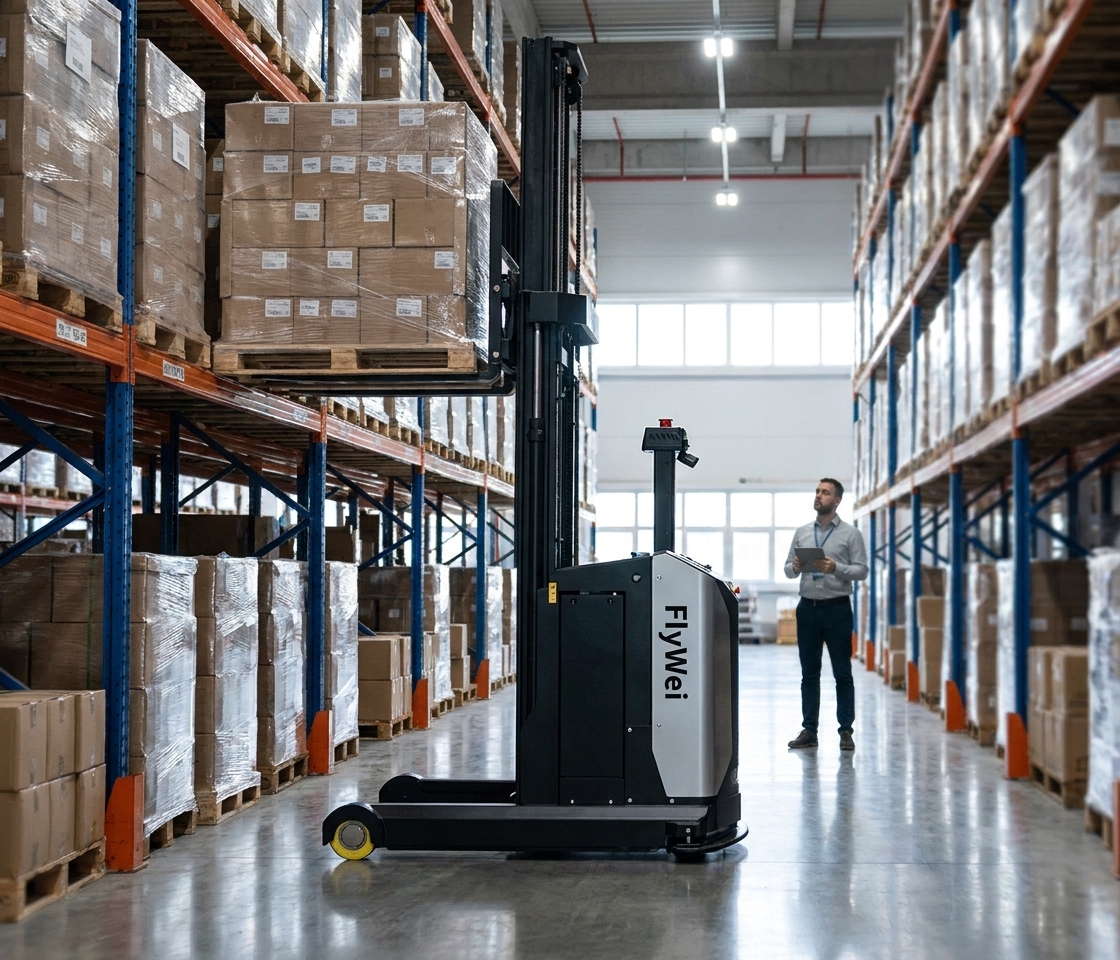
Illustrative scenario. This shows how autonomous forklift and AMR automation typically works for a UK modular and offsite construction operation. It is a representative engineering example, not a named client reference: the operator is generic, and every figure is an indicative capability range, not a measured project result.
Offsite construction promised the discipline of a factory: a covered hall, repeatable stations, a volumetric room module moving forward on a takt clock. What many UK modular and panelised plants inherited instead was a factory floor with a building site's materials habits. Timber packs, plasterboard, insulation, light-gauge steel, windows and finishes arrive by curtainsider, then get fought forward to the line by counterbalance truck, all shift, by the same skilled people meant to be building. When a modular line stops, it is rarely because nobody could fix the panel. It is because the panel was not there yet.
Operation profile
An illustrative UK modular construction manufacturer — an offsite plant building volumetric modules and panelised frames for housing and student or healthcare accommodation. Sector-typical, not drawn from any single site.
- Sector: modular and offsite construction manufacture, with a materials yard and covered laydown
- Scale band: a production hall in the region of 10,000–30,000 m², plus external yard and trailer parking
- Shift pattern: typically one or two production shifts across five days, often with a materials shift ahead of the line
- Throughput band: a takt-based line turning out a handful to a few dozen modules or panel sets per shift, behind several hundred pallet, pack and stillage movements
- Load types: mixed and awkward — banded timber and board packs, insulation bales, plasterboard, steel sections, window and door sets, part-pallets of fixings and finishes
At-a-glance application snapshot
Indicative capability ranges across the manufacturers FlyWei integrates — engineering envelopes, not a quotation for any specific site.
- Autonomous counterbalance forklifts: payloads typically 2–3 tonnes, for heavy packs, steel and yard-to-hall trunking
- Autonomous pallet trucks: payloads typically 1.0–3.0 tonnes, for repetitive runs between goods-in, the consumables store and line-side buffers
- Autonomous stackers and reach trucks: lift heights typically from around 3 m to roughly 10 m by class, for putaway and retrieval of boarded stock
- Latent jacking and lifting AMRs: payloads typically 150–1,000 kg, for kit trolleys, stillages and cassette carts moving station to station
- Travel speed: generally in the region of 1–2 m/s laden, tuned down in pedestrian zones
- Runtime: typically a full shift per charge, with opportunity charging at idle points
- Aisle requirements: narrow-aisle classes typically work from around 1.6–2.0 m; counterbalance work generally wants 2.7–3.5 m
- Navigation: natural-feature and laser SLAM, so a working hall needs no re-flooring or guidance wire
The challenge
The line is fed by the people meant to be building it
In most offsite plants, materials movement is nobody's job and therefore everybody's. Fitters and line leads step away to fetch a pack, and the takt clock absorbs it. That time never shows as downtime — it shows as a slightly slower module, every module.
Long, heavy and awkward is the norm
Very little here is a neat 1200 × 1000 pallet. Packs overhang, steel is dense and short, insulation light and enormous, window sets fragile. Load stability and load-specific handling matter more than raw speed.
The yard and the hall are one traffic system
Deliveries land in an open yard in British weather, are staged outdoors or under a canopy, then cross into a hall busy with pedestrians, gantries and part-built modules. Mixed traffic across that threshold is where near misses concentrate — and the move operators most want a person out of.
The programme changes, so the layout changes
A modular plant reconfigures: a new housing type, a different pod, a client spec, and stations shift. Automation that must be re-commissioned every time the hall is re-laid gets quietly abandoned within a year.
The solution
The vendor-neutral point decides the design. FlyWei is an independent UK systems integrator, not a manufacturer, so the honest answer to ‘which robot?’ for a modular plant is normally ‘more than one, from more than one maker’. A single-supplier catalogue forces one machine family onto four different movements; an integrator picks the right class for each and makes them run as one fleet.
A typical design splits four ways. Yard-to-hall trunking of heavy packs suits an autonomous counterbalance forklift — a driverless forklift with the mass and fork geometry for banded timber and steel, and outdoor-tolerant sensing for the canopy run. Goods-in to the consumables store is repetitive horizontal work, where an automated forklift AGV or autonomous pallet truck earns its keep. Putaway into racking is stacker and reach-truck territory; where the store is tight, a very narrow aisle class recovers floor area rather than demanding more. Line-side kit — trolleys, stillages and cassette carts — is usually better served by lifting robots and latent jacking AMRs than by anything with forks.
Making a mixed fleet coherent is a software and controls question. A fleet management layer sits above the plant's existing systems: it takes work from the ERP, WMS or scheduler over a documented interface, turns it into missions, traffic rules and vehicle assignments, then writes completions back so that system remains the record of stock. Vehicles from different manufacturers can be commanded through the VDA 5050 open standard rather than a bespoke integration per supplier. On the floor, the most valuable connection is often the simplest: a call button or andon signal wired through the line PLC, so a station requests its next pack the way it would call a materials handler. Safety and navigation controllers handle the machine level — scanner zoning, speed reduction near pedestrians, and the interlocks that let a robot share a threshold with people.
How a deployment runs
Our engineers usually start a modular project with a site survey, not a specification. In a plant this fluid, the movement map matters more than the machine list.
- Site survey: walk the yard, threshold and line; log every recurring move, its load type, distance and who does it today; measure aisles, door heights, floor condition and gradients.
- Simulation: model candidate flows against takt time and delivery pattern, including the awkward hours — two curtainsiders at once, a station calling early. Fleet size and buffer positions get settled here, before anything is bought.
- Phased rollout: one flow first, usually the yard-to-hall trunk or the consumables putaway loop. One flow running properly converts a plant faster than a hall-wide switchover.
- Live operations: run alongside manual trucks during handover, with operators trained to call, override and recover the fleet, not just watch it.
- Scale: add line-side AMR loops once the first flow is stable, and re-map after a reconfiguration — with SLAM that is a mapping exercise, not a re-installation.
Typical results
Honest expectations, stated as directions rather than invented figures.
- Travel and fetch time generally falls, showing up as a steadier takt rather than a headline number: the line waits for materials less often.
- Skilled fitters and joiners are typically redeployed onto build work instead of materials chasing — usually the strongest argument in a sector short of trades.
- A materials shift ahead of the line becomes feasible, because a full shift per charge with opportunity charging allows near-continuous running.
- Pedestrian and vehicle interactions at the threshold typically reduce, since the repetitive crossings are automated first.
- Damage to packs, window sets and part-built modules generally trends down, as repeatable approach paths replace variable handling.
What to consider for your site
- Which moves are genuinely repeatable, and which only look repeatable because one experienced person does them the same way?
- What is the real floor condition across yard, threshold and hall — gradients, joints, standing water, ramps?
- Can your ERP, WMS or scheduler expose open work and accept confirmations, or is a file-based exchange the starting point?
- How often does the hall get re-laid, and who owns re-mapping afterwards?
- Which loads are truly non-standard, and do any need bespoke forks, clamps or a load-specific carrier?
- Is leasing or buying the better fit for a plant whose volumes may change with the order book?
If this sounds like your plant, the next step is a survey, not a quotation. FlyWei is an independent, vendor-neutral integrator: we specify across manufacturers, and if a flow is better fixed with racking, a buffer or a schedule change than a robot, that is what the survey will say. Talk to us about your operation or book a free site survey — we map the moves before anyone talks about machines.