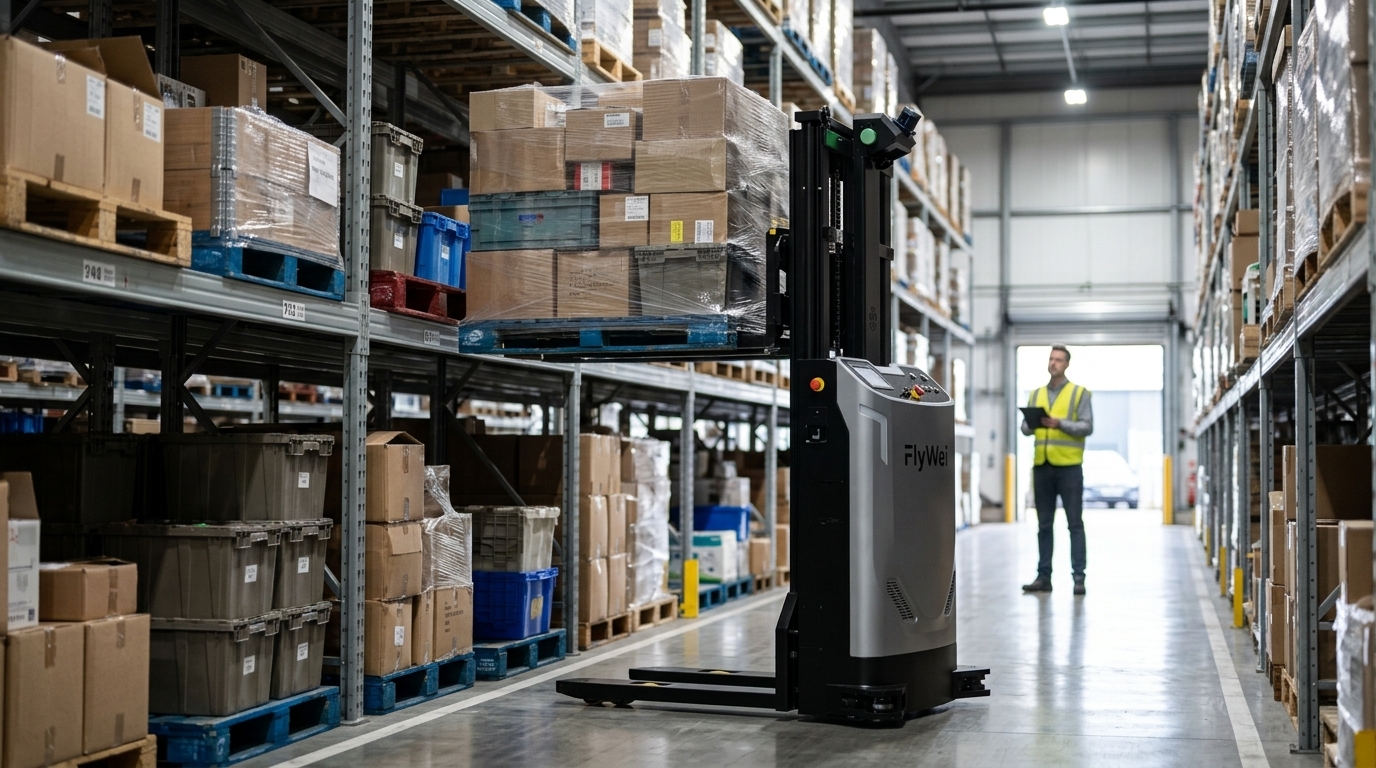
A UK industrial supply and MRO (maintenance, repair and operations) distributor typically stores tens of thousands of active SKUs, from bearings and fasteners through cutting tools, adhesives, PPE and lubricants. The intralogistics job is not big-box pallet movement — it is high-mix, small-quantity replenishment, cross-dock and next-day dispatch, all under a service-level clock. This illustrative case study looks at how a vendor-neutral autonomous forklift and AMR (autonomous mobile robot) system typically supports that kind of operation, and how an independent UK integrator like FlyWei approaches the design.
Illustrative scenario. This case study describes a representative UK industrial supply and MRO distribution operation to show how autonomous forklift and AMR automation typically works in this sector. It is not a named client reference; any capability figures are stated as engineering ranges, not project-specific results.
Operation profile (illustrative)
- Operator type: A UK-based industrial supply and MRO distributor supplying manufacturers, contractors, facilities teams and utilities.
- Scale band: A regional distribution centre in the region of 12,000–25,000 m2, holding tens of thousands of active SKUs across bin shelving and pallet racking.
- Shift pattern: Typically a day inbound and put-away shift and a late pick-pack-dispatch shift, with an optional overnight replenishment window.
- Throughput band: Order volume in the region of a few thousand to low tens of thousands of order lines per day, weighted heavily toward small, mixed cases and single-unit picks.
At-a-glance application snapshot (typical, indicative capability ranges)
- Autonomous pallet trucks (typically 1.4–3.0 tonne payload): Move pallets from goods-in to reserve racking and pull replenishment down to the pick face.
- Autonomous counterbalance forklifts and autonomous reach trucks: Handle stacking and retrieval up to typical UK warehouse racking heights, in the region of 6–10 m depending on truck class.
- Autonomous pallet stackers and very narrow aisle (VNA) variants: Fit space-constrained MRO layouts with indicative aisle widths from around 1.6–1.8 m.
- Latent-jacking AMRs and goods-to-person robots (typically 150–1,000 kg payload): Move totes, roll-cages and mobile shelving units for high-mix pick zones.
- Runtime: Typical LiFePO4 shift-length runtimes with automatic opportunity charging at docking stations, enabling extended or lights-out operation.
The challenge
Industrial supply and MRO distributors face an unusual mix of intralogistics pressures. The SKU count is very high, order lines are small and often single-quantity, and cut-off times are unforgiving because customers depend on next-day delivery to keep production and maintenance schedules running. That leaves directors of operations with a recurring set of pains:
- Travel time dominates pick cost. Where slow-moving long-tail SKUs share a building with fast-movers, pickers can walk many kilometres per shift on a typical pick tour.
- Peak amplification is severe. Month-end, contract callouts, seasonal maintenance and framework re-orders create sudden spikes that a fixed manual headcount cannot flex to.
- Reserve-to-pick-face replenishment is chronic. Because pick-face bins are small, they need refilling multiple times per day to keep pickers productive.
- Safety exposure is real. Mixed traffic — pedestrians, manual powered pallet trucks, counterbalance forklifts and racking — is a live risk on every shift.
- Skilled labour is scarce. Recruiting and retaining licensed forklift operators is now a strategic risk in most UK regions, and shift patterns worsen churn.
The solution — a vendor-neutral, multi-manufacturer system
FlyWei is a vendor-neutral UK systems integrator, which means our engineers begin by matching robot class to job — not by defending a single manufacturer's catalogue. For a UK industrial supply and MRO operation, a typical design layers three robot classes plus a neutral orchestration layer.
1. Autonomous forklifts for reserve and replenishment
Driverless counterbalance forklifts, autonomous reach trucks and autonomous pallet stackers handle the heavy lift: goods-in put-away to reserve racking, replenishment drops to pick-face floor locations, and inter-zone pallet moves. Choosing between counterbalance, reach and VNA classes is driven by racking height, aisle width, floor flatness and payload profile — not by brand loyalty. Because FlyWei is independent, we can specify an autonomous forklift from whichever manufacturer best fits the physics of the building.
2. AMRs and lifting robots for the pick face
Latent-jacking and goods-to-person AMRs move totes, roll-cages and mobile shelving racks from bin storage to picking workstations. That converts walk-to-goods into goods-to-person, and for a high-SKU MRO operation, that is typically where travel-time savings are largest. For heavier sub-assemblies or kit trolleys, higher-payload lifting robots handle the same task with heavier under-carriage.
3. A neutral fleet controller and safety layer
Because vendor-neutral integration means multiple robot brands may coexist on one floor, the fleet manager, traffic control and safety layer are chosen for interoperability. That includes support for open protocols such as VDA 5050 where the customer wants brand-agnostic future expansion, plus rated safety controllers on every autonomous forklift asset.
WMS and ERP integration
Integration into the operator's existing WMS or ERP — via standard APIs, database middleware or message-bus adapters — is usually the make-or-break item, not the robots themselves. A phased integration typically starts with put-away and replenishment tasks before adding pick-workflow triggers, and evolves toward full task orchestration as confidence grows.
How a deployment typically runs
- Free site survey. Our engineers walk the DC, measure aisle widths, sample throughput, capture racking geometry and profile SKUs by velocity.
- Simulation and business case. We simulate fleet sizing and shift utilisation before quoting anything, so the design is sized to the operator's real work, not an assumed vehicle count.
- Phased rollout. Typically one zone or one workflow first (for example, goods-in put-away) with a small fleet, so the operator's team can build confidence in live operations.
- Live operations. Robots run under the fleet controller, WMS-triggered; the customer's team owns day-to-day supervision from a single dashboard.
- Scale. Additional zones, additional robot classes and additional shifts are added as ROI is proven, without re-tendering the whole system.
Typical results (ranged and qualitative)
- Travel time on high-runner replenishment routes generally falls significantly once put-away and replenishment are automated end-to-end.
- Operators are typically redeployed to higher-value tasks — quality checks, value-add kitting, customer service — rather than pushing pallets.
- Night-shift and lights-out replenishment often becomes feasible for the first time, smoothing the load on day-shift pickers.
- Safety incident risk on mixed-traffic aisles typically reduces because autonomous trucks operate with certified safety scanners and predictable, repeatable paths.
- Peak elasticity improves: adding a robot to an existing fleet is generally faster than recruiting, licensing and onboarding a new forklift operator.
What to consider for your site
- Is your SKU count high enough that walk-time dominates pick cost? Then a goods-to-person AMR layer is worth simulating.
- Are your aisles standard, narrow or very narrow? This dictates the class of autonomous forklift you can deploy.
- What is your WMS or ERP, and does it already expose task-management APIs?
- What is your peak-to-trough ratio? The larger the swing, the stronger the case for a leased or hybrid fleet that can flex.
- Do you want single-manufacturer simplicity, or multi-manufacturer resilience through a neutral controller?
Talk to an independent integrator
FlyWei is an independent, vendor-neutral UK systems integrator of autonomous forklifts, lifting robots and AMR controllers. Because we are not a single-brand OEM, we can design an MRO or industrial supply automation solution that matches your building, your WMS and your ten-year plan — not our sales quota. Capex, leasing and hybrid commercial models are all available. Book a free site survey to see how autonomous forklift and AMR automation would look inside your DC.